

200+ Basketball Drills for Coaches
Below you'll find over 200 basketball practice drills for youth, middle school, high school, and college coaches. The drills are organized by category.
These drills will help you improve the basketball skills that are necessary for successful play.
Players, check out the individual basketball drills for players section.
The drills are organized into 4 main categories and then divided further into 15 sub-categories based on what basketball skill they focus on. Our goal is to make it easy to find exactly what you’re looking for! The number in parenthesis is how many drills you’ll find for that topic.
Each category below includes youth basketball drills for kids, advanced drills for older players, progressions, and fun basketball games to incorporate into your practices.
Basketball Skill Developmental Drills By Category
Basketball Drill Tips & Related Resources
Basketball Drill FAQ’s For Coaches
Want Practice Drills that WIN MORE
GAMES and Buikd High-IQ Players?
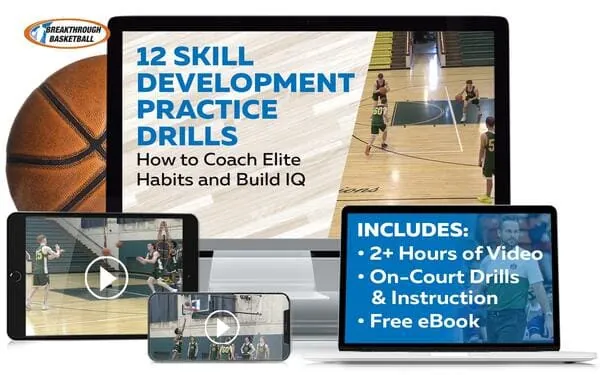
Coach Nick LoGalbo's 12 Skill Development Practice Drills Program gives you proven, game-tested methods that turn practice time into game-day success. Inside you'll get:
-
Drills that directly translate to winning gameplay
-
Skill progressions for offense & defense
-
IQ-building habits your players will carry into games
-
Step-by-step guidance from a USA Basketball coach
Offensive Skill Drills
1. Dribbling Drills (33)
2. Footwork Drills (24)
3. Lay Up & Finishing Drills (27)
4. Passing Drills (24)
5. Shooting Drills (25)
Team Offense Drills
6. Half Court Offense Drills (34)
7. Transition Offense Drills (24)
Defense & Rebounding Drills
8. Man to Man Defense Drills (15)
9.Pressure Defense and Trapping Drills(7)
10. 2-3 Zone Defense Drills (3)
11. 1-3-1 Zone Defense Drills (2)
12. Rebounding Drills (19)
Athletic Development Drills
13. Warm Up Drills (16)
14. Conditioning Drills (17)
15. Speed Drills (5)
What Are Some Good Basketball Drills & Games for Kids?
If you're a youth coach, here's a collection of over 100 youth drills & games specifically for kids (for ages 7 to 14 years old).
What Drills Should You Use During Basketball Practice?
We recommend starting with a good warm up, then spend 20-60 minutes on skills (which includes dribbling, passing, footwork, finishing, and shooting), then you split up the rest of the practice based on your teams identity and what you feel is important. That will include team defense, team offense, rebounding, and special situations (press break, BLOB plays, etc).
So your practice plan format might look something like this:
- Warm up (in the hallway before practice)
- 45 minutes of basketball skill drills
- 15 minutes of defense & rebounding drills
- 15 minutes of team offense drills
- 15 minutes reviewing special situations (inbounds plays and press break)
- 30 minute scrimmage
Note, we suggest utilizing small sided games to enhance skill development, team defense, and team offense sessions. You might do that by alternating drills and small sided games. Example: start with partner pass & pivot drill and follow it up with 3v2 passing games. Then repeat the cycle with dribbling, defending, shooting, and so on.
By incorporating small sided games you'll make practice fun, keep players engaged and enhance their skill retention.
What Are The Basketball Skills Your Drills Should Address?
Basketball skills are the fundamental physical, technical, and mental abilities that allow a player to perform effectively in game situations. For coaches, basketball skills are the building blocks that determine how well players can execute offensive and defensive concepts under pressure.
At the most basic level, basketball skills fall into several key categories:
1. Shooting Skills
The ability to score efficiently from different areas of the floor. This includes:
Proper shooting mechanics
Finishing at the rim
Shooting off the catch and off the dribble
Free throw shooting
For coaches, developing shooting skills means focusing on repetition, shot quality, and game-like decision making, not just form shooting.
2. Ball Handling Skills
Ball handling skills allow players to maintain control, change direction, and create advantages against defenders. These skills include:
Dribbling with both hands
Protecting the ball under pressure
Changing speed and direction
Creating space to pass or shoot
Strong ball handling skills give players confidence and reduce turnovers — especially against pressure defenses.
3. Passing Skills
Passing skills involve more than just throwing the ball accurately. Effective passers:
Read defenders
Deliver the ball on time and on target
Use a variety of passes (chest, bounce, overhead, one-handed)
Pass to scoring areas
For coaches, teaching passing skills means emphasizing vision, timing, and decision-making, not just technique.
4. Defensive Skills
Defensive skills allow players to guard the ball, help teammates, and disrupt the offense. Key defensive skills include:
On-ball defense and footwork
Closeouts
Help defense and rotations
Rebounding and boxing out
Well-developed defensive skills lead to more stops, transition opportunities, and overall team success.
5. Footwork and Movement Skills
Footwork is the foundation of nearly every basketball action. This includes:
Jump stops and pivots
Cutting and changing direction
Balance and body control
Defensive slides
Players with strong footwork execute skills more efficiently and are better prepared to play at higher speeds.
6. Mental and Decision-Making Skills
Basketball is a fast, decision-based game. Mental skills include:
Court awareness
Spacing and timing
Confidence under pressure
Knowing when to shoot, pass, or attack
Coaches can improve mental basketball skills by using small-sided games, constraints, and game-like drills that force players to read and react.
Why Basketball Skills Matter for Coaches
Offenses, defenses, and plays only work when players have the skills to execute them. Developing strong basketball skills:
Improves game performance
Reduces turnovers and breakdowns
Increases player confidence
Makes teams more adaptable
For coaches at every level, the goal is not just to run drills — but to build transferable basketball skills that show up in real games.
How Do You Run Basketball Drills Correctly?
The first thing to realize is that the great coaches and players focus on the little things.
Too many coaches make the mistake of starting the drill and just running through the motions.
Like we teach at our basketball camps, each drill needs to have a purpose, and you really need to watch closely to perform each aspect correctly.
For example, when running a defensive sliding drill, you need too make sure each player continually maintains a wide base, keeps their hands out, maintains good balance, keeps their butt down, and so on. It's the little things that make you a better player.
You CAN'T let them slip!!
Practicing drills is when players get better. In fact, the most important aspect of running your practices and getting better as a player, is how you run those drills.
In order to get better, you need to practice over and over to develop good habits and muscle memory. If you don't practice the RIGHT way, you're just developing bad habits and training yourself to play the wrong way.
So I urge you to take the time to learn the detailed fundamentals of basketball. And then run the drills to train your body to perform those fundamentals without even thinking about it.
Making it Fun
One of the best ways to stay motivated and get better is to keep things fun.
This can be done by adding competitive twists to the drills or simply incorporating fun youth drills.
I've found that most players, especially younger ones, really enjoy fast paced drills that really keep things moving.
You can do a variety of things to keep them moving. You can set up stations, so a group of players work at a station for a few minutes, then you blow the whistle and they run to the next station.
You can also run multifacet drills that have players running, shooting, passing and doing a variety of things.
The trick is to have enough coaches or helpers watching each area, making sure each player is using proper form.
After players run around for a bit, take a few minutes to demonstrate the correct method and slow them down to perform the drill correctly. Then you can crank things up again and start them off. Just keep it mixed up and your players will maintain better focus and listen to you.
Competitive Game-Like Drills For Your Players
In addition to fun drills and fundamental drills, you should also incorporate drills where players can use their skills in game-like situations against defenders. The article The Missing Link To Player Development explains this skill development philosophy in more detail.
If you would like to see more of these competitive skill drills, check out Sanderson's Gamed Based Training System.
Articles On Running Drills and Practices
- 5 Tips to Run Your Basketball Drills More Effectively
- 10 Tips For Getting Your Basketball Team Focused, Motivated, And Playing Hard!
- Dealing with Short Practice Time
- Practices Should Be Messy?
- How To Get More Out Of Practices By Overloading Drills
- Stop Sabotaging Your Team & Practice LESS Half Court Offense
- Serial Practice - Mix It Up To Level Up Your Practices
- Block Practice - The Reports Of Its Demise Are Greatly Overrated
- Coaching Basketball: Observe Another Team's Practice - A Great Complement to Coaching Clinics
- Save Practice Time & Energy with The Power of Platform Drills
Interactive & Printable Youth Basketball Practice Planning Templates & Samples
Basketball Drills FAQs For Coaches
Choosing the Right Drills That Develop Basketball Skills
Q: How do I know which drills are right for my team's age and skill level?
Start with your team's weaknesses. For younger players, prioritize fundamentals (ball handling, footwork, layups). For older teams, choose drills that transfer directly to your system and game situations.
Here are a 3 resources to get you started:
Q: How many drills should I use in one practice?
Typically 4–6 drills max. Focus on quality reps and progressions instead of rushing through too many activities.
One great idea is to use platform drills. These are drills you can come back to time after time and tweak through the use of constraints. Platform drills are a great way to save time and make your practices more efficient.
Q: I read about different types of drills - block, serial, random. Which are best?
All of the above. Seriously, your practices should include all 3 types of drills.
-
Block practice drills are great for initial teaching
-
Serial practice drills are a great way to mix skills as players improve
-
Random practice drills are the most game-like and provide the most challenge
Pick the type of drill based on what you’re teaching and how skilled/experienced your players are.
Q: Should I run different drills for different skill levels? What are the best basketball drills for beginner and advanced players?
Yes — and no. Use the same drill with built-in progressions or modifications so advanced players can be challenged while beginners focus on basics.
This is the beauty of using constraints. You can continually scale your drills to make sure that your players are appropriately challenged!
Q: What are the best basketball drills for beginners and advanced players?
The best basketball drills for your players will vary depending on their experience and ability. With beginners, there will be a focus on the fundamentals - basic dribbling, finishing, & shooting drills. Developing proper technique and getting reps is key.
With more advanced players, the best basketball drills will involve multiple skills. Additionally, you should start to incorporate decision-making into your drills so that it more closely resembles the game.
Ball-handling drills, shooting drills (form shooting, block shooting, & game-like shooting), 1-on-1 variations, closeout drills, and small-sided games (2v2, 3v3) are versatile and adjustable and should be used for all players.
3v3 should be used at every level. It’s a great way to get players more touches and decision-making reps.
Some players think the fundamentals are boring. That’s a myth. No matter the level, solid fundamentals win!
Here are a couple resources with great fundamental drills:
Running Drills Effectively
Q: How long should each drill last?
8–15 minutes is ideal for most drills. Long enough to learn, short enough to stay fresh. When drills go too long, players get bored.
Q: How do I avoid players standing around?
Use small groups, multiple stations, or partner drills. Avoid long lines and give players defined roles (shooter, passer, rebounder).
Q: Should I demonstrate every drill?
If it’s new or complex, yes. Keep demos short and clear. For familiar drills, just use reminders or corrections on the fly.
One helpful tip is to give each drill a memorable name. That enables you to just say the name of the drill and players can get right into it without an explanation.
Tracking & Competition
Q: Should I keep score during drills?
Yes! It adds intensity and focus. Score drills as much as possible.
Use competitive scoring (e.g. 1 point per make, bonus for streaks or time goals).
Here are 3 scoring systems you can utilize:
Q: How can I measure improvement in drills?
Track things like shooting percentage, time to complete, or reps in a set amount of time. Keep weekly progress sheets or leaderboards.
The tracking is critical, but so is the sharing. Make sure your team knows how they are doing and if they are improving or not. It’s great to have data to back up your observations.
Consider measuring not just team but individual drills, too. This can be helpful for playing time decisions.
Green Light Shooting Systems are a great way to do this.
Q: How do I make drills competitive without embarrassing weaker players?
Compete in small groups or by personal bests. Focus on improvement rather than ranking. Team-based scoring helps too.
There is a fine line to this. Anytime you keep score, there will be winners and losers. What is critical is to determine why players are losing? If it’s a lack of effort or focus, that’s a problem that should be addressed head on.
If it’s a lack of experience but the player is working hard, that’s okay. In those scenarios, be sure to encourage those kids and show their individual improvement, even if it’s not resulting in winning drills.
Managing Groups & Practice Flow
Q: How do I run drills with a big team and few baskets?
Use stations, mirror drills, and rotate teams in short bursts. Have every player bring a basketball. Small-sided games are especially helpful in limited space.
Here are 3 resources to help combat this problem:
Q: How do I manage rotations and reps?
Assign roles: shooter, passer, rebounder — then rotate every 1–2 minutes. Use a whistle or timer to keep things moving.
Here’s a tip from How To Run Championship Practices With Nate Steege that can save time and make your practices run more smoothly.
Q: What do I do if players are at very different skill levels?
You can approach this 2 different ways.
For competitive drills, group players by ability - this helps make drills more competitive and makes sure all players are challenged.
For non-competitive drills, mix players - this ensures all players interact. It allows stronger players to help weaker players and enables weaker players to learn from stronger players.
Progression & Variation
Q: How do I keep drills from getting stale?
Change the scoring system, time limit, or add constraints (e.g. weak hand only, move after pass). Introduce variations every 1–2 weeks.
Here are some ways you can constrain drills from The Game Based Training System With Nate Sanderson.
Q: When should I move on to a harder version of a drill?
When the original version looks easy and players are executing with good form and focus. Avoid moving on too soon.
This does not mean they are getting it right 100% of the time. If a player is doing it right 75-80% of the time, consider adding a layer of difficulty.
If, after initial teaching, they are getting it right less than 40-50% of the time, consider removing a layer of challenge.
Q: Can one drill cover multiple skills?
Absolutely. Good drills combine decision-making, movement, passing, and defense. Example: 3-on-3 closeout touches on spacing, help D, and communication.
Using drills that hit multiple skills makes your practices more efficient. It also more closely mimics the game, where players are constantly changing between different skills.
The Drive, Kick, Swing drill is an example of a drill from The Zoom Offense With Nate Steege that incorporates a number of skills.
Motivation & Engagement
Q: How do I keep energy high during drill work?
Add scoring, create small challenges, rotate quickly, and keep feedback positive. Music or mini-competitions are great too.
And make sure to play! Too many coaches drill, drill, drill. Players want to play. Strategically utilize scrimmaging to keep players engaged and work on game situations.
Q: What if my players want to just scrimmage?
Use small-sided games that teach the same concepts you’re drilling. Let them play, but with structure and teaching moments.
Also, tailor your 5v5 scrimmages to your team’s needs. You should do a lot of 5v5, but that doesn’t mean just rolling the ball out.
Here are a couple ideas:
3-5 possession scrimmages
Scrimmages that work on end of game situations (for example, 1:30 left, down 2)
Scrimmages where you automatically “win” if a certain action occurs (a player takes a charge, you score on a backdoor cut, etc.)
Q: How do I get buy-in from players during “boring” fundamental drills?
Explain the “why,” tie it to in-game success, chart progress, and celebrate small wins. Challenge them to beat their own records or go for a streak.
Remind them of the Kobe quote: “Never get bored with the basics.”
That said, make sure the drill is still challenging. If your players have improved to where the drill does not challenge them, that’s great - it means they’ve gotten better! At the same time, it means you should now use a more challenging drill - or, even better, have them apply the skill in a game-like situation.
1v1 drills are great for that!
FREE BONUS PDF
72 Winning Basketball Drills
Related Resources
How To Run Championship Practices With Ryan Schultz & How To Run Championship Practices With Nate Steege- Coach Schultz and Coach Steege share over 20 drills each that they’ve used to build state championship programs. The drills work at every level. In addition to the drills themselves, you’ll see candid footage of how an outstanding coach runs a high level practice. These 2 products are sure to make your practices more efficient & effective.
The CMC Practice System with Kevin Furtado - Learn how to create a culture and practice environment that builds leadership, togetherness & competitiveness with Coach Kevin Furtado. Coach Furtado has used this system to win over 500 games in his career. It creates motivated players who come to practice ready to learn and get better. In addition to the culture and leadership tips, you’ll see a number of the drills he uses to build winning habits!


 Facebook (145k Followers)
 YouTube (152k Subscribers)
 Twitter (33k Followers)
 Q&A Forum
 Podcasts