
Basketball Strength Training: Complete Guide for Players & Coaches
Basketball strength training is very different from traditional bodybuilding or general weightlifting. Players don’t just need bigger muscles — they need explosiveness, balance, coordination, and durability. The goal isn’t to bench press the most weight in the gym. The goal is to move faster, jump higher, stay healthy, and perform better on the court.
For youth, middle school, and high school players, basketball strength training should focus on building a foundation of movement skills, core stability, and proper mechanics. When done correctly, it improves vertical jump, first-step quickness, lateral speed, and overall body control. Just as important, it plays a major role in injury prevention — protecting knees, ankles, and hips during a long season.
Coaches also need to understand that effective basketball strength training changes throughout the year. In the off-season, players can build strength and power. In-season, the focus shifts to maintaining strength and staying fresh.
This guide will show you how to approach basketball strength training the right way — so players develop explosiveness and resilience without sacrificing speed, mobility, or skill development.
The basketball strength training principles outlined on this page are drawn from the work of Cody Roberts, creator of Breakthrough Basketball’s Athletic Development Program. Roberts has spent years training basketball players at the youth, high school, and collegiate levels, specializing in performance-based strength development that translates directly to on-court results. His approach blends sports science, movement efficiency, and basketball-specific demands — focusing on explosiveness, injury prevention, vertical jump development, and total-body athleticism. Rather than generic weight room routines, Roberts’ system is built specifically for basketball players who need speed, power, balance, and durability. His experience working hands-on with athletes and developing structured, progressive programs ensures that the basketball strength training guidance provided here is practical, safe, and proven to improve performance.
To get FREE Training Secrets to TRANSFORM Your Athleticism, click the banner below
Basketball Strength Training: Complete Guide
Why Basketball Strength Training Matters
Basketball strength training improves performance in nearly every area of the game. Stronger players absorb contact better, hold defensive position longer, and finish through traffic more effectively. But strength alone isn’t enough — it must transfer to speed and explosiveness.
A properly designed basketball strength training program enhances:
-
First-step quickness
-
Defensive lateral movement
-
Balance and body control
-
Injury resilience
Because basketball is a game of repeated sprints, cuts, and jumps, strength training must support those movements. When players build functional strength — especially in the hips, glutes, core, and hamstrings — they become more explosive and more durable throughout the season.
Basketball Strength Training for Youth Players
Basketball strength training for youth players should emphasize movement quality first, not heavy lifting. Middle school and younger athletes benefit most from learning how to:
-
Squat properly
-
Hinge at the hips
-
Lunge with balance
-
Control their core
-
Land safely from jumps
At younger ages, bodyweight exercises, resistance bands, medicine balls, and light dumbbells are more appropriate than heavy barbell work. The focus should be on coordination, posture, and stability.
When youth players master movement patterns early, they build a foundation that allows them to safely increase intensity as they enter high school.
Basketball Strength Training Exercises for Guards
Guards rely heavily on speed, agility, and change of direction. Basketball strength training for guards should prioritize:
-
Single-leg strength (split squats, lunges, step-ups)
-
Core rotational strength
-
Posterior chain development (glutes and hamstrings)
-
Lateral movement strength
Because guards handle the ball and attack closeouts, improving unilateral strength and balance is critical. Single-leg exercises mimic game movements and improve control when stopping, cutting, and exploding past defenders.
Upper body work should focus on shoulder stability and strength for ball protection and absorbing contact — not just building size.
Basketball Strength Training for Vertical Jump
One of the biggest benefits of basketball strength training is improved vertical jump. To jump higher, players must develop:
-
Hip and glute strength
-
Explosive triple extension (hips, knees, ankles)
-
Eccentric strength for better force absorption
Exercises that support vertical jump improvement include:
-
Squats (front or goblet variations)
-
Romanian deadlifts
-
Hip thrusts
-
Box jumps
-
Depth drops and landing drills
Strength builds the engine. Plyometrics teach the body to apply that strength quickly. Combining both produces the best results.
In-Season vs Off-Season Basketball Strength Training
Basketball strength training should change depending on the time of year.
Off-Season Focus:
-
Build maximal strength
-
Increase muscle balance
-
Improve power and explosiveness
-
Correct imbalances
In-Season Focus:
-
Maintain strength
-
Reduce volume and fatigue
-
Prioritize recovery
-
Avoid soreness before games
In-season lifting sessions should be shorter and less intense, focusing on maintaining strength without interfering with practice or game performance.
Common Basketball Strength Training Mistakes
Many players and coaches make mistakes that limit results or increase injury risk.
Common errors include:
-
Ignoring single-leg strength
-
Neglecting core stability
-
Skipping mobility work
-
Lifting too heavy too soon
-
Not adjusting during the season
Basketball strength training should enhance performance — not leave players slow, sore, or overtrained. The goal is efficient movement, explosive power, and long-term durability.
4 Core Elements of Basketball Strength Training
Basketball weight training should address the body as a whole. This means that while you want to do a basketball upper body workout, you also want to incorporate a basketball leg workout. It also means that whatever muscles you work, you should also work the opposing muscle groups.
It further means starting with your foundation, which involves stability, coordination, technique, and form. If you aren't moving efficiently, you're well on your way to injury and pain later on.
Basketball weight training shouldn't just focus on movements you're doing on the court. It should also focus on the muscles and joints that support those movements, as well as the efficiency of those movements.
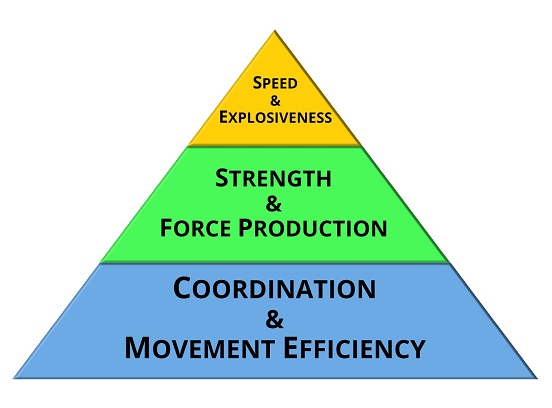
When it comes to coordination and movement efficiency, ideally, you want to nail down mobility, posture, balance, and stability exercises before moving onto force production and absorption or agility exercises. Build on your foundations first and you'll succeed in more relevant movements and exercises.
The following sections offer examples of mobility, posture, balance, and stability exercises to help give you some idea as to what you should be doing in your basketball weight lifting regime - or at least offering you a starting point.
1. Mobility
Mobility refers to the ability of your joints to actively move through the full range of motion. It's frequently confused with flexibility, which means the ability of a muscle to lengthen.
So, why is mobility important in a basketball strength training program?
Mobility allows you to move through a given range. It allows you to gear up and power up for those big shots. And it makes all other movement easier. More mobility equals less chance of injury and a greater range of motion to move through creating greater efficiency and power.
In basketball strength training, mobility exercises should focus on the hips and ankles. When you run or jump, you extend your ankles, knees, and hips.
For example, ankle mobility can easily be improved through ankle movements, such as ankle circles, calf raises, and more. Ankle circles, in particular, are easy and straightforward to perform. Begin by sitting in a chair or on the ground. Slowly move your ankle in a circular motion clockwise. Do this about 10 times for 2-3 sets. Make sure to also do the opposite ankle and do the same counter-clockwise.
Another important exercise focusing on mobility, specifically that of the hip, is the contralateral lunge.
Here's how you do it:
- Begin with your legs much wider than hip-width apart.
- Lunge into your right side.
- At the same time, reach your arms up high.
- Return back.
- Lunge into the right side again and this time, turn and reach your arms to the side.
- Return back.
- Lunge again and this time, reach your arms out and down.
- Repeat this on the opposite side and perform about 10-12 repetitions for 2-3 sets.
This exercise targets hip mobility, but it also has aspects of stability and posture, which are discussed in more detail below.
2. Posture
Posture is a tricky one. Many people neglect their posture all day long. You might sit hunched over. Or you might extend your neck forward to view your phone screen. A lot of aspects of society support a bad posture. But you can counteract this through your basketball weight workouts. Posture, again, comes back to moving efficiently, decreasing muscle imbalances, and reducing your risk of injury - especially back pain.
How can you incorporate posture exercises in your basketball strength workout?
For one, start with fundamental movement exercises and pay attention to your posture during those exercises. As an example, be sure your shoulders, knees and toes are in alignment during your body weight squat exercises.
Second, focus on core and upper back exercises.
The transverse abdominis is a core muscle that is frequently neglected. And surprisingly, you can have a 6-pack but also a weak transverse abdominis. By neglecting this muscle, you leave yourself susceptible to back pain and dysfunctional movement patterns.
Practice contracting it to start. Lie on your back with your knees bent and your feet flat on the ground. Imagine a tightrope pulling your hip bones together or stopping the flow of urine. You can feel with your fingertips in between your hips to see if your tightening up the correct muscles or not. And make sure to breath throughout the contraction! Aim to hold it for 5-10 seconds and perform it 10-12 times for 2-3 sets a day.
For upper back strengthening, bent-over rows, lat pulldowns, upright rows, and similar exercises support a strong back. These exercises focus on pulling the shoulder blades back and down, ensuring you don't end up with a hunched over appearance or posture.
While these make up any weight-lifting program, for basketball players specifically, you should focus on your posture in any move. To strengthen the core, you may want to try moves like the High Plank Knee to Elbow exercise:
- Begin in a high plank, with your hands directly under your shoulders.
- Bring your right knee up toward your elbow, just to touch.
- Send your leg back and do the same thing with your opposite knee and elbow.
- Continue to alternate sides.
- Perform 10-12 reps for 2-3 sets.
During this exercise, it's important to consciously contract your core. This will further help protect your lower back and build a solid and strong foundation, which will also help you in other more direct basketball training exercises and plays.
3. Balance
Undeniably, balance is critical in basketball. Players move quickly and jumping gives way to a greater risk of falls. You also want to ensure your leg balance is on point to keep from drifting to one side or the other.
The best way to improve balance is by practicing it. Stand on one leg at a time. Try to hold it for at least a minute, then try the opposite leg. If this is easy, add a pillow on a grippy surface to challenge yourself further. How long can you stand on one leg without losing your balance? Make sure to stand by a stable object in case you lose it.
Another way to do this exercise includes:
- Standing on one leg.
- Bending forward at the hip with your arms straight.
- At the same time, lift your unsupported leg straight back. Your body should form a straight line from your fingertips to your toes.
- Pause, then stand back up tall, bringing your foot almost to touch the ground.
- Do this again for 10-12 repetitions and 2-3 sets per side.
This exercise not only challenges your balance, but also incorporates hip mobility and glute activation. These are important for eventual force production and strength by helping you control movements through proper balance.
In addition, you should incorporate plenty of "single leg" strength training exercises into your workouts.
4. Stability
Stability refers to the control you have over a movement. This often comes down to smaller muscle groups that support your joints throughout a given movement.
Similar to why balance is important in basketball, stability also allows you to master certain shots and moves. It keeps you in control of your body during a fast-paced game.
So, what stability exercises should you start with in your basketball lifting workout? The single-leg stance outlined in the balance section above helps with this. Squats and lunges may also help improve ankle, hip, and knee stability - which are key aspects in basketball training.
To include stability and build on the previous single leg exercise, do the following:
- Stand on one leg.
- Hold a medicine ball in both hands close to your chest.
- Bend forward at the hips and bring your unsupported leg back. At the same time, extend your arms in front of you while still holding onto the medicine ball.
- Reverse the movement and come back to a standing position.
- Do 10-12 repetitions for 2-3 sets per side.
- Make sure to engage the upper back by pressing the shoulder blades down and back throughout the exercise.
Leveling Up: Focusing on Your Strength and Force Production - Basketball Strength Training Workout
Another important element included in strength training for basketball is strength and force production. This allows you to jump higher and accelerate faster. Ultimately, you can't jump higher or run faster than the force you are able to produce.
Yet, many basketball players tend to focus on plyometrics rather than the development of good foundational strength, including that of the core, obliques, glutes, and more. But ultimately, you won't be able to improve your vertical jump or your game as quickly or as well without certain strengthening moves.
For blunt strength and force production, try this mini-workout to start.
WARM-UP: 5-10 minutes of jump rope or running on the spot.
EXERCISE #1: The Goblet Squat
- Position your feet wider than shoulder-width apart.
- Hold a weight or kettlebell in both hands between your legs.
- Bend your knees and slowly squat down. Make sure to keep your shoulder blades down and back and your core engaged with a straight back.
- Lower until your thighs are parallel to the floor, then push back up.
- Perform 10-12 repetitions for 2-3 sets.
EXERCISE #2: Depth to Box Jump
- Stand in front of a box.
- Squat all the way down, loading up the muscles and joints.
- Push off and jump up onto the box.
- Step back down and repeat for 10-12 reps and 2-3 sets.
EXERCISE #3: Bent Over Reverse Fly
- Stand with your feet about hip-width apart.
- Hold a dumbbell in each hand.
- Bend over at the waist with a slight bend in your knees.
- Slowly pull your arms up and out (as if you were trying to fly).
- Pause, then lower back down.
- Repeat for 10-12 reps and 2-3 sets.
EXERCISE #4: Medicine Ball Throws
- Hold a medicine ball in both hands.
- Throw the medicine as high as you can by driving through your knees and extending your arms high into the sky.
- Hold the medicine ball in both hands.
- Squat down, bringing the medicine ball between your legs and push up, throwing the medicine ball straight up into the air.
- Repeat this cycle for 10-12 reps and 2-3 sets. Make sure you pay attention here to avoid getting a medicine ball in the face.
EXERCISE #5: Hang Snatch
- Hold a bar in front of you.
- Slowly bend forward at the hips, slightly bending your knees and keeping your back straight.
- All at once, drive the hips forward, shrug up, and force the bar straight up into the air over your head.
- Carefully lower and repeat 10 times for 2-3 sets.
EXERCISE #6: Bench Press
- Lie face up on a bench.
- Hold a bar with a wide grip over your chest or hold a dumbbell in each hand.
- Slowly lower, bending your elbows wide.
- Push back up and repeat for 10-12 reps and 2-3 sets.
Cool Down
Afterward, make sure to stretch out your quads, hamstrings, glutes, chest, shoulders, biceps, and triceps. These moves also incorporate the foundations including stability, balance, posture, and mobility. Ensure you are constantly thinking of these aspects throughout each move to guarantee proper form and to thwart injury. This is just a taste of the kind of exercises an individual may perform to improve their game, speed, and jump - all whilst taking into account foundational aspects.
Avoid Injury Before It Happens
Ultimately, basketball strength training programs shouldn't jump right into movements performed on the court. You need to start with the basic foundational movements and exercises that support you and your body in improving your movement efficiency and coordination first.
And once you've improved your coordination and movement efficiency, you can make your way up The Pyramid of Development...
Take your off-season basketball weight training to the next level by doing it the right way.
Get a Behind-the-Scenes Look
at Advanced Division I Trainings
You can learn all about this training approach in our FREE e-book: "DOMINATE: How the Training Secrets of Top Division I Programs Can Transform Your Athleticism Forever".
Written by Cody Roberts, a highly-respected performance coach and Assistant Strength and Conditioning Coach at the University of Iowa.
You'll learn:
- The surprising secrets D-I trainers use with their players (that most athletes have never heard of)
- What you need to do BEFORE plyometrics to make sure you see the biggest vertical jump gains
- Training methods that make sure your workouts translate to REAL RESULTS on the court
- How to incorporate the Pyramid of Development into your workout program to enhance your results
- 6 dynamic exercises you can use immediately (with video tutorials)
Enter your email address below and I'll send you a copy of DOMINATE right away...
These are the workouts that most "regular" players don't ever learn about, and they're virtually guaranteed to give you a competitive edge on the court.
No matter where you are as an athlete, this e-book will change the way you think about training from this day forward.
To get FREE Training Secrets to TRANSFORM Your Athleticism, click the banner below
Frequently Asked Questions About Basketball Strength Training
What is basketball strength training?
Basketball strength training is a performance-focused training program designed to improve explosiveness, speed, vertical jump, balance, and injury prevention for basketball players. Unlike bodybuilding, the goal is not just muscle size but functional strength that transfers directly to on-court performance.
How often should basketball players do strength training?
Most basketball players benefit from strength training 2–4 times per week depending on the season. In the off-season, players can lift 3–4 days per week to build strength and power. During the season, 1–2 shorter sessions per week are typically enough to maintain strength without causing fatigue before games.
Is strength training safe for youth basketball players?
Yes, when supervised properly and focused on correct movement mechanics, basketball strength training is safe for youth players. Emphasis should be placed on bodyweight exercises, core stability, balance, and proper technique before progressing to heavier resistance.
Does strength training improve vertical jump?
Yes. Basketball strength training improves vertical jump by increasing lower-body strength, especially in the glutes, hamstrings, and quads. When strength training is combined with plyometrics and proper jumping mechanics, players often see significant improvements in jumping ability.
Should basketball players lift heavy weights?
It depends on age and experience level. High school players with proper supervision can safely lift moderate to heavy weights using good technique. However, the focus should always be on movement quality, power development, and injury prevention — not simply lifting heavier numbers.
To your success this season and beyond!
Joe and Jeff Haefner
Co-Founders, Breakthrough Basketball

|
|||||||||



 Facebook (145k Followers)
 YouTube (152k Subscribers)
 Twitter (33k Followers)
 Q&A Forum
 Podcasts