
Why Great Players Master the Mid-Range (Even in a 3-Point Era)
Matt was an excellent point guard on one of my best teams. He was a good shooter and ball handler. Unfortunately, he was 5’7.
His quickness and ball handling enabled him to reach the paint. However, once he got there, he often found himself in trouble.
Generally, one of three things happened:
He got his shot blocked
He had to take a wild layup to avoid a shot block
He turned the ball over by getting too deep and not being able to find a good passing option
For the first 6-8 games of his junior year, this was a major issue. I was getting frustrated with him. I didn’t know it at the time, but he was also getting frustrated with me. Why?
Because I was relentlessly preaching “3, Free, or Key” when it came to shot selection.
And it wasn’t just me. Analytics say the midrange shot is dead. Coaches everywhere badmouth it. I recently watched an Alabama men’s game where they took their first mid-range shot with 6:00 left in the game.
The reasoning behind my mantra was sound. Statistically, shots at the rim and 3 point shots are more efficient than the midrange shots. And yet, I was missing part of the picture.
Look no further than the NBA’s points per game leader — think Shai Gilgeous Alexander, Jalen Brunson, Devin Booker. They make a killing in the midrange.
What’s that mean for you? If you want to be an elite player, it means a lot. Because here’s the truth: smart players still need the mid-range. In crunch time, you aren’t getting to the rim. And you probably aren’t getting a wide-open 3.
So, do you have a counter when those options are taken away? That’s what separates the best of the best.
Not only that, but if teams defensively are trying to take away layups and 3’s, what are they willing to give up??? Can you take advantage?
The bottom line is this - It’s not about abandoning the 3-point line or the rim— it’s about having options when defenders take it away.
Keep reading to find out:
Why you need the midrange
Why it benefits EVERY player to train it
How to practice your midrange game
When to take the midrange shot
The Shot Everyone Ignores — and Why You Shouldn’t
The MidRange Isn’t Dead — It’s Selective
At higher levels, defenses run shooters off the line and protect the rim. That means there’s space in between.
Great players don’t force bad 3s — they step into open pull-ups.
The key word is selective.
Bad midrange shots are rushed, contested, and off-balance.
Good ones come after a strong drive, a hesitation, or a one-dribble rhythm pull-up.
Why Every Player Should Train It
The midrange builds footwork, touch, and timing — all essential for finishing and 3-point consistency.
Practicing 1- and 2-dribble pull-ups improves your ability to stop on balance. That skill transfers directly to transition, closeouts, and pressure situations.
You’ll also notice: when your pull-up improves, defenders stop overplaying the drive… and your 3-point looks get easier.
A “3-Dimensional Scorer” - someone who can score at the rim, in the mid-range, and beyond the arc- is nearly impossible to guard!
The Midrange Advantage: How & When To Score From the Spots Defenders Forget
How to Train It
Start simple:
-
Drill 1: 1-Dribble Pull-Ups
Catch beyond the arc, rip, take one dribble & shoot. Work from both wings, the top, and the corners. Be sure to go right and left, working on good 1-2 footwork. -
Drill 2: Chair Drill
Place a chair at the 3-point line. Attack it, make a hard move, stop in rhythm & pull up from 15 feet. -
Drill 3: Combo Moves
Add a shot fake, jab, or crossover before your pull-up. Focus on staying low and balanced.
If you’re looking for more, here are five additional drills to help master the midrange from Becoming A 3 Dimensional Scorer With Tim Schuring & The Breakthrough Basketball Shooting & Scoring System.
When to Take The Midrange Shot
As we said, the midrange should be used selectively. Here are three scenarios where it makes sense:
-
When your defender flies by on a closeout.
-
When you start a drive, but see the help defender slide over and block your path.
When the clock is under 8 seconds.
Train it for those moments — not as your first option, but your smartest one.
How Adding A “Middie” Changed Matt’s Season & Changed My Mind
Matt and I eventually sat down to talk about his struggle in the paint. He asked me if he could shoot pullups from the open spot when he beat his man.
It hadn’t occurred to me that through my “3, free, & key” motto, I had taken that away from him.
I told him yes, as long as he demonstrated that he could shoot an efficient percentage on those shots.
Over the next month, he worked tirelessly on his midrange game. Whether it was to prove me wrong or to solve his problem, I don’t know. But I do know it worked.
His newfound midrange game transformed him and our season. It also taught me an important lesson. While analytics are important and we should study them, the game isn’t played on paper.
Ultimately, the more options a player has, the better they will be.
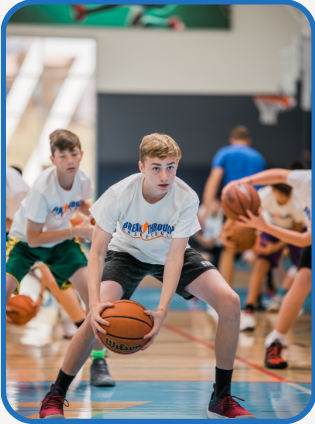
Adding scoring options is one of the primary focuses of our Breakthrough Basketball Camps. Find one near you and take your game to the next level!
Gain the Edge to
Stand Out on the Court
Breakthrough Basketball Camps help players improve their skills and decision-making while building the confidence to shine on and off the court. Trusted by over 150,000 players nationwide, our camps provide:
-
Experienced coaches who know how to teach every level
-
Skill development in shooting, ball handling, and all-around play
-
Game-like situations that build confidence under pressure
-
A positive, motivating environment parents can feel good about
-
Beginner, Youth, and Advanced Camps - Ages 6 to 18
|
|||


 Facebook (145k Followers)
 YouTube (152k Subscribers)
 Twitter (33k Followers)
 Q&A Forum
 Podcasts