
When Pressure Hits… Everything Falls Apart (And It’s Not Your Players’ Fault)
You’ve probably lived this before. I know I have!
Your team looks sharp in practice. You run your offense. You make clean passes. Your guards are confident.
Then you get into a real game… and the other team picks up full-court pressure.
Suddenly:
Your ball handlers pick up their dribble in the worst spots.
Your wings stop moving and start “watching.”
Your passes float instead of snap.
Your players panic, throw it to the wrong color jersey… and the other team scores without even running offense.
And what makes it even more frustrating?
It’s not like your kids aren’t trying.
They’re trying too hard… and the pressure turns your team into something you don’t recognize.
That’s why you need sound concepts when facing pressure. When players understand press break concepts, they don’t need you to “joystick” for them. They play with competence and confidence.
Coach Mike Tartara has mastered press offense by teaching effective concepts.
His press break system isn’t built around having one elite point guard who can dribble through chaos. It’s built around structure, spacing, and simple concepts that work against any press.
But here’s the missing piece most coaches overlook:
Concepts win games… but drills build habits.
In this post and the video below, you’ll see 3 high-impact drills Coach Tartara uses to pressure-proof his teams — plus a late-game inbound idea you can use when you absolutely HAVE to get the ball in.
No matter what age group you coach, the ability to handle pressure with poise and confidence is a game changer!
And yes… these drills directly complement the concepts taught inside Press Break Mastery with Coach Mike Tartara. Stay tuned, as the product launches tomorrow!
3 Drills to Help Your Team Handle Pressure (And Stop Melting Down)
1) Pressure Passing Drill (Small Space, Big Results)
If you’ve ever watched your team turn the ball over against pressure and thought…
“We don’t even look like we practice.”
This drill is your answer.
Coach Tartara uses Pressure Passing because it forces players to:
-
move to get open
-
screen to create space
-
pass away from defenders
and handle chaos without needing a perfect setup
How Pressure Passing works:
It forces the offensive players to screen and pass away from the defense.
The volleyball court lines are out-of-bounds, which are identified by cones.
The goal is to complete as many passes as possible as a team in the smaller space.
The first team goes, and then the second team goes. The team with the fewest passes completed has some sort of consequence.
All players from each team must inbound the ball before switching who is on offense.
-
The offense can inbound from any area around the perimeter.
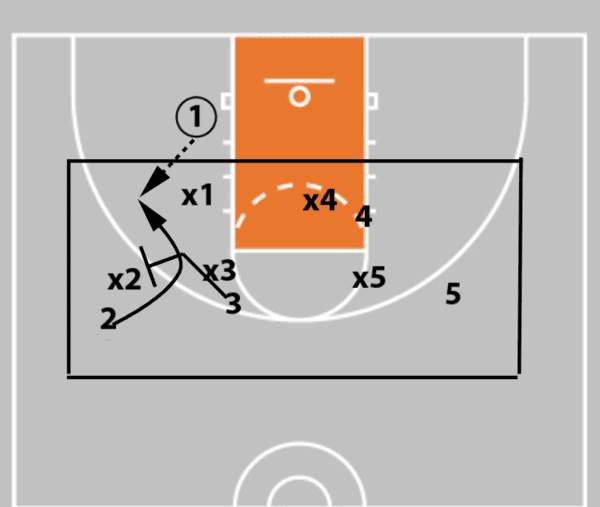
Players screen for each other.
If a player goes out of bounds, the drill ends for them, and the other team gets to go.
There is no dribbling.
Coaching Tips:
This is a good drill to allow players to be physical, since not all fouls are called in games either.
Offensive players are working on screens, passing angles, vision, and pivoting.
When the second team is on offense, you can either count up or count down the number of passes.
Having a consequence holds the players accountable for how hard they play.
2) Vision Drill (How to Stop Getting “Run & Jumped”)
One of the sneakiest reasons teams struggle with pressure is this: They dribble to the sideline and get trapped… then act surprised.
But presses don’t work because they’re “complicated.” Presses work because they force you into bad dribble angles.
Coach Tartara teaches a simple principle:
Keep the ball in the middle of the floor.
Because the second the ball gets pinned on a sideline, the defense has you exactly where they want you.
How the Vision Drill works:
This is a great drill to prepare for a jump-and-run press.
-
We want to keep the ball in the middle of the floor.
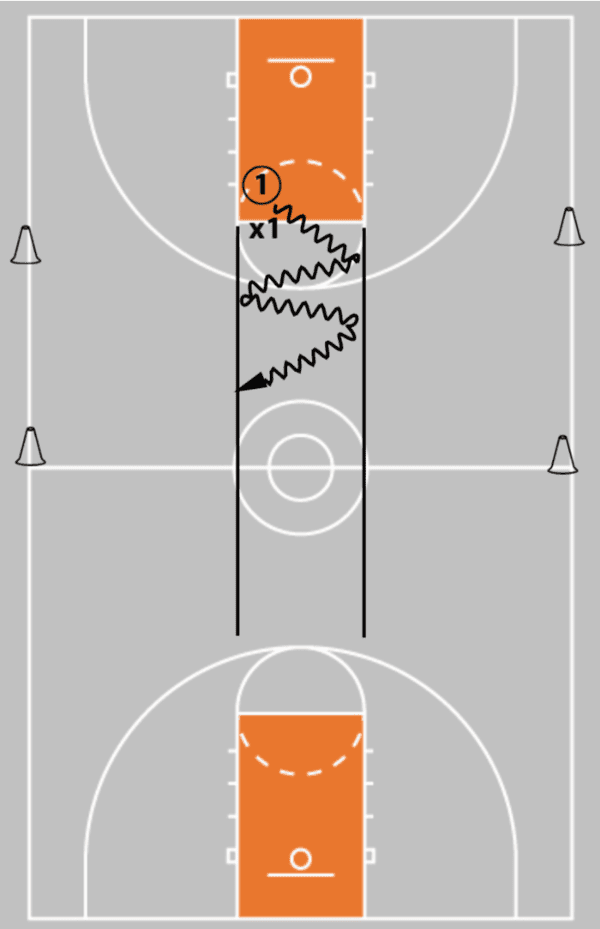
Cones are placed on the sidelines.
While the ball handlers are zigzag dribbling, their eyes need to be on the opposite cone.
This allows them to see the entire court to be prepared for when the jump is coming.
A defender should be used to make the game feel more game-like.
Dribble to half court before the next group goes.
All players should take part in this drill, even the Bigs.
Coaching Tips
Offensive players should have their backs to their defender to protect the ball.
When the players are dribbling away from you, you should be able to see the profile of their faces.
If you cannot see their profile, they are in a bad position if they are jumped.
Coach Tartara explains it like this: If you can see a player’s face (or profile), they’re seeing the floor. If you can’t… they’re about to get jumped. That’s a simple cue your players can actually remember.
3) Post-Up Drill (Catch Strong, Hold Strong, Stay Calm)
Most coaches focus on ball handling when teaching press break. But one of the biggest press-break problems happens before the dribble even starts:
Your player can’t catch the inbound under pressure.
They catch it off-balance… they immediately dribble into trouble… or they get stripped because they never truly secured the ball.
Coach Tartara’s Post-Up Drill fixes that.
What it teaches:
creating space to receive the ball
catching with strength
keeping a live dribble available
reading before reacting
How the Post Up Drill works:
One of the most important parts of handling pressure is being able to collect the ball and keep a live dribble.
This drill teaches multiple things.
Creating space
Catching and squaring up
Taking contact
Not wasting dribbles
The offense will be in more control and will not allow the defense to dictate play.
Every player will post up.
-
Players must maintain the ball for two seconds before passing.
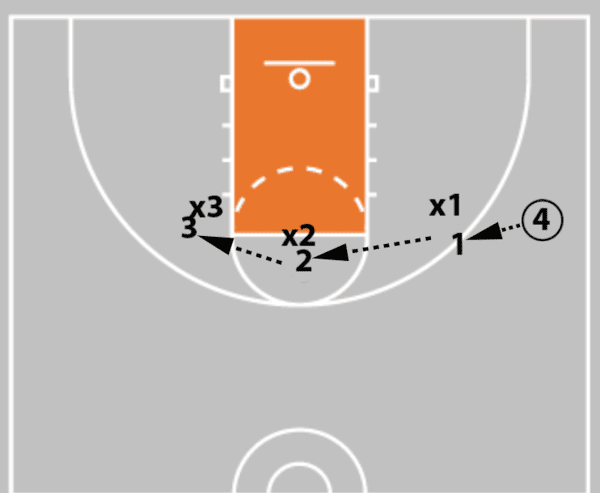
Players must get into the defender when posting up and receiving the pass.
After two seconds, the player passes it to the next offensive player, who is posting up.
This goes down the line.
Players rotated through all positions.
Coaching Tips:
Defenders should be physical.
Players must make sure they square up to the basket in the first two seconds of having the ball.
Bonus: A Late-Game Press Break Inbound That Creates Confusion - Football
Coach Tartara shares a late-game idea that’s incredibly simple… but very effective.
It’s based on something we’ve all seen in big games:
Alternative formations confuse defenders.
When teams set up in a normal inbound alignment, the defense already knows where to deny, where to trap, and where the “safe pass” is.
But when you line up differently — even for one possession — defenders often hesitate.
And hesitation is all you need to get the ball in clean.
Every player is set out of bounds.
Setting up in an alternative formation tends to confuse the defense.
This setup is especially effetive for youth teams. Youth teams often struggle against pressure because the deep pass isn’t an option. This helps the inbounder by giving them four realistic inbounds options.
“Triple Slant Drag”
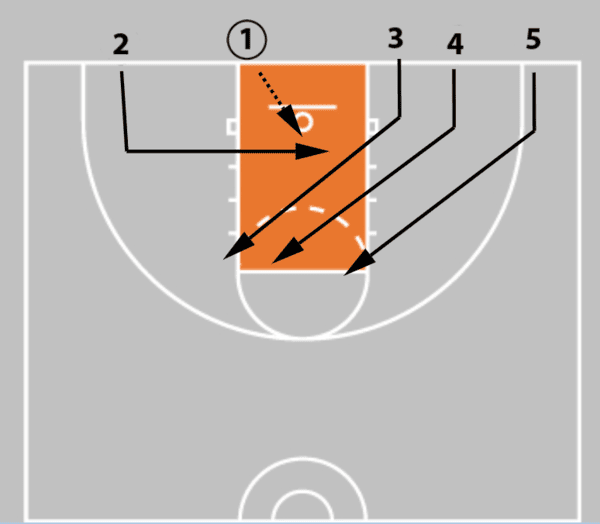
The three players on the right run a slant pattern.
The player on the left runs a drag pattern and receives the pass.
The offense clears out for the ball handler.
“Twins”
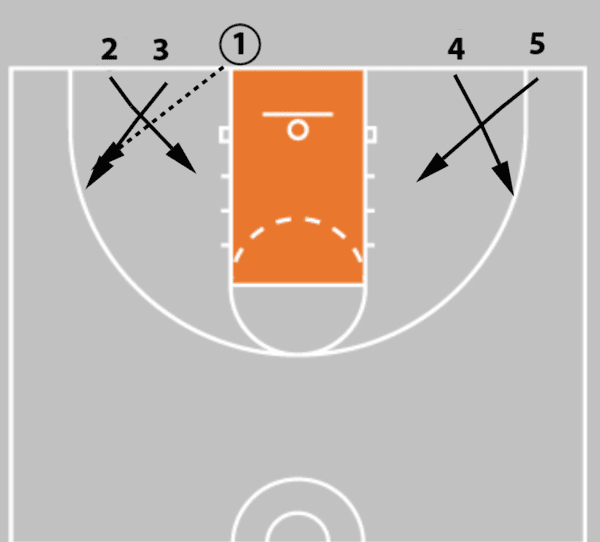
Both sets of players cross over each other to get open.
Player 3 receives the pass.
Player 1 steps in, ready to receive the swing pass.
The beauty is: you don’t need to install 12 different press breaks.
You need one reliable structure and a couple wrinkles that help you survive the biggest moments.
Why These Drills Work (And How They Fit the Bigger Press Break System)
These drills aren’t random.
They’re not “fun games” that look good on social media.
They are targeted tools that build the exact habits Coach Tartara teaches in his press break concepts:
spacing
vision
strong catches
composure
and decision-making under stress
So if you’re a coach who wants to stop feeling helpless against pressure…
This is how you do it:
Teach the concepts. Train the habits. Repeat.
Conclusion: Want to Be Press-Proof? Start Here.
Pressure doesn’t just steal possessions.
It steals confidence.
And once your team starts expecting turnovers, they play tighter… pass softer… and make worse decisions.
But the good news is this:
You don’t need a roster full of elite guards to beat pressure.
You need:
-
simple habits
-
game-speed reps
-
and a system your players can trust
If you want the complete blueprint Coach Tartara uses to attack any press (full court, three-quarter court, or half-court traps), check out:
Press Break Mastery with Coach Mike Tartara
It’s a complete system that teaches:
How to beat presses from multiple alignments
How to create 2-on-1 scoring chances
How to stay calm in pressure moments
and the drills that build it into your team
If you’re ready to stop fearing pressure and start turning it into points… Press Break Mastery with Mike Tartara is for you. Check back tomorrow for the product launch!
|
|||


 Facebook (145k Followers)
 YouTube (152k Subscribers)
 Twitter (33k Followers)
 Q&A Forum
 Podcasts