
Motion Offense for Youth Basketball

We highly recommend motion offense for youth basketball because it's an extremely effective way to develop players. Motion offense allows you to teach fundamentals while working on your team offense. That might seem strange at first, but you actually work on skills and motion offense at the same time. It's an extremely efficient way to practice. Not to mention, motion offense gives players freedom to learn "how to play".

When teaching a patterned offense and set plays, you waste countless hours trying to get players to memorize the pattern. This is a waste of time and takes away from skill development (which is the MOST important thing for young kids).

Back to my original point, here's how you can work on Skills (fundamentals) and Motion Offense at the same time...

  1. First, pick a couple cuts or screens that you think would be good for your group. For example, you could choose down-screens and away-screens.
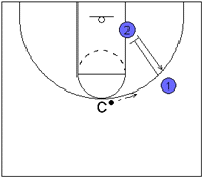
  2. Next, run shooting/footwork drills that incorporate those movements. You could have two offensive players (no defense). One player on the wing, another player on the block. A coach or third player could have the ball on top of the key. The player on the wing sets a down screen, the other player rubs off the screen, catches the ball, pivots, and shoots. Now repeat over and over. Your players are working on screens (part of your motion offense), pivoting footwork and shooting (skills).

  3. You can do the same thing with away screens, basket cuts, and any type of cut or screen. The key is to choose a couple elements from your motion offense and turn those elements into skill building drills. Your imagination is the only limit to the types of drills you can come up with. It's also important to mix things up and make the drills fun too!

By practicing this way, you save a huge amount of time and get more done.

In a youth motion offense, your primary rules should allow you to maintain spacing, maintain order, keep people moving, and keep everyone involved. For example, use a 5-out motion and have three rules:
  1. After every pass, the passer moves. (Cut or screen)
  2. Do not stand still for more than 2 seconds.
  3. Take the first good shot.
When teaching motion to young players, don't go too fast and don't worry too much about your players executing offense. If they maintain decent spacing and move around, you are in good shape. Almost all of your time should be on skill development. Then as time goes on, you can take a skill and show them how to use it in different situations in the motion. But even before that just let the kids get comfortable on the court. Let them play and learn at the same time as you. Movement and spacing will cause things to happen. They will start figuring things out.

Youth coaches should concentrate on teaching skills and then just letting kids play. Motion is perfect for that.

Related Articles & Products

Don Kelbick's Motion Offense - A Comprehensive Guide to Implementing a Motion Offense

Open Post Offense - Motion Offense, Diagrams, Drills, and Plays

Could 3 on 3 Basketball Be the Best for Youth Players?

Motion Offenses, Drills, & Tips

To get FREE Youth Practice Plans & Bonus Drills, click the banner below


What do you think? Let us know by leaving your comments, suggestions, and questions...


Comments

Most Likes First   Oldest First   Newest First

Kevin says:
6/24/2022 at 5:32:50 PM

I've been coaching youth basket as my kids progress. They are now at the 5th-6th grade level I love the idea of 5-out motion. My biggest problem is that the teams always half-court press. My girls dribbel to the midline and 3/4 of the time cant get past the defender waiting at midcourt. How do I even start a motion offense if we can't get the ball to the top of the key?

I have found two solutions that work but I don't really like them.
1.) Set a ball screen and the dribbler then attacks. Most the time however, the dribbler runs to the corner and gets stuck. 2.) Give the best dribbler the ball everytime and just blow by the mid-court defender. That doesn't set up the offense though.

Any advice on how to run a 5-out motion offense when the other teams simply set up a half-court press is much appreciated.

Like
  1 person liked this. 1 reply  

Breakthrough Basketball says:
6/28/2022 at 8:16:10 AM

Hi Coach,
Thank you for reaching out. We found this resource that Coach Jeff Haefner put together that could possibly give you some ideas.

Basketball Press Offense: How to Break Any Type of Press and Avoid Turnovers -- Press Breaker Drills, Offense, and Strategy

https://www.breakthroughbasketball.com/offense/press-breaker

Hope you find it helpful!

Like


Ross says:
2/9/2022 at 2:47:25 PM

Thanks for the info. I'm helping to coach a third and fourth grade boys rec team. Many of our kids are playing on a team for the first time. It seems like a lot of people recommend the 5 out for this age group. But they can't shoot from the perimeter. It's just too far. Does it make sense to do a 3-2 so you have a couple kids in shooting range? I feel like that would give them more opportunities for open shots. But this is my first time coaching, so I don't know what's best for these kids. Thanks!

Like
  1 reply  

Jeff Haefner says:
2/10/2022 at 7:12:42 AM

Great question...

You could run a 3 out 2 in motion. One of two things will generally happen...

1. You have a couple big players that can score inside and you have some success from an offensive standpoint. But your guards don't have any success because the lane is always clogged up (no space to drive) and their main job is to pass to the posts. So they guards don't get much from it. And your posts don't develop guard skills (make sure to avoid pigeonholing young kids into positions... that's a common mistake that really hurts those kids in the long run).

2. You don't have posts that can score and there are no drives lanes for guards. And it's a complete mess.

Either way, it's not an ideal situation.

This is why most youth teams run a 5 out. It keeps driving lanes open and you can even post up temporarily as you cut through.

The big things is to have positionless offense (positions are interchangable)... which is what the 5 out gives you. So all players develop and you can also have a little bit of scoring success while you're at it.

Like


Ali Calloway says:
7/8/2021 at 12:17:12 PM

I love your website and use many of your ideas/suggestions for my youth teams. I have also used many of your drill work for my camps and clinics.
My problem is that with my youth league teams, I have different players each year and do not truly get to develop the motion offense. So, what I do is use a little of the motion offense - just a brief introductory and use that. I wish I could have the same group every season to fully allow my players to understand. Most other coaches run set plays on offense and run zone defense and a full-court press, so I know the players will not have the opportunity to learn spacing & other aspects of the motion offense the next season if they are not on my team.
During my camps and clinics, the players get more of an idea of the motion offense.
Do you have suggestions that I can use to help with coaching my youth league teams?

Like
  2 replies  

Mark Brase says:
7/9/2021 at 11:44:02 AM

Hi Ali-

Not knowing exactly how your youth league is structured I would tell you a couple of things.

1. While you are not getting the opportunity to develop the motion offense concepts with your players as deep as you'd like to, it is still great that you are exposing them to this and doing what you can with the time you have. These players will definitely benefit from what you have been doing.

2. Is it possible to work with the director of the league and see if they are willing to look at the rules for the league, such as everyone runs a motion offense and teams play 1/2 court man-to-man defense? You may have to do some selling as to why this is best for all player development, but there's a chance the league director has simply never thought about this.

Another option with this is having all teams and coaches taught the motion offense at a camp/clinic prior to league games, so everyone is on the same page.

These options may not work for you, and if not, keep doing what is best for the youth players.

Learning how to play good 1/2 court man defense and run a motion offense will definitely benefit the players you coached in their future. I think you are doing things right. If you only have the players for 1 year, stay with what you are doing and progress as far as you can- like you've been doing.

Good Luck!

Mark Brase
Breakthrough Basketball

Like
  1 person liked this.  

Mark Brase says:
7/9/2021 at 11:44:08 AM


Like


CoachDPE says:
6/12/2021 at 10:45:00 PM

Thanks for this! For the last few years I’ve struggled with taxing trying to find the right “system” for my 6th-8th grade girls team.
We play against teams that are capable of running some pretty detailed systems. We are not quite there.
This helps give us direction offensively while effectively building our skills.

Like
   

Riley says:
1/9/2021 at 1:02:58 PM

I love the motion offense. I coach a higher level 4th grade boys team and I'm having difficulty getting them to move off of the ball to create constant motion. Any suggestions?

Like
  1 reply  

Jeff Haefner says:
1/10/2021 at 10:13:20 AM

Lots of ways to do that. Personally, I usually have two rules:
- when you pass, go cut or screen
- when you're 1 pass away from the ball and covered, go cut or screen immediately

That can be trained with a drill like this:
https://www.breakthroughbasketball.com/play.asp?id=437

Some coaches have the rule "don't stand for more than 2 seconds" instead of the "1 pass away rule".

Let us know if this works for you or if we can help with anything else.

Like


Greg says:
10/8/2019 at 10:14:09 AM

So I coach a 5th & 6th grade girls travel team. I really like your motion offense ideas. However, I was also reading another motion offense article on the site where it goes into the details of the five out motion offense. Sounds a little complicated for fifth and six graders. At what age experience/ skill level do you go from the after every pass screen or cut mentality motion offense to the more “defined” motion offense described in the other article?

Like
  1 reply  

Jeff Haefner says:
10/11/2019 at 6:20:23 AM

Greg - Could you let me know what article you're referencing that describes a more "defined" motion?

At the high school level, we keep it basically the same and it's just as simple as our "youth" motion. The only difference is:

1) we add a few more cuts and screens to use (maybe add ball screens, screening away, back screens, and/or hand offs).

2) our players are much better at setting screens, using screens, cutting, spacing, and reading defense

3) our players are more skilled

That's the difference between high school and youth for us. Otherwise it's the same motion that can take the form of 5 out, 4 out, or even 3 out formation. I actually don't care about formation or really talk about it. I just want SPACING, players to cut or screen after every pass, and want them to get open when they are one pass from the ball and covered.

Like
  1 reply  

Greg says:
10/11/2019 at 1:12:06 PM

Hello Jeff,
The other article I was referring to was the "5 Out Motion Offense - Cutters". This is the link: https://www.breakthroughbasketball.com/offense/cutters

In the 5 out motion offense (cutters) article I reference above it seems like players are rotating through the same spots along the perimeter, after cuts/screens, etc. Whereas in the article "motion offense for youth basketball", I had envisioned the players starting in a set (5-0 or 4-1, etc.) but then start moving around to all different locations (by their own choice) using cuts and screens and not staying in any spot for more than 2 or 3 seconds. That sounds very random to me where the cutter offense seemed more "defined" (for lack of a better word) and slightly complicated for 5th and 6th graders...

Thanks for responding. Love the site!

Like
  1 reply  

Jeff Haefner says:
10/12/2019 at 8:50:21 AM

Coach - The Cutters offense is simpler than you'd think. It's one of the more popular offenses for 5th/6th level because it's simple.

You'll also find that if you teach spacing and basket cuts, players will naturally start following a similar pattern as Cutters. For good spacing, it just makes sense for the player to fill the vacated spot after the cutter moves. And after you basket cut, the space is usually opposite of the pass. So regarding the pattern, it's fairly natural.

In any case, teach spacing, basic cuts, get players movement and sharing the ball, driving into space, and fundamental skills. That's really all you need.

Like


Edward Phillips says:
1/23/2019 at 10:18:55 AM

Can you please elaborate on "start the ball with a trap at half court or in the corner"? Do you mean for defense?

Like
   

James says:
11/4/2017 at 6:35:40 PM

I love the motion offense for young kids! I am coaching a team of Kindergartners and 1st graders, most of whom have never played before. Do you suggest the motion offense for this age group? If so, what are some tips you could give me for teaching this offense to such a young group? I'm thinking: 1. Make sure all 5 spots are filled (floor balance) 2. Pass and cut. 3. Fill in any empty spot on the floor that you see after you cut. Anything else I should be doing to implement this offense with such young players?
Thanks!

Like
  1 reply  

Jeff says:
11/7/2017 at 10:48:31 AM

That is really young. I would play 100% 1v1 and 3v3 games. I would not play 5v5. I don't even like 5v5 with 3rd and 4th graders.

If you must play 5v5 (I didn't let my kid play at that age) so I don't have any great advice. It will just be a mess and you have to make the best of it.

Just teach them spacing, let them have fun, and work on basic dribbling, passing, and pivoting skills. I don't use spots because I want kids to learn spacing concepts instead of just running to a spot. But they are so young it doesn't matter.

Again I would just play 3v3 in practice and constantly emphasize spacing and moving around (maybe just basket cuts) but I'm not sure even that is worth the time required for such young kids.

Also lower the baskets to 8 ft and use really small basketballs.
https://www.breakthroughbasketball.com/basketballs/size-chart.html

Good luck!

Like


Stephen says:
1/19/2017 at 10:47:02 AM

I love this offense, but it is total chaos right now. Half of my team are complete beginners from grade 6-8. Do you have any suggestions for teams that really pressure the wings hard. Right now, when the ball is being pressured and the wings are being pressured it is hard to get anything started. Right now I am playing a 5 out, so I am telling my players to make a quick basket cut so the baseline players can fill up or to screen down to the baseline players right away, but that is assuming the players on the baseline haven't made a cut already because they counted to 3 in their head already. Also, do you ever have the wings do v-cuts to get open or do you just find that slows down the offense and would rather them just cut through so someone can fill their spot? If you have any suggestions that would be great, but I do think that this might just take practice and patience. Tjamls

Like
  1 reply  

Jeff Haefner says:
1/20/2017 at 3:14:26 PM

Coach - There are lots of effective ways to get ball entered to wing. I have tried them all and they all work. Take your pick...

- Teach players to V-cut on the initial pass. It usually works best to walk into defender, step through with feet, seal, and bounce out.

- Have the PG dribble at the wing and/or penetrate and kick to the wing (attack with dribble).
https://www.breakthroughbasketball.com/offense/how-to-initiate-your-offence

- Have players cut or screen immediately when covered. This stays consistent with based rules of offense... when one pass away get moving right away by cutting to the basket or screening away.

- Have your right wing and left corner exchange positions (turns into rub screen). This doesn't work every time but you can call it out when in a pinch.

- Have a wing or post start the play with a ball screen.

Regarding your question about v-cuts, I will let players v-cut on the initial pass to start the offense. After that I don't like them v-cutting because players behind fill and spacing gets messed up. Now when players fill they can pop out to get better angle but I don't consider that a traditional v-cut.

Like


Craig Lindeman says:
2/12/2015 at 11:37:18 AM

I coach a team of five and six year olds and obviously the biggest thing for me is to work on fundamentals, but alongside passing, dribbling, shooting, etc. I am also wanting to teach good spacing. My initial efforts is to give everyone a number (basically a 3 out 2 in formation) so that at least we start out with good spacing, but as soon as the ball is in play that all goes out the window. How do you recommend I encourage good spacing throughout the play and moving without the ball? Do I go ahead and introduce a motion offense or do I just try to get kids to cut to the basket after the pass? Also, how soon is too soon to start teaching screens?

Like
  1 reply  

Jeff says:
2/12/2015 at 12:00:24 PM

I usually use no dribble passing games to teach spacing. That way we are practicing lots of skills at once... passing, pivoting, spacing, and general offensive concepts.

With 5 and 6 year olds, I would give the offense a major advantage. So maybe you have two team of 4-5 players in a 30x30 grid. Team A has the ball. Team B just has 2 defenders in the game. Team A tries to get 20 successful passes. First to 20 passes wins. No dribbling. Only passing and pivoting. If the ball goes out or it's stolen, the other teams gets the ball. So it's always 4-5 offense against 2 defense.

With older players we go 3on3, 4on4, or 5on5. But that is way to hard for young kids.

If players are close together they will struggle but if the spread out it works. Lots of teaching opportunities.

Also, with 5-6 year olds. I have never taught "offense". In fact I have never played 5on5 and would not recommend it. We play almost all 1on1 and 3on3 up until about the age of 9. It works much better from a development standpoint.
https://www.breakthroughbasketball.com/blog/index.php/could-3-on-3-basketball-be-the-best-for-youth-players/

Beyond that, we teach spacing in basically all drills, scrimmages, and games. It's something you emphasize in everything at all levels. Some coaches like to use spots and/or use the 3pt line for spacing.

Like
  1 reply  

Jeff says:
2/12/2015 at 12:03:33 PM

We also play an advancement game. No dribble advancement. You score by passing and advancing the ball to the other end of the court without turnovers. Again give the offense a big advantage (starts with 3 vs 1). Then maybe 4 vs 2.

For screening, I started with screens at the age of 9. But we practiced twice a week to learn fundamentals and cutting for a couple years first. It all depends on the particular group your coaching. But I'd say they need to get real good at lots of other things like cutting, spacing, dribbling, etc before worrying about screening.

Like


Pat says:
12/19/2014 at 5:45:38 PM

I am coaching 9-10 year olds. In the past I have run a "set" offense against a required zone defense. Your opening paragraph makes a lot of sense to me and I am ready to stop wasting time teaching a set play and move to a motion offense based upon principles. But how do I tell the kids to originally get configured on the court? 1-3-1? Does it matter? Should they have "positions"?

Like
  1 reply  

Jeff Haefner says:
12/20/2014 at 6:37:47 AM

Pat - I would suggest running a transition offense using a "numbered break". That gets players in spots and with good spacing so you can flow into your motion offense. So 2 could sprint to right corner, 4 to left corner, 5 to strong side block, 1 to right wing, and 3 trails to left wing.

The PG can pass to open player. If they have a good shot they take it. Otherwise it flows right into motion without hesitation.

You can also have real simple quick hitter entry to enter the ball and kick start the motion. This can be helpful when the defense is set after dead ball situations, etc. You can go box, stack, 1-4, etc. Or you can just start from fast break spots.

Like


Rod says:
3/24/2014 at 8:20:07 PM

@Kristi,

I would say it''s mainly b/c your kids are right handed, don''t feed confident enough in their dribbling to go left, and get nervous in games against kids they don''t know.

I would day to introduce drills to get them passing to their left side in a circle, and dribbling off the triple threat to the left w/ their left hand as well.

Like
  1 person liked this. 1 reply  

J says:
12/17/2014 at 9:48:21 PM

All younger kids will dribble to the side theyre most comfortable with. To break this tendency have all the righties dribble exclusively with the left hand during practice. Within a few weeks you will see the team working both sides of the court. Build confidence in the off hand and watch the fun that comes with success

Like


Kristi says:
2/8/2014 at 11:19:47 PM

I have a problem with kids "forgetting" the offense- and just dribbling to the right baseline and getting trapped. In practice they do fine with pass, cut to the basket..., etc and in drills. At game time they seem to freeze.. Suggestions? This is a rec team, mixed ability ages 9-11

Like
   

buc says:
1/30/2014 at 7:25:50 AM

Does motion offense work even 2-3 zone?

Like
   

David Sullender says:
11/5/2013 at 4:14:57 PM

I run a drill that I call "street ball." When you play in a pickup game or street ball you are constantly moving either cutting or screening. I tell my kids to run a half court offense as if they were street balling.
Then we introduce motion offense to them and they are amazed at how much similar it is to street ball with some rules we put in place.

Like
   

Jim J says:
7/19/2012 at 10:33:23 AM

My groups right now are 9-11, so we can put some good work into the motion offense. I usually start with 4 out and 1 roaming the baseline. The key is getting the players to move to space. After the PG makes the first pass, he is required to cut through. This then opens space for the other players to go to. I have only one or two true post players so they are the baseline players and ultimately get the ball near the hoop. Luckily, I have a passing PG who makes it all work.

Like
   

Scott Crank says:
4/1/2012 at 6:30:31 PM

An excellent way to describe the motion offense. It is something I will try with young kids to bet them all involved with the offense

Like
   

Joe Haefner says:
3/19/2012 at 8:43:11 AM

DS, this is something that I've battled with too. Personally, I don't think this is much of an issue as long as you're teaching them how to play. Everybody has different styles and beliefs. And every situations is different. What might work best for my situations may not work the best for your situation.

Personally, I like to give them choices, but teach them why they might do certain cuts in certain situations. Short-term is this going to make your offense look the best... probably not, but I believe it will develop better players over the long haul. It gets them involved and it gets them thinking. When they are able to take some ownership, they become more passionate and involved with the team.

After a few years and enough repetitions, the kids start to figure out how to play basketball.

Last fall, I heard a parent say a sarcastic remark to a former coach about our "lack" of offense after the first tournament and 8 practices together. Some kids had only made it to 3 practices due to football. As you probably are already thinking, how the heck are your supposed to be getting a new group of kids executing an offense? To give you a little background, the previous year his son played on a team that had over 40 set plays in the 7th grade. Well, I only teach one motion offense and a few sets, so it was quite different.

The same parent came up to me at the end of the season and said how much better the kids got offensively individually and as a team. I think we won our last 4 tournaments after starting 1-5 in the first two tournaments.

So I know it can be done with "choices". Which way is better... who knows!?

By the way, I do use rules.

1. Keep spacing.
2. Pass and move.
3. Don't stand still for more than 3 seconds.

After that, I introduce situations and show them how you could attack in those situations.

Like
  1 reply  

Kevin says:
12/28/2016 at 11:53:52 AM

What kind of situations do you introduce?

Like
  1 reply  

Joe Haefner says:
12/31/2016 at 11:27:55 AM

The situations are endless, but here are a few examples I've done with my team.

- After every pass, you must basket cut.
- After every pass, you must screen away from the ball.
- No dribbles allowed.
- 2 dribble limit on each catch.
- Ball on the wing - pass into the post. Then play.
- Every possession must start with ball screen.
- Possession starts with a pass to the corner.
- 10 passes before a jump shot (lay ups only)
- 3 Ball reversals before a jump shot (lay ups only)
- 2 post touches before a jump shot (lay ups only)
- Start the ball with a trap at half court or in the corner.


Like


Ken says:
3/16/2012 at 6:45:08 PM

If were running a 3 out or 4 out I would say, "IF the defender is above the 3 point line, V Cut & BACK DOOR ( cut all the way to the rim so you don't confuse your own player ) If he is below the arc, screen away.

Like
   

DS says:
3/16/2012 at 6:37:56 PM

I love motion offense, but instead of giving choices wouldn't it be better to give them rules for when to basket cut versus pick away? I've found that with choices you get kids that always do the same thing and it usually results in basket cuts because that is easier to remember than picking away and more natural. For example, maybe say after you pass you that you basket cut if you have a clear path, but if not you pick away. The reason I think things like this are better is because I heard Andy Landers say at a clinic one time that you never give kids choices - you give them rules, because if you give them choices they will always come back with "but coach you said..." if you give them choices. He gave great examples of how he learned this in his career and it's always stuck with me! Just a thought.

Like
   

JOHN MILLER says:
4/20/2011 at 11:08:40 AM

I HAVE 2 7TH GRADE GIRLS AND THE COACH FOR THE TEAM CAN NOT COACH THE LEAGUE THEY JOINED. I PLAYED A LITTLE WHEN I WAS A KID BUT IM NOT A PRO AND THESE GIRLS ARE ALL BEGINNERS WHAT IS THE MAIN THING TO START WITH ?

Like
   

Derek Darko says:
3/26/2011 at 10:51:51 AM

I am searching for a motion offense to implement with a group of 5th-6th graders. None are exceptionally good shooters and none are exceptionally good post players. I am looking for something easy to learn, so they do not become overwhelmed during in-game situations. What would you recommend? Thanks.

Like
   

Joe Haefner says:
2/1/2011 at 9:30:19 AM

Steve,

I've used a similar drill called 'No Dribble', except I didn't think of letting them dribble when they get the ball in the paint. That's a great idea.

And you're right. It teaches them to move without the ball and recognize cutters!

Like
   

Steve Thompson says:
1/31/2011 at 5:55:31 PM

Joe and Jeff, great advice. I have been coaching basketball for over 30 years and I really appreciate your honest answers. A motion offese started right when players learn basketball will benefit them so much as they grow with the game. You've already hit on the two simplest forms, the cut to the hoop or screen away. Here is something that I do for all levels of players and that is a drill that I simple call "X". In a full court scrimmage, players are not allowed to dribble, unless in the paint. This may seem like such a simple drill but it will teach players to move without the ball as well as passers to recognize cutters. I joe said earlier "It may look ugly at first..." but you'll be surprised at how well kids will run the court and score often without ever putting the ball on the court. I use this in games just to entertain the crowd.

Like
   

Jeff Haefner says:
1/9/2011 at 8:22:43 PM

Bob - I recommend motion offense as soon as the kids start playing basketball. The great thing about motion is that you can make it as simple as you want. You create rules that fit your team. Your rules could be as simple as:
- when you pass cut all the way to the basket
- don't stand for more than 3 seconds (cut to the basket for find another spot)

You can put them in any formation you want (5 out, 4 out 1 in, etc). Our motion offense ebook would help you better understand how it works and give you ideas for rules.

Like
   

Bob E says:
1/8/2011 at 2:28:14 PM

At what age group would you recommend using a motion offense? Even with 4th & 5th grade girls 90% of them new to basketball? If I had to do this first year of coaching again, I would consider starting with a motion offense instead of what we're trying now, a 1-2-2 offense with plays that incorporate dribble-drives, screens, give'n goes and hand-offs. But maybe you guys with more experience would say 4th & 5th grade is too early to introduce Motion. Something tells me teaching principles instead of plays and spending more time on drills than on diagrams would be a good thing even at the 4th & 5th grade level!

Like
   

Joe Haefner says:
1/3/2011 at 9:05:41 AM

Ron, I usually start by giving them two choices: basket cut or screen away. Some teams, you have to give one choice. For example, when you pass, you cut. Then, after they get the hang out it, you can add the screening options and more.

For players away from the ball, it's simple they can cut to the basket or screen somebody. It'll be ugly at first, but as they get more experience, they'll start to figure things out. Just be patient and have fun!

Like
  1 reply  

Greg says:
12/11/2014 at 7:44:40 PM

Joe,

What do you mean by screen away, is that what you refer to in your second paragraph? Or does it mean, if the ball goes away from you, you look for a screen to set?

Also, when they cut to the basket and do not get the ball they then do what? Find the open spot?

Thanks!

Like
  1 reply  

Joe says:
12/12/2014 at 8:28:15 AM

Screen away means you go away from the ball and set a screen for another player on the perimeter. That player then cuts off the screen toward the ball (often times curling off the screener).

Look at this page to learn about different types of screens and definitions:
https://www.breakthroughbasketball.com/Offense/offensiveTheory

And yes, after you cut to the basket and you don't get the ball, just find an open spot (to improve spacing).

Like


Ron says:
12/28/2010 at 10:32:02 PM

When you say that the players should move after 2 seconds, WHERE should they move? Any tips? I know that some "waiting" should occur, i.e., fill up if your teammate cuts, but how do you balance that "waiting" and moving?

Thanks!

Like
  1 reply  

Jeff says:
1/25/2019 at 3:59:03 PM

Cut or screen after 2 seconds. Players can choose their cut or screen. If they don't know how to cut or screen, teach them a couple simple actions in practice... like basket cut and screen away.

Beyond that keep spacing, except when you're setting a screen. Most important thing in offense is spacing. If you just have decent spacing, a little bit of player movement, and some skilled players.... that makes for pretty effective offense.

If you need more direction, start with a simple offense like this:
https://www.breakthroughbasketball.com/offense/cutters
<a href="https://www.breakthroughbasketball.com/play.asp?id=7704"> https://www.breakthroughbasketball.com/play.asp?id=7704</a>

Like


Load more comments (18 more)
Leave a Comment
Name
:
Email (not published)
:
Eight plus sixteen is equal to?  (Prevents Spam)
Answer
:
 Load New Question
Comments
:
Leave this Blank
: