

5 Rules for Increasing Your Shooting Range Without Ruining Your Form
Step into any gym and watch players shoot. The younger they are, the better the chance that they start chucking from downtown… and make very few.
They see Steph Curry or Caitlin Clark pull up from 30 feet, and naturally, they want to do the same.
There is nothing wrong with wanting more range.
But here is the problem…
A lot of players start shooting farther before their shot is ready for it. Instead of building real range, they start pushing the ball, dropping their release, losing balance, or developing bad habits that make them worse shooters from every distance.
Increasing your range is not about seeing how far you can shoot.
It is about extending your range while keeping the same smooth, balanced, repeatable form you already use closer to the basket.
Who Should Actually Work on Increasing Their Range?
Not every player should be focused on increasing their shooting range yet.
The players who should be adding range are the players who are already shooting a high percentage from closer distances.
Too many young players are still inconsistent from the elbow, but they already want to spend most of their time shooting threes.
And too many older players are still inconsistent from the three-point line, but they want to keep taking steps back to shoot from even deeper.
In both cases, that is probably a mistake.
As a general guideline, many coaches like to see players make at least 45% to 60% of their uncontested shots from a certain distance before moving back.
Why? Well, if you are taking unguarded shots and making 45%, come gametime, there is always slippage, meaning you will shoot a lower percentage. So that would likely knock your shooting percentage into the 30s or lower.
So if you are making less than 45-60% of your uncontested shots, your time is probably better spent improving your mechanics, balance, rhythm, and consistency from your current range.
Because the goal is not to shoot deeper with bad form.
The goal is to shoot deeper with the same form.
Before moving back, ask yourself:
Am I still balanced?
Is my release the same?
Am I using my legs?
Is the ball coming off my hand cleanly?
Am I finishing high instead of pushing forward?
If the answer is no, you are probably too far away.
5 Rules for Building Deeper Range the Right Way
Once a player can shoot a solid percentage with good form from their current range, then it makes sense to start extending. But even then, range should be built gradually.
These five rules will help players move back without creating bad habits.
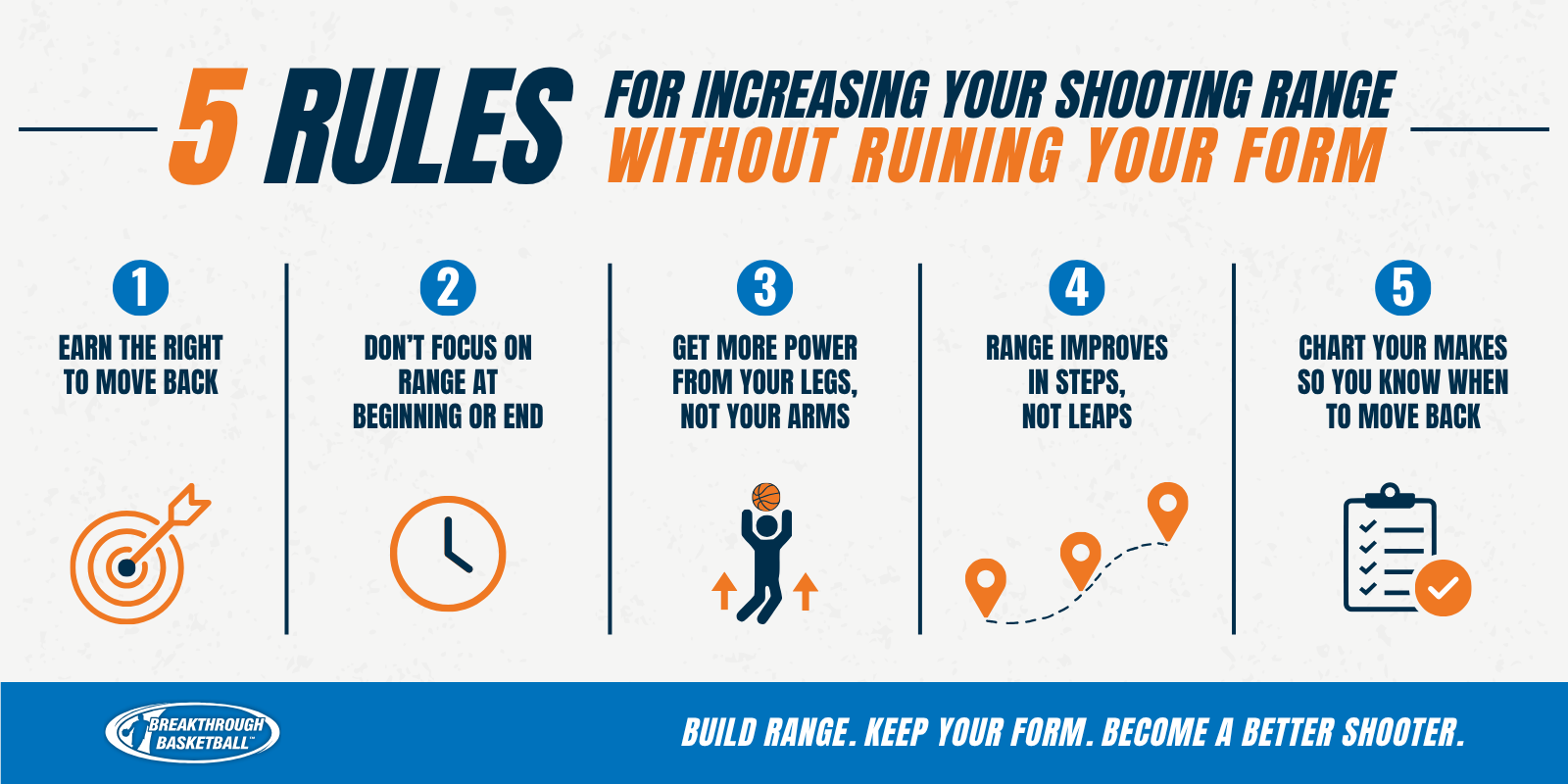
Rule #1: Earn the Right to Move Back
If your range right now is 15 feet and you want to increase it to 19 feet, you have to earn it.
That means you do not just walk into the gym, back up 4 feet to the 19-foot range, and start launching shots.
Instead, start at the distance where your shot already feels comfortable and repeatable. Then move back only when your makes and your form prove you are ready.
For example, choose three spots on the floor from 15 feet. Shoot 10 shots from each spot. If you make at least 15 total shots with good form, then move back to 17 feet and repeat the same process.
If you make at least 15 out of 30 from 17 feet with good form, then move back again.
But if you do not make 50%, stay at that same distance for the day.
That does not mean you failed.
It means you are building range the right way.
Try This Drill: 50% Or Bust Shooting
Pick three spots from your current comfortable range.
Shoot 10 shots from each spot.
If you make at least 15 out of 30 with good form, move back 1-2 feet and repeat.
If you make fewer than 15, stay at that distance for the day and continue working on your form, balance, and rhythm.
The key is this: makes only count if the shot looks and feels like your normal shot.
Rule #2: Don’t Focus On Range At Beginning Or End
Adding range should not be the last thing you work on during a shooting routine.
But it definitely should not be the first.
Deep shooting is much harder when your body is cold, your legs are not warm, and your rhythm is not there yet. That is when players often start forcing the ball just to get it to the rim.
Start closer to the basket. Get your touch, balance, footwork, and rhythm first. Then, once your shot feels smooth, begin working your way back.
This helps players build range from a strong foundation instead of guessing, pushing, or hoping.
And don’t wait until the end of a workout when you are exhausted and your legs are dead either! This would be detrimental as well, since you need the power in your legs to add range.
Rule #3: Get More Power From Your Legs, Not Your Arms
Your shooting form should remain consistent as you move farther from the basket.
The extra power should come from your legs and hips, not from changing your release.
One of the most common mistakes players make is trying to get more distance by pushing and straining with their arms or turning the shot into a two-handed push.
This is especially common with younger players who are not strong enough yet or are shooting with a ball that is too big or too heavy for them.
When players need more distance, they should think about loading their legs, getting their feet set, and shooting in one smooth motion.
Power should come from the floor.
The release should stay relaxed, clean, and repeatable.
Coach’s note: If a player has to twist their body or shoot with two hands to reach the rim, they are probably too far away. Move them closer and let their range grow naturally as their strength and mechanics improve.
Try This:
Take 10 jumpshots from your normal range, somewhere you are comfortable shooting from and can make 50% of your shots. Maybe that is 16 feet.
Focus on how far down you are bending your legs when you take these shots.
Now take a step back and shoot from 18 feet.
Do the same thing, but focus on bending your legs just slightly more so you are just a little bit lower when you start your shot. The goal is to get more power from your base, while keeping your arm motion the same.
The change in how low you start will be very subtle. Not a huge difference. You want to be comfortable going into your shot.
Rule #4: Range Improves In Steps… Not Leaps
Slow and steady wins when it comes to increasing range.
Stop trying to increase your range in 3-5 foot jumps. That is too big of a leap for most players.
If your range is currently 17 feet, do not immediately focus on shooting from 22 feet.
Start at 18 or 19 feet.
Small increases in distance allow your body to adjust without forcing major changes to your mechanics.
Big increases in distance often lead to frustration, poor balance, lower release points, and bad habits that are hard to fix later.
Real shooting range is built gradually.
Try This Drill: One-Step Range Ladder
Start at your comfortable shooting distance.
If you make 2 shots in a row, take a step back.
If you make 2 shots in a row after you step back, take another step back and do the same.
Anytime you miss 2 shots in a row, take a step in.
Take 20 shots doing this drill and see how far back you finish.
Continue working backward one step at a time as long as your form stays the same.
Rule #5: Chart Your Makes So You Know When to Move Back
Do not guess.
Chart.
Players should track makes and misses in their shooting workouts. This is a good idea for any shooting routine, but it becomes even more important when trying to add range.
Otherwise, players start guessing whether they made enough shots to move back.
And sometimes a player feels like they shot well, but the chart tells a different story.
If you are trying to increase your range, you need honest feedback.
Charting your shots tells you whether you should move back, stay at the same distance, or move closer and focus on form.
It also helps players see progress over time, which is important because range does not always improve overnight.
Try This Drill: Chart Your Range
Choose one distance and shoot 30 shots.
Write down your makes and misses.
Also write down a quick note about your form. For example:
Felt balanced
Missed short, long, right, left
Pushed the ball
Release felt smooth
Legs felt tired
If you make 50% or better with good form, move back 1-2 feet next time.
If your percentage is low or your form breaks down, stay at that distance or move closer.
Common Mistakes Players Make When Trying to Shoot From Deeper
When players try to increase their range too quickly, the same problems show up again and again.
Watch for these mistakes:
Pushing the ball solely with the arms
Shooting with two hands
Excessively leaning or jumping forward
Excessive twisting of the shoulders
Losing balance on the landing
Moving back too quickly
Practicing deep shots while tired and sloppy
Counting makes even when the form is poor
A made shot with bad form can still build a bad habit.
That is why players should care about both results and mechanics.
Final Reminder: Do Not Let Pride Decide Your Shooting Range
Try not to have too much pride when working on your shooting range.
If you are shooting 35% from 17 feet, take a few steps in and concentrate on your form.
That is not embarrassing.
That is smart player development.
It is easy for players to feel pressure when they see their friends shooting deep threes or pulling up from logo range.
But if you truly want to get better, you have to build your shot the right way.
Earn your way back.
Move gradually.
Chart your progress.
And never sacrifice your form just to say you can shoot from farther away.
Good luck!
|
|||||||||||



 Facebook (145k Followers)
 YouTube (152k Subscribers)
 Twitter (33k Followers)
 Q&A Forum
 Podcasts