
The Spanoulis DHO Action: A Simple 5-Out Dribble Handoff That Creates Rim Pressure and Open 3-Point Shots
Here is a great offensive action that puts pressure on the rim, exploits mismatches, and creates open 3-point shots if the defense collapses.
This is called the Spanoulis Action. It is especially useful for teams that run 5-out motion, dribble handoff concepts, or positionless offense.
It gives your players structure, but still allows them to make decisions.
It can be used at the middle school, high school, college, and even the pro levels.
What Is Spanoulis Action? A Complicated Look Yet Simple Execution
Some offensive actions look complicated on film.
But when you actually break them down they are built on simple concepts: spacing, timing, cutting, screening, and reading the defense.
That is true about the highly effective Spanoulis Action that Frank Bennett from USA Basketball and Chaminade HS in St. Louis teaches and demonstrates in the video below.
It has the look of a complicated action, but when you pull back the curtains, it is a simple action that any offense can incorporate.
Vassilis “Kill Bill” Spanoulis is considered one of the best players to ever play in Europe, and he helped make this action famous.
The Spanoulis Action is a simple 5-out action where a player starts low on the floor, often near the corner or underneath the basket, then cuts hard up toward the ball to receive a dribble handoff.
The goal is simple:
Get the cutter catching the ball with speed and momentum.
From there, the cutter can turn the corner, shoot if the defender goes under, pass if help comes, attack a switch, or flow into the next action.
At its core, Spanoulis Action is just a hard cut into a handoff.
But when it is timed well, it can create major problems for the defense.
Additionally, you can add some simple counters that keep the defense scrambling.
The Set Up - Video, Diagrams, and Instructions
Check out the video below as well of Coach Frank Bennett demonstrating the Spanoulis Action!
For those of you unfamiliar with Coach Bennett, his coaching accolades are quite impressive.
Coach for USA Basketball
2016 Missouri Coach Of The Year
2016 Missouri State Champion
4X Metro Catholic Conference Coach of the Year
Coached multiple NBA players at Chaminade, including Jayson Tatum and Bradley Beal
4 Final Four finishes
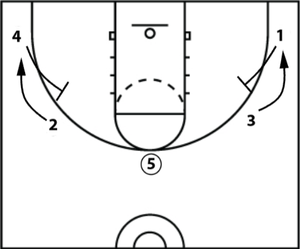
Here is the basic setup.
Start with the ball near the top of the floor.
One player starts low, often near the corner or underneath the basket.
That player cuts hard up toward the ball.
In the play above, Coach Bennett uses a flare screen on both sides of the court to start the action.
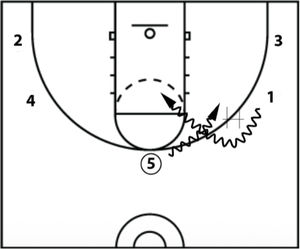
The player with the ball delivers the dribble handoff, or “Get.”
The cutter receives the ball with speed and attacks.
As Coach Bennett pointed out, which side you run the action from depends on who you want attacking off the initial DHO. If the player is left-handed, start on the right side. If the player is right-handed, start on the left side.
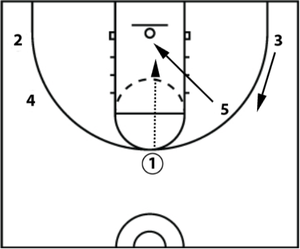
If the defense switches or takes away the initial handoff, a pass or lob into the post player rolling to the basket could be wide open.
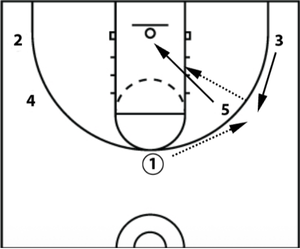
If they defend the roll well, a pass to the wing could create a post entry opportunity.
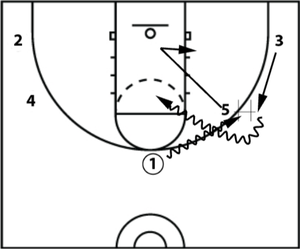
Another option is for the initial attacker off the DHO to stop and dribble back towards the wing for a second DHO.
The roller will want to space out if the ball handler attacks. This forces the help defender into a difficult choice. The defender can stop the ball handler which leaves the post player open. Or they can stick with the post player which gives the ball handler an easier opportunity to score at the rim.
But the details make it work:
The cutter must sprint.
The handoff player must be strong and patient.
The other three players must stay spaced.
The cutter must read the defense instead of predetermining the shot.
Teaching Point #1: Sprint Into the Handoff
The cutter cannot jog.
They need to sprint into the handoff like they are trying to create separation before they ever touch the ball.
This is where many young players make the mistake. They casually cut up to the ball, receive the handoff with no advantage, and the action becomes a harmless exchange.
The cut creates the pressure.
The handoff helps finish the advantage.
A good teaching cue is:
“Cut like you are trying to lose your defender before you catch it.”
Teaching Point #2: The Handoff Player Must Become a Screener
The player giving the handoff is not just handing the ball to a teammate.
They are also becoming a screener.
If the handoff player drifts, turns sideways, or gives the ball too early, the cutter’s defender can stay attached.
But if the handoff player is strong, patient, and delivers the ball at the right angle, the defender has to fight through traffic.
A good teaching cue is:
“Hand it off, then screen the defender.”
That small detail can turn a simple handoff into a real advantage.
Teaching Point #3: Keep the Floor Spaced
Spanoulis Action works best when the floor stays spaced.
If players crowd the ball, the cutter has nowhere to drive.
If weak-side players stand too close together, help defenders can guard two players at once.
If another player cuts at the wrong time, they may bring an extra defender into the action.
In 5-out offense, the other three players cannot become spectators. They need to hold spacing, occupy their defenders, and be ready to lift, replace, back cut, or spot up.
Teaching Point #4: Read the Defender
Spanoulis Action gives the cutter options.
But players have to read the defense.
Use this simple guide:
If the defender trails, turn the corner and drive.
If the defender goes under, shoot or re-space.
If the defense switches, attack the mismatch or move the ball.
If help steps up, kick to the open teammate.
If the handoff is denied, back cut or flow into the next action.
A good teaching cue is:
“Use the handoff to create the advantage, then read what the defense gives you.”
Simple Drill Progression
Start with 2-on-0.
Teach the cutter to sprint into the handoff, receive the ball with momentum, and attack for a layup or pull-up.
Then move to 2-on-1.
Add a defender trailing the cutter so the offensive player learns to read whether to drive, shoot, or reject the handoff.
Then build to 3-on-3.
Add a corner player and a weak-side defender. Now players can work on spacing, help reads, kick-outs, and the corner cut.
Finally, put it into 5-on-5 and let players flow into it naturally from your offense.
Teach the movement first.
Then teach the reads.
Common Mistakes to Watch For
When coaches first teach this action, these mistakes show up often:
The cutter jogs into the handoff.
The handoff player gives it too early.
The handoff player drifts away instead of screening.
The other players watch instead of spacing.
Players predetermine the shot before reading the defense.
That last mistake is important.
The goal is for the action to create an advantage and for the offense to exploit that advantage.
Final Thought
Spanoulis Action does not have to be complicated.
At its core, it is a hard cut into a handoff.
But when it is taught the right way, it teaches players to move with purpose, use the handoff like a screen, maintain spacing, and read the defense.
Start simple.
Teach the cut.
Teach the handoff.
Teach the spacing.
Then teach the reads.
That is when Spanoulis Action becomes more than a set play.
It becomes a weapon inside your 5-out offense.
Big News! Next Week…
If you want more great actions like this, be sure to look for the new Simplified 5 Out Offense with Frank Bennett in your inbox. It launches next week!
|
|||||||



 Facebook (145k Followers)
 YouTube (152k Subscribers)
 Twitter (33k Followers)
 Q&A Forum
 Podcasts