

Junk Defense - Box & 1 Defense
In basketball, defenses come in all shapes and sizes, but one of the most unique and strategic defensive schemes is the Box-and-1 defense. This hybrid defense is a combination of zone and man-to-man principles, designed to neutralize an opposing team's best scorer while maintaining strong team coverage.
Used strategically, a box-and-1 can throw an opponent off and help you steal a game. It’s even been used at the NBA level, most notably by Nick Nurse and the Toronto Raptors in the 2019 NBA Finals.
So, what exactly are the rules of this defense, and why would a coach choose to implement it? Let’s break it down.
6 Reasons Why a Coach Would Run a Box-and-1 Defense
While the Box-and-1 is not a standard defense used for an entire game, there are several situations where it becomes a valuable tool:
- 1. To Shut Down a Dominant Scorer
- If the opposing team has a standout player who is significantly better than the rest of the team, a Box-and-1 forces other players to step up.
- This can disrupt an offense that relies too heavily on one individual.
- 2. To Disrupt Offensive Rhythm
- Many offenses are designed to attack traditional man-to-man or zone defenses, but the Box-and-1 creates an unusual look.
- It forces teams out of their normal sets, leading to rushed shots and poor decision-making.
- 3. To Force Role Players to Beat You
- By taking the best scorer out of the game, the defense challenges the remaining players to create and score under pressure.
- If the opponent lacks multiple offensive threats, the Box-and-1 can be highly effective.
- 4. To Adjust to a Hot Shooter
- If an opposing player starts the game on fire, a coach can switch to a Box-and-1 to cool them down and make them work harder for shots.
- 5. To Protect Foul-Prone Defenders
- If a key defender is in foul trouble, playing in a zone allows them to stay on the floor without as much risk of picking up another foul.
- 6. To Create Confusion
- Teams that are unprepared for the Box-and-1 may struggle to adjust in real-time, leading to turnovers and bad possessions.
- It can be especially effective against younger teams or teams that rely on structured offensive sets.
Positional Responsibilities in the Box-and-1 Defense
There are 3 primary positions in the box-and-1 defense:
- Chaser – this player is responsible for guarding the other team’s star player. They have only 1 job - do not let that player get the ball. They follow the star all over the floor. When the star doesn’t have the ball, they deny them the ball. They don’t have any help responsibilities.
- Block/low box defenders – these defenders start on the block. They are responsible for the blocks & corners. They must be in position to help on drives and should be strong rebounders.
- Elbow/high box defenders – these defenders start on the elbows. They are responsible for the wings & top. They should be your more mobile defenders, as they have to cover a lot of ground.
Rules of the Box-and-1 Defense
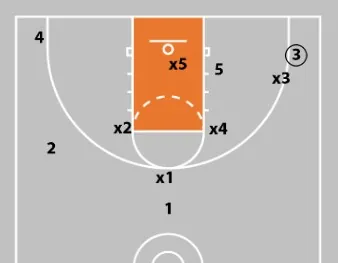
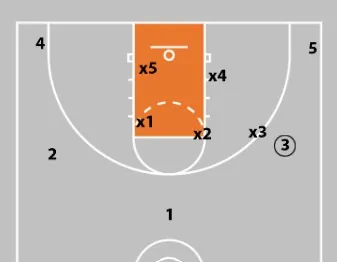
The Box-and-1 defense is structured with four defenders playing a zone in a box formation while one defender (the chaser) plays man-to-man against the opponent’s primary scoring threat. Here are the basic principles:
- 1. Four Defenders in a Box Formation:
- Two players cover the low blocks near the basket.
- Two players cover the free-throw line extended, near the elbows.
- These four defenders are responsible for contesting shots, protecting the paint, and stopping penetration.
- When not on the ball, they are dropped back into help positions.
- 2. One Defender in Man-to-Man:
- This player follows the designated offensive threat everywhere on the court.
- Their job is to deny passes, disrupt rhythm, and prevent easy shot attempts.
- 3. Rebounding rules
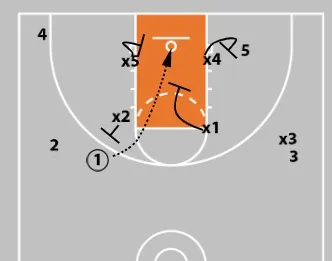
- On every shot, 1 player should be contesting.
- The other 3 box players should form a triangle to box out the blocks and the front of the rim.
- 4. Help and Rotation Responsibilities:
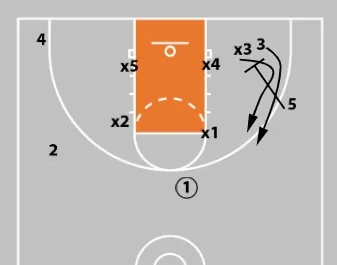
- The four zone defenders must stay alert, communicate, and rotate quickly if the offensive player being guarded in man-to-man beats their defender.
- If the player being guarded man-to-man gets the ball, the other 4 must get into the gaps to help on drives.
- Defenders must close out on shooters when the ball is swung around the perimeter.
- The zone must shift to prevent easy cuts and second-chance opportunities.
- When the ball is in the corner, everyone must shift to at least the mid line.
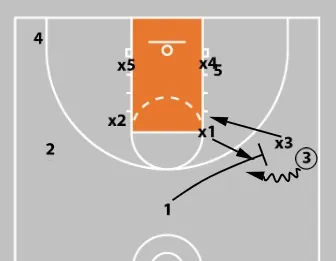
- 5. Screening Rules
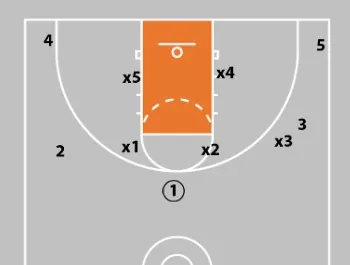
- If the star player is screened off the ball, their defender must fight through. The closest box defender should help until the chaser gets through the screen.
- Generally, the chaser should chase (follow all off the ball screens). This encourages the star to curl, pushing them back towards the center of the floor and other defenders.
- On a ball screen, you have a couple options:
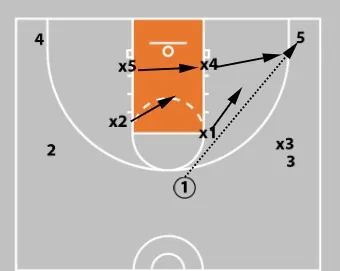
- Switch – the chaser moves into the box, and the closest box player now chases the star
- Trap – try to get the ball out of the hands of the star player
- Hedge or drop – give help on the star for a second to allow the chaser to recover before dropping back into the box
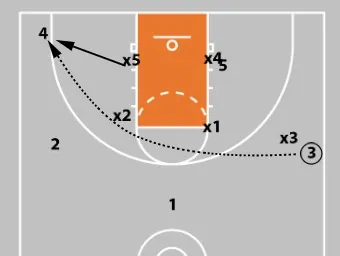
- 6. Skip Passes
- Skips are covered by the closest player. As a general rule:
- Skips above the second hash are covered by the elbow defender
- Skips below the second hash are covered by the block defender
- Skips are covered by the closest player. As a general rule:
- 7. Adjustments Based on the Offense:
- The Box-and-1 may shift depending on where the star player moves.
- If the offensive player tries to isolate or drive, the zone defenders must collapse and help.
- Coaches may switch the man-to-man assignment if foul trouble arises or if a different defender is better suited for the matchup.
- Some coaches will morph the defense into a diamond & 1 formation.
3 Limitations Of The Box & 1
- Exposed middle – the middle of the defense (whether you run it as a box or diamond) is open. If the ball reaches the middle, the offense has good options.
- Hard to use against good teams – good teams generally have multiple good players. This defense is effective against teams with 1 standout. It can be exposed by more balanced teams with multiple players who can make shots.
- Not as effective versus bigs – this defense is most effective against guards. Against bigs, you often end up with 2 or 3 defenders guarding the same area, leaving large areas of the court open.
Final Thoughts
The Box-and-1 defense is a situational weapon that can completely change the flow of a game when executed correctly. It requires discipline, communication, and quick adjustments, but when used strategically, it can neutralize even the best scorers and force teams to play uncomfortably. Coaches who understand when and how to implement the Box-and-1 can use it as a powerful tool to shift momentum and secure victories.
If you're struggling to contain a dominant scorer, consider giving the Box-and-1 a try—it might just be the game-changer you need!
|
|||


 Facebook (145k Followers)
 YouTube (152k Subscribers)
 Twitter (33k Followers)
 Q&A Forum
 Podcasts