

How to Become a Better Three-Point Shooter in Games
A Shooting Drill and Training Tips to Make More 3-Pointers in Games
Over 30+ years of coaching and hundreds of conversations with parents, one concern comes up again and again:
“My son or daughter is a great shooter at home. But in games, they really struggle.”
If that sounds familiar, you're definitely not alone.
A lot of players can make three-pointers when they're standing still in an empty gym.
Then the game begins.
Now they have to sprint into a shot, relocate after a pass, come off a screen, control their momentum, organize their feet, and release the ball before a defender closes out.
Suddenly, the same player who looked comfortable during warmups struggles to make shots in the game.
That's one of the biggest differences between being a good practice shooter and becoming a dependable three-point shooter in games.
The three-point shot has become increasingly important, but the shots players get during games are rarely stationary or predictable.
To become a better three-point shooter, players eventually need to learn how to shoot after different movements and game actions.
As Coach Bob Patton explains below, the increased reliance on the three-point shot has changed what coaches look for and how advanced players need to train.
Why Three-Point Shooting Matters in Today's Game
A player doesn't have to be an elite three-point shooter to help an offense. But the defense has to believe they can make an open shot.
When defenders respect the three, they can't help as far into the paint, crowd post players, or shrink driving gaps as aggressively.
That's why dependable shooting creates value even when the player isn't taking the shot. It creates space for everyone else.
And as perimeter shooting becomes more important at every position, players need workouts that prepare them for the kinds of threes they'll actually get in games.
Why Standstill Shooting Isn't Enough
Catch-and-shoot repetitions still matter. They help players build mechanics, rhythm, footwork, and confidence.
But game shots rarely happen under perfect conditions.
Players may need to:
- Sprint into transition
- Relocate after a pass
- Come off a screen
- Use a dribble handoff
- Attack a closeout
- Shoot after one or two dribbles
That movement creates a new challenge: controlling momentum.
Players have to organize their feet, establish balance, locate the basket, and prepare the ball quickly enough to shoot before the defense recovers.
That's where many strong practice shooters struggle.
They can make shots when everything is predictable, but once movement is added, their footwork becomes inconsistent, their upper body drifts, or their release changes.
That's why advanced shooting workouts need to progress beyond stationary repetitions.
Build the Shot → Add Movement → Add Decisions
First, establish mechanics and range. Then practice those mechanics after game-like movement. Finally, add defenders so players have to decide whether to shoot, attack, create space, or move the ball.
Three-Point Shooting Drill for Shooting After Movement
Advanced 4-Shot Elbow Series
This four-shot shooting drill forces players to repeatedly move into different game-like three-point opportunities, organize their feet, get balanced, and shoot off the catch.
Instead of repeating the same stationary shot, players practice four different movements they'll commonly encounter during games.
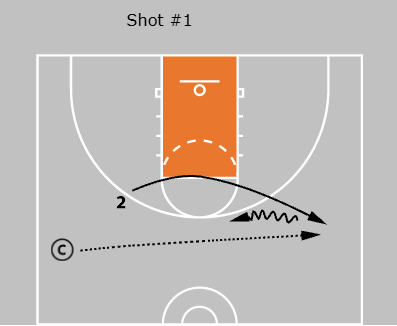
Shot 1: Shallow Cut + One-Dribble Shot
The player shallow cuts from wing to wing, catches the pass, and attacks right or left off the dribble for the shot.
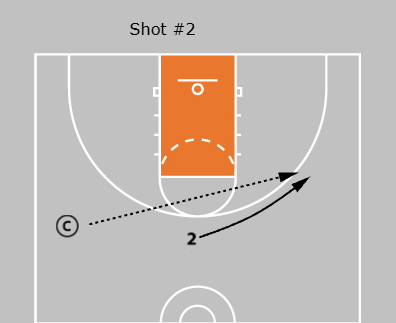
Shot 2: Fade to the Corner
The player fades toward the corner, gets their feet organized, and shoots off the catch.
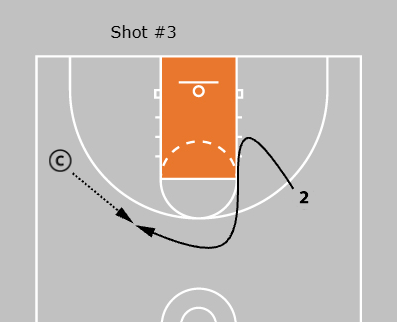
Shot 3: V-Cut to the Wing
The player V-cuts into the paint, pops back out, and curls toward the wing for a catch-and-shoot opportunity.
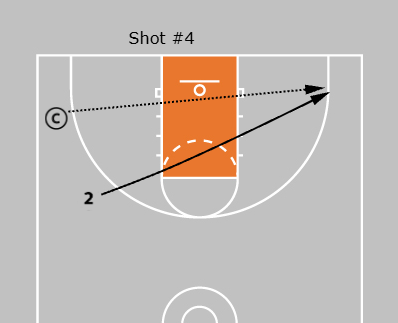
Shot 4: Cross-Court Sprint to the Corner
The player sprints across the court to the opposite corner, gets under control, organizes their feet, and shoots the catch-and-shoot three.
How Many Reps?
Complete all four shots for one repetition.
Perform 3 total reps, shooting 2 free throws after each rep.
5 Tips for Getting More From This Shooting Drill
1. Learn the movements before increasing the speed.
Start at a controlled pace so the footwork and positioning are correct. Once the movements are comfortable, gradually increase to game speed.
2. Sprint into the shot, but arrive under control.
Players should move hard between locations while still organizing their feet, controlling momentum, and establishing balance before the shot.
3. Prepare before the catch.
Locate the basket, show your hands, and begin organizing your feet before the pass arrives.
4. Track each movement separately.
Don't only record total makes. Track each of the four actions so you can identify which game-like shots need the most work.
5. Practice both sides of the floor.
Mirror the sequence on the left and right so players become comfortable shooting after movement in both directions.
As players become more comfortable, the continuous movement also challenges them to maintain their mechanics while tired.
Don't Sacrifice Shooting Form for Three-Point Range
Before adding movement, players need to be strong enough to shoot from three-point range without changing their natural mechanics.
If a young player has to push the ball from their chest, use two hands, lean forward, or throw the ball toward the basket just to reach the rim, they're probably not ready to train from that distance.
Move them closer.
Let them develop proper mechanics, balance, footwork, and confidence first. As their strength and skill improve, they can gradually move farther from the basket and add more difficult movements.
Don't skip the foundation just because a player wants to shoot threes.
The goal isn't simply to get behind the three-point line as quickly as possible. It's to build a repeatable shot that will eventually hold up from longer distances, after movement, and against defensive pressure.
Progress From Movement to Game-Like Decisions
Once a player can consistently make shots after movement, add another challenge:
A defender and a decision.
Instead of automatically shooting every repetition, the player might have to read the defender and choose whether to:
- Shoot the three
- Use a sidestep to create space
- Attack the closeout
- Pull up after one or two dribbles
- Pass and relocate again
Now the player isn't simply practicing how to make a three-point shot.
They're learning when to take one.
That's an important difference.
The goal isn't to develop players who simply take more threes. It's to develop players who can prepare quickly, stay balanced, read the defense, and confidently take the right three-point shots.
What's the Next Step in Your Shooting Development?
Not every player should train the same way.
Players still building consistent mechanics need a foundation. More advanced players need movement, closeout reads, relocations, ball-screen actions, and other game-speed situations.
Coach Bob Patton's shooting programs are designed for those different stages:
Foundational Shooting, Scoring & Skill Development is designed for youth, middle school, and developing high school players working on mechanics, balance, footwork, and shot preparation.
Elite Shooting & Scoring Blueprint is designed for advanced players ready to improve movement shooting, closeout attacks, relocations, sidesteps, and other game-speed scoring skills.
Build the Shot. Add Movement. Add Decisions.
That's how practice shooting begins to transfer to games.
What do you think? Let us know by leaving your comments, suggestions, and questions...
|
||||||||



 Facebook (145k Followers)
 YouTube (152k Subscribers)
 Twitter (33k Followers)
 Q&A Forum
 Podcasts