
9 Stats That Every Serious Basketball Coach Should Track

Home > Coaching > Stats > 9 Stats That Every Serious Basketball Coach Should Track

I'm a big believer that you should track what is important. As a basketball coach, you can't track everything -- so you pick what you believe are the most important stats and focus on them.

Here's what we believe are the most important basketball statistics for a competitive level coach (high school level and higher) where the primary objective is to win games. (Note: Youth coaches should focus primarily on development and youth appropriate stats like rebounds, assists, high fives, completed passes and so on.)


The First Four Stats (Top Level Stats)

The first four stats give you an instant snapshot of what's happening in the game.

If you beat your opponent in ALL four stats, you will always win. Always.

Basketball is really simple! To win you either need to shoot a higher percentage or take more shots than your opponent. That's all you can do. That's the only way to win a game.

Let's take a look at the stats...


Stat #1 - Field Goal Attempts (FGA)

If you can find a way to consistently take more field goal attempts that your opponent takes (take more shots), then you have a good chance to win games. You can even win if your shooting percentage is lower than your opponent (you know... you're having one of those "off shooting nights").

If you're having an off shooting night, you better have a team that is capable of getting more FG attempts than the opponent!

That's why you need to know if your team is getting more FG attempts or not. It's a critical stat.

Now you don't always have to get more FG attempts than your opponent. For example, if you're shooting 93% and your opponent is only shooting 14%, then you probably won't be getting more FG attempts than your opponent (due to fewer offensive rebounding opportunities).

That's why you should look at your FG attempts and then immediately look at the next stat to put things in perspective...


Stat #2 - Effective Field Goal Percentage (EFG%)

Effective Field Goal percentage gives you an accurate reading on who is shooting better... you or your opponent. EFG% gives more credit to made 3 point field goals since they yield 1.5 times the scoring of a 2 point field goal. The formula is... EFG% = (2Pt + 1.5 x 3Pt) / FGA.

If you can shoot a higher EFG% than your opponent, you have a chance to win the game. We all know shooting is important. So it's certainly something you want to track. I like EFG% because it objectively tells you whether you have the shooting advantage over your opponent or not.

EFG% affects many areas of the game. A good percentage will help you cut down your opponent′s fast break opportunities -- which allows your defense to get set and cut down on personal fouls.

If your EFG% is lower or about the same as your opponent, you better be getting more FG attempts and/or winning in the next two stats...


Stat #3 - Free Throw Attempts (FTA)

This stat will tell you who gets to the free throw line more often. Of course you want to get there more often, for a variety of reasons. For one, getting to the line gives you a "free shot".

Defensively, fouling keeps your team from running in transition, can get key players in foul trouble, and thwarts all your hard work on defensive possessions.


Stat #4 - Free Throw Percentage (FT%)

Free throw percentage is the last piece of the puzzle. We don't put a lot of focus on this stat (although we do shoot a ton of free throws in practice), but this final stat gives you the rest of the story and helps you determine where points are coming from.


Comparing to Your Opponent

By looking at these 4 stats and comparing them to your opponent, you can always tell whether you are winning or losing a game. For me, these are KEY Performance Indicators that all coaches should look for each game. (Note: Be sure to look at the summary report at the end of this article to get a better visual of how you can use these stats. )

Again, if you can beat your opponent in the 4 stats above, you will always win the game. It's impossible for you to lose. And if you beat your opponent in 3 out of the 4 stats above, you'll usually win that game too.


Our Goal

So as a goal, we're always trying to beat our opponent in at least 3 out of those 4 stats. That's our goal every time we play a game.

If you're not looking at those 4 stats above, how can you objectively determine what you should be focusing on as a coach? Maybe you're focusing on the wrong things? Looking at stats helps you figure out what you should be practicing and avoid that mistake.


FREE BONUS PDF
5 Checklists For Elite Coaching

Enter your email below to get your FREE copy of 5 Checklists For Elite Coaching
Age Level
Youth Middle School High School College Other
Category
I'm a Coach I'm a Coach & Parent of Player I'm a Parent I'm a Player I'm a Trainer Other
Please do not change the values in the following 4 fields, they are just to stop spam bots. Leave them blank if they are currently blank.

The Next Five Basketball Stats

Now after looking at the 4 stats above, you can drill down into the next 5 key stats to get a clearer picture of what's happening. The 5 stats below feed directly into the 4 primary stats above.


1) Turnovers - As a coach, you want to know how many turnovers you commit and how it compares to your opponent.


2) Defensive Rebounding Percentage (DReb%) - DReb% is the percentage of available rebounds the defensive team gets. The formula is... DReb% = DReb / (DReb + Opponents OReb).

As we've explained in other articles, you should look at rebounding percentages instead of totals -- because totals do NOT give a true indication of your rebounding performance.


3) Offensive Rebounding Percentage (OReb%) - OReb% is the percentage of available rebounds the offensive team gets. The formula is... OReb% = OReb / (OReb + Opponents DReb).


4) Fouls - Fouls are the enemy of good defense. Nothing is worse than working really hard on a possession only to foul your opponent and gives them two easy free throws.


5) Attempts in the Paint - This is a critical stat that affects offense, defense, and all areas of the game. We want more attempts in the paint than our opponent.


These 5 key stats have a big impact on the game and have an impact on the "4 top level stats" at the beginning of the article.

For example, committing turnovers will lower your FG attempts (a top level stat) and conversely raise your opponent′s FG attempts.

Also, what happens after most turnovers? They turn into easy lay ups for your opponents, which increases their EFG% (another top level stat).

And when the lay ups are missed, you're very rarely in good box-out position. So the opponent gets more rebounds (thus affecting DRB%). In addition, players often commit fouls trying to make up for mistakes and stopping lay ups in transition. And so on.

So as you can see, turnovers alone affect your FG attempts, rebounding, free throws, fouls, defense, and offense.

And if you examine each of the 5 stats above, you'll see they have a big impact on the game and feed directly into the 4 top level stats.


What Do You Look at First?

I always start by looking at the first 4 top level stats because they are directly related to each other and are what I consider "high level indicators".

Then I look at the bottom 5 stats. As an example, I might see that everything is pretty even except our opponent has 10 more FG attempts than us. I want to know why!!

So I look down and might see that our defensive rebounding is terrible and we have 5 more turnovers than the opponent. Now I objectively know what's happening in the game -- and what's helping or hurting us the most.


How to Make it Easier to Collect and Calculate the Stats
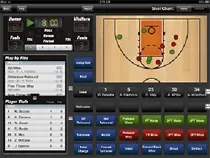
That might all sound great and all of us coaches would love to have detailed stats at our finger tips. So how do you easily keep track of all these stats?

To make it easier to collect and calculate the stats above, you can try our app called Breakthrough Stats. You can download the app in the iTunes store.

The app makes it much easier to collect and calculate all the stats you'll want to improve the performance of your team.

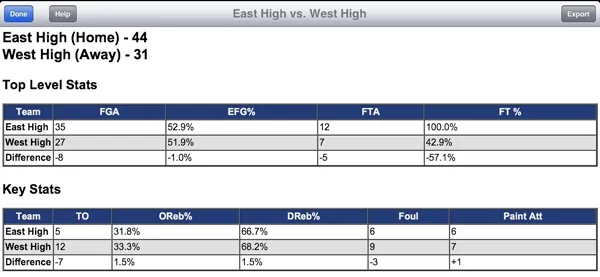
Below you'll see a screen shot of the Key Stats Report. In just a couple taps of the iPad or iPhone, you can instantly calculate all the stats.

This report is the first thing I look at during half time and after the game is over. It gives me a quick and clear story of the game and an objective snapshot of what we need to work on.

You can see the 9 stats above (that we believe are most important) are conveniently grouped into this concise report.
Look at the "Difference" Row

You'll notice the row on the bottom called "difference". I immediately look at the difference to see how our team is doing. If it's a negative number, that means we're not doing good. If it's a positive number, that means we're beating our opponent in that area (and just as importantly I can see exactly how much we're beating them by).

This is a critical report for us and this tool makes me a better coach.

Of course there are other ways to collect and calculate this information. But this app will make it easier.

FREE BONUS PDF
5 Checklists For Elite Coaching

Enter your email below to get your FREE copy of 5 Checklists For Elite Coaching
Age Level
Youth Middle School High School College Other
Category
I'm a Coach I'm a Coach & Parent of Player I'm a Parent I'm a Player I'm a Trainer Other
Please do not change the values in the following 4 fields, they are just to stop spam bots. Leave them blank if they are currently blank.


What do you think? Let us know by leaving your comments, suggestions, and questions...


Comments

Most Likes First   Oldest First   Newest First

dude123 says:
12/23/2021 at 7:28:12 PM

Awesome Article! Really help me with the project I am working on!!!

Like
   

Gary Sexton says:
8/7/2021 at 5:39:13 PM

Do you make BreakthroughStats App for Windows 10?

Like
  1 reply  

Jeff says:
8/11/2021 at 12:00:11 PM

Sorry it's only available on Apple IOS devices (iphone and ipad).

Like


Coach Bill says:
11/13/2020 at 1:19:02 AM

I've been using Breakthrough Stats for the last 3 years or so, and it's been a great way to get the raw numbers for each game. I watch my game videos, and track everything.

The one thing it lacks is a tie-in to the video itself - so ideally you can click on turnovers for example, and find the spot in the video where all turnovers occurred.

If you're looking for this sort of video + stats integration, check out Hoopsalytics.com. It's a web-based video and analytics app specifically for basketball. As a coach, being able to see the box score numbers and watch video clips for the corresponding events is pretty awesome.

Like
   

wayne says:
2/26/2020 at 10:47:23 AM

I think youth development stats should be looked at differently than college and pro stats. Also, I am not seeing a stat on assists. In my "unqualified" opinion, stats should be tallied on each player. Then some sort of formula should be applied to come up with the individual players "+/-" number. Players with the most positive numbers should be encouraged to do more of what they are doing. Players with negative rating should be similarly educated....and played less until they can correct. It seems that playing time stat per player also needs to be implemented. Some players do not do well with low minutes and other players have diminishing returns with high minutes. Just an opinion from a novice : ) .

Like
  1 reply  

Jeff Haefner says:
2/26/2020 at 11:37:51 AM

For youth development, I agree with you. This article does not give good advice for youth coaches. I believe youth coaches should focus on development. Winning should be a secondary goal, not the primary goal.

This article was written competitive level coaches (high school level and higher) where the primary objective is to win games. If fact, I'm going to add something to the beginning of the article to mention that. This was based on what I was doing at the high school level and it didn't occur to me (until now) that youth coaches might think this was intended for them. My mistake. Thank you for the comment! Appreciate it!

Like
  2 replies  

Jeff Haefner says:
2/26/2020 at 11:55:17 AM

Also, here are a couple good articles about stats for youth teams:
https://www.breakthroughbasketball.com/stats/3-adjustments-youth
https://www.breakthroughbasketball.com/coaching/Bigelow-Encouraging-Players

Like
   

Jim Taylor says:
3/27/2022 at 1:59:07 PM

With all due respect, I think your stats are important at any level, starting with youth sports. We sell our children way too short. They are capable of learning so much at early ages. I played organized basketball starting in 7th grade and I was terrible. By the time I was in 9th grade, I became one of the starting guards on our 9th grade team. I can assure you that winning was just as important to me as it was for my Jr. High coach. The youth of today IMHO is handicapped by the Participation Trophy mentality that many parents and coaches have imposed on them so as not to hurt their fragile egos. I learned a lot from losing. It was easier than winning. Learning how to win served me well later in life as a Youth Coach and in the workplace. As a youth, I played Little League ball at a time before coaches were required to play Little Jimmy the same amount of time as all other players on the team. I rode the bench unless my team, The Glasva Orioles, were either way ahead or way behind. Fortunately, I got into a lot of games b/c the Glasva O's were quite good. It was to me a microcosm of life then and now. It didn't break my will; it made me stronger. As a Youth Basketball Coach, I was not hampered by having to allow each of my players to play an equal amount of minutes. We won our share of games. I used to tell my players that I didn't care who started each game and to prove it I would start different players every game. I told them what was more important was who was in the game at the finish when the game was on the line.

Like


Coach Wright says:
11/19/2019 at 12:43:12 AM

I absolutely LOVE the "Raider" stat on so many levels! It is such a positive way to reinforce good habits. 1) It reduces the damage done by turnovers, 2) it helps to prevent a negative reaction (bad body language, frustration foul, etc.) which keeps everyone mentally in tune to what is happening on the court, and 3.) it reinforces habits of effort and aggression, which apply to all areas of the game. I hope you don''t mind, but I will definitely be stealing this idea. Thanks for posting!

Like
   

123 says:
10/21/2019 at 11:34:01 PM

123

Like
   

Abel says:
8/7/2019 at 9:11:03 PM

Overall I enjoyed your thoughts, and found them valuable. However, I have one quibble. In an article on statistics, I hate to see an early sentence that isn't true:

"To win you either need to shoot a higher percentage or take more shots than your opponent. That's all you can do. That's the only way to win a game. "

Consider team A that only shoots 2 pointers. They go 20 for 20, scoring 40 points. 100% shooting, and 20 attempts. Now think about team B, that only shoots 3s. They go 14 for 19, scoring 42 points and winning the game. But their shooting percentage is lower (74%) and their attempts are lower as well.

So there is a way to win a game by shooting a lower percentage and taking fewer shots. 10 years ago I would have said this is mostly a mathematical exercise, but given what the Warriors and Rockets have done to the NBA, I see it becoming a practical concern.

Like
  1 reply  

Jeff Haefner says:
8/8/2019 at 7:33:10 AM

Good point. The sentence can be true or false depending on how you interpret it.

If you shoot a higher FT, higher, 2pt, and higher 3pt % and take same number of shots... you're going to win the game.

I kept the wording "shooting percentage" somewhat vague to keep the statement simple. In a sense, it is very simple and that's part of the point we're trying to make...

Stats can be simple but they can also be complicated. I like to keep it simple.

But in reality FT shooting has to be considered in addition to the 2pt and 3pt shots you take.

That is why the article lists the "4 most important stats" to be:
- FGA
- EFG% (which considers both 3pt and 2pt shots)
- FTA
- FT%

I suppose I could reword the sentence you pointed out to say...

"To win you either need to shoot a higher EFG and FT percentage -- or take more shots than your opponent. That's the only way to win a game."

Is that any better? I'm not sure. Again, it depends how you interpret it.

But I don't think that matters. If as a coach, you can find a way to consistently take more shots than your opponent and shoot a higher percentage, you're going to win a lot of basketball games!

If anyone has a better way to convey these ideas or a better way to look at stats, we'd love to hear it. Always appreciate suggestions!

Like


Coach Drew says:
4/10/2017 at 12:28:13 PM

Great thoughts. I love the simplicity of your level 1 stats and the breakdown of how your level 2 stats directly relate to level 1. Your players do need to understand the stats you are trying to produce and it seems that most players would easily understand FGA. Great stuff!

Like
  1 reply  

Jim Taylor says:
3/27/2022 at 12:53:40 PM

I agree. I believe it's over-simplistic to rely on only the 4 level 1 stats. In general, all things considered equal, if both teams have the same number of possessions, the team shooting the highest percentage generally comes out on top. If both teams shoot identical %s, the team with the most possessions will generally prevail. So, possessions is a key Stat that is directly related to FGA and is critical. Also, winning teams generally make more free throws than their opponents attempt. And, because possessions are key, don't underestimate the importance of Turnovers. I expected my teams at any level from youth thru high school age to score 2pts for every minute of the game. It was true before the 3pt shot was allowed and is still true and it works at any level even at the college and pro level. Do the arithmetic. It's not rocket science. It presumes of course that your team plays great defense. By scoring 2pts per minute and playing great defense, any team at any level should win most of its games if they are 24, 32, 40 or 48 minutes. The reason that it doesn't hold as true in the NBA is that the defense played at the Pro level is lousy.

Like


Jacob Kelly says:
11/19/2016 at 11:06:26 PM

Jeff,

I have tried using similar apps for stat tracking for baseball and found it really difficult to keep up with the pace of the game. Obviously with basketball the game moves much faster. Is this app easy enough to use during a fast paced game? Or does it take more than one person? Who usually keeps the iPad/iPhone during the game?

Thanks for all your help. I really appreciate you and your website.

-Jacob Kelly

Like
  1 reply  

Jeff Haefner says:
11/21/2016 at 9:00:29 AM

Jacob -

Good question. We have kept live stats for around 100 games... ranging from 3rd grade to 10th grade.

You need a spotter (two people). One person has iPad and other person is there calling out stats (spotter)... just in case the person with iPad looks down and missing something.

I will tell you... some people are more comfortable with entering stats on an iPad than others. Most of the time, it's fine. But sometimes you get people just not comfortable. It also takes some practice.

We use the same one or two stat keepers all season. At the beginning of the season I will just ask they keep a handful of basic stats I want. Then after a couple weeks I have them add more stats as they get comfortable. If you ask them to do everything on day one, they will probably get frustrated.

We have also done stats for baseball games... again you need a spotter... otherwise it gets hard to keep up with a live game.

As far as who keep stats... with youth teams it's a parent or relative. Often times, assistant coaches are spotters. I almost always find one relative that loves to keep the stats. At high school level, it's usually a student manager or player for one of the teams not playing.

If you have any questions, let me know. We have been doing this for several years now and have learned a few things along the way.

Like


DuWayne Krause says:
7/14/2015 at 5:48:52 PM

Here's a radical idea that some of you are going to hate, but it has a considerable amount of logic to it. Basketball is a simple game of pass and catch. Therefore, turnovers is the most important offensive statistic because it measures team and individual performance, making some statistics, like assists, unecessary. If a player throws a good pass and the teammate scores there is an assist. If the player throws the same good pass and the teammate misses the same shot there is no assist. If your team is good at running their offense they will be able to pass and catch all night and good shots will develop. If not, there will be a lot of turnovers. If a player is a good passer and has good decision making ability he/she will have few turnovers. If not he/she will have a lot of turnovers. Most of the rest of your statistics are a result of the simple question "How good is your team at pass and catch?"

Like
  1 reply  

Jeff says:
7/15/2015 at 11:20:50 AM

I agree that turnover stats are very important. That's why we list turnovers above in the article and we don't list assists. There are some really good coaches that emphasize keeping turnovers low and good passing (ex: Bo Ryan).

Like


John Cullen says:
6/9/2015 at 11:02:21 AM

I would suggest a new stat which I think is very important in motivating our defense to respond differently after a turnover. We call them Raiders since that is our mascot. It is one of our key individual most important plays along with deflections (which indicates you are in position, anticipating and playing hard), First to the floor which helps us win the 50/50 balls along with charges which protect our basket. So, a raider is a statistic which indicates what happens after a turnover. We immediately yell " need a raider as we recover". It causes pride in recovery instead of disgust and disappointment or surrendering to the impending layup or easy basket. Any player or our team that causes us to get the ball back without them scoring gets a raider. So we keep a team % of raiders and it lets us know how we are responding to bad situations such as turnovers. It builds character and allows us to use lack of attention to that recovery response as a reason to sub stitute. Normally we try to get 55-60% Raiders. It is hard but often results in wins because it really frustrates the opponent when we stop them in a transition situation or get a stop as they run their offense after a steal or causing a turnover. Let me know if you think it is valid.

Like
   

Joe Hogan says:
2/11/2015 at 11:52:30 AM

One stat your site talked about a while back had to do with team defense: points per possession for your opponent. All you need to do is count how many times your opponent had the ball. Divide their points by their number of possessions. It's an incredibly revealing stat.

That is such a terrific and simple stat - tells you how frequently you stop your opponent from scoring. Great to track through the season and versus individual teams if you play them more than once.

If this stat improves you are giving yourself a great chance to win. And it provides a goal for an entire team to work for together.

Like
   

Dennis says:
12/16/2014 at 2:03:21 PM

I like the app and thinking about purching it. My question is when recording a forced jump ball or jump victim is it automatically recorded as a turnover?

Like
  2 replies  

Dennis says:
12/17/2014 at 12:47:45 PM

Dennis,
It does not record a turnover automatically.
You have to do that yourself.

Like
   

Dennis says:
12/17/2014 at 3:50:04 PM

Dennis,
Just to clarify a bit further. A jump ball doesn't necessarily count as a turnover. It depends on the possession arrow. Thus, the app leaves it up to the user to decide if it should be counted as a turnover.

Like


Jeff Haefner says:
12/3/2013 at 2:23:56 PM

Lance - That is a good question. I looked at TO% a while back and forgot about it. I think it's an interesting stat but I have not experimented with or used the stat myself.

At the moment I just look at how we compared to the opponent and also just use a gut feel on how well I think we did... If our opponent applied zero pressure and we still have 12 turnovers, that is too high. If the opponent pressed us non stop, gambled, and had great athletes, I might be ecstatic with 12 turnovers.

Whether you compare to the opponent or use TO%, there are shortcomings because of numerous factors. For now comparing to the opponent works for me and is a metric the players seem to understand. However during the off-season I may take a look at TO% and consider it down the road.

Like
   

Ken Sartini says:
12/3/2013 at 12:02:26 PM

I think that TOs are part of the game, keeping them at a minimum is the key... along with, does the other team score after we turn it over.

We definately wanted to to force more TOs than we committed.... but we also wanted to turn their TOs into points while playing tougher D after we turn it over.

The faster the pace of the game, the more TOs their will be... IMO You have to figure out how many turnovers you are going to be comfortable with.

Like
   

Lance says:
12/3/2013 at 11:24:37 AM

Good article.

When you look at turnovers, do you just look at the number committed and how it compares to the opponent, or do you take number of possessions into account? A TO% so to speak.

Like
   

Jeff Haefner says:
11/13/2013 at 7:32:44 AM

Sorry, at this point we do not have an Android version in development.

Like
   

shadi says:
11/13/2013 at 3:42:28 AM

Will there be an Android version of the app?
thank you :)

Like
   

Jeff Haefner says:
10/29/2013 at 11:12:37 AM

Murray - It does not an an international court. However we have quite a few people in other countries using the app and it works fine for them.

Like
   

Murray Mackay says:
10/23/2013 at 6:22:42 AM

Does the programme have the International court?
I am sure that I could use this app as I coach both able bodied and Wheelchair basketball.

Like
   

Ken says:
10/10/2013 at 9:03:42 PM

Good stuff

Like
   

Jeff says:
10/9/2013 at 4:44:04 PM

This looks like an outstanding App. I'm coaching a 5th grade boys team and am wondering would this be beneficial at this age level? Any input from other 5th grade coaches who have used this would be appreciated.

Thanks.

Like
   

Dave says:
10/9/2013 at 1:35:10 PM

Jeff:

This is actually my profession - I'm a software developer with over 30 years experience and I've both given and taken many classes in UI design, so I know what you went through. It sounds like you're targeting many different use models, which is hard to do. In my opinion, the "kitchen sink" approach of making the program service all of them from the same screen is a mistake. Better to have different screens for the different use models. Or you could do it the Apple way and just make it work for the most common use model. And I have some other thoughts about how to deal with the issues you have. But I do respect your choices and your program does look cool, and you obviously put a lot of time into it. Good luck with it, and thanks for a great web site!

Like
   

Jeff Haefner says:
10/9/2013 at 10:54:11 AM

Marty -

Thanks for the feedback! Adding a separate shot chart report is high on our priority list. We have designed some really cool options into that report that I think you'll like.

I don't know when the developers will get that feature completed (I wish I could). But I can tell you it's very high on the priority list.

Like
   

Marty says:
10/9/2013 at 10:38:54 AM

I've been using the app for my daughter's 6th grade basketball team, and I really like it.

One suggestion on the reports that are generated - I would like to see a shot chart (for both teams) included in one of the reports or as a separate report. I share the data I am tracking with our other coaches, and that is one set of data that I cannot show them unless they actually look on my ipad.

Like
   

Jeff Haefner says:
10/9/2013 at 10:23:25 AM

Allen -

Good point. Yes, I do think Points Per Possession is a very valuable stat!

I actually do look at that stat and it is reported in the Breakthrough Stats App.

Points Per Possession gives you a very accurate indication of the effectiveness of your defense and your offense. It takes into account your rebounds, free throws, turnovers, shooting %, and everything.

From a high level standpoint, there isn't much more important -- except maybe the final score.

Should it be included in the article above? Maybe. But I'm not sure where to put it. It doesn't logically fit into my structure so I just keep it separate.

You could potentially structure your stats like this:

Your Points Per Possession (Offense)
Opponents Points Per Possession (Defense)

Then have the rest of your stats below that...
EFG%
Reb%
Etc.

The reason I did not structure like that is because PPP does not make much sense to my players. However Field Goal Attempts does make sense to them...

I share stats with them and they understand the concept of getting more "shot attempts" than the other team. So as a result they buy into the importance of REBOUNDING, VALUING THE BALL, and so on.

This structure has been very effective for me. So I wanted to share.

I'm glad your brought up PPP. Great stat that I do look at. I also look at each players Value Point Score and a few others. But I didn't want to let the article get too long and wanted to pick what I thought were the top 10 or less.

Like
   

Allen Thomas says:
10/9/2013 at 9:49:24 AM

Do you consider points per possession or possession efficiency ( number of possessions that result in points) to be valuable stats? I have always thought rebounding % was more important then total rebounds for reasons you mentioned above.

Like
   

Jeff Haefner says:
10/9/2013 at 8:24:40 AM

Dave -

Yes, we have considered those ideas for the app. All good ideas, that believe it or not, we did consider. However after going through all the options and designing numerous versions of the interface with our design team, we as a team decided all those buttons were necessary and/or made for a better all around app...

With app and software design, consistency is crucial (this includes button placement, wording, and following standards that users are used to). We also wanted lots of flexibility because talking with coaches we have found there are LOTS of different ways people want to track stats. So it was designed for max flexibility. A couple examples...

We have both 2pt and 3pt buttons because some people do NOT track shots on the shot chart. They turn that feature off. So both buttons are needed in that situation. In addition, having both 2pt and 3pt helps if the user puts the shot directly on the 3 point line.

Some people only track a few stats. In addition, sometimes people accidentally get "off" when they are tracking stats. So sometimes your smart app will "infer" the wrong thing and mark your defensive rebound as an offensive rebound. That is very frustrating so we decided not to infer whether it's offensive or defensive and simply let the user decide by choosing a button.

Another benefit to having rebound buttons separate -- it allows you to easily add a corrective rebound later.

Believe it or not... some people don't want to track points... they only want to track rebounds and assists. As an example, with our youth team... we only track "made passes" and "rebounds". I don't want the kids even seeing points because some never score yet. But I do want them seeing hustle stats like rebounds, loose ball recoveries, and made passes are great too because it's something everyone can succeed at and start building confidence.

The other factor of more buttons vs. fewer buttons with prompting: I found it took longer to tap a button and then be prompted for a second item as opposed to hitting one button that didn't require a second prompt. So, it's a tradeoff between having more buttons to look for vs. taking extra time to answer a second prompt. Based on feedback from user's we found they liked not having to respond to a second prompt to be quicker.

We put a tremendous amount of thought and work into the development of this app. There are so many variables and scenarios to consider when designing an app. We tried to design it to be as streamlined and flexible as possible.

We have found that with just a little practice, the interface is incredibly streamlined. More so than any other app we have tried. Is it perfect? No. There is always room for improvement and there's always something you can do better. But I have found it works really well and there are minimal touches required to record a stat. You can go pretty quick.

Like
   

Jeff says:
10/9/2013 at 7:07:54 AM

I like the stats you have, but feel steals and assists should be included. A player could have 3 turnovers, but a t the end of game have a +6. Those are two key stats which are left out, stats which usually occur free throw line to free throw line. Hustle and teamwork stats. Vital to success. :)

Like
   

Dave says:
10/9/2013 at 6:59:44 AM

Your app looks pretty cool, and I like the stats. But having used other basketball game tracking apps out there, I've learned that it's all about ease of use when entering game stats. I'm a youth coach, and have parents enter the stats during games.

Have you considered streamlining your interface? For example, you don't need seperate buttons for 2 and 3 point shots made/missed - the app can infer hat from the shot location. You also don't need seperate buttons for offensive and defensive rebounds - it can infer that from which team just shot. You don't even need permanent screen buttons for rebounds at all - it could prompt you after a shot was taken. Removing redundant buttons and prompting for events based on the situation at the moment would reduce clutter and make the program easier to use.

Like
   

Ken Sartini says:
10/7/2013 at 2:54:10 PM

Jeff / David

As for free throws.... we were typically a pretty good FT shooting team. We had kids come in during the summer and shoot 1,000 every day.

So, our goal was to shoot more FTs than they made. A lot of games are won and lost at the line, especially in the 4th qtr.I would definately leave in the top 4.

JMO

Like
   

Jeff Haefner says:
10/7/2013 at 2:34:48 PM

David - Good point. I should clarify.

The main reason I leave FT% at the top is because it has a direct affect on the final score of the game, and leaving it there helps give me an overall snapshot of the game. All 4 of those top stats directly affect the final score -- if I take one away (like FT%), I lose part of that snapshot and story. I want to see the entire story in one simple and concise place.

So for me it's just a logical way to tell the story of the game and see precisely why we won or lost. Looking at those top 4 stats give me a very quick indication of what exactly is happening.

But I do agree with you. Not much you can do about your opponents FT shooting percentage. :)

Like
   

David says:
8/28/2013 at 11:19:35 AM

This is a great article, one of the few I have read that emphasizes the importance of FGA. So many people just talk about FG% (or eFG%) without regard to the number of shots. We have won numerous games over the years where the two teams shot basically the same percentage from the floor but the score wasn't close because of the number of turnovers we forced. FG% is only relevant if the two teams' FGAs are relatively equal.

You mentioned you don't emphasize FT% much but I would go further. I think it is pointless to compare yours with your opponent's because you have no control over your opponent's shooting ability. I would demote this stat out of your top group because of that.

Like
   

Bill says:
7/24/2013 at 12:22:19 PM

Sounds like a nice app. I'm surprised it's not available for Android since it has a larger market share....

Like
   

Jeff Haefner says:
7/24/2013 at 9:29:03 AM

Phil - Sorry, at this point we do not have an Android version in development.

Like
   

Phil says:
7/24/2013 at 7:57:25 AM

Will there be an Android version of the app?

Like
  1 reply  

Jeff says:
2/7/2015 at 7:50:58 PM

The article is a useful start in thinking about statistics but if you are playing at competitive levels you need to get much deeper fast. I consider shooting percentage to have its primary value in teaching shot selection.

The first four stats are the mathematical equivalent of saying ”if you score more points than your opponent you'll always win”. This is true but looking at the scoreboard is even faster. You need to be able to analyze games that aren't so cut and dried.

The next five start the path to understanding but you won't really be there with just those 5. I'm a big believer in rebounding but turnovers and assists and understanding their underlying causes are really critical - are those points in the paint coming from assists? If you can build a team that is scoring off assists you are starting something special.

Like
  1 person liked this.  


Load more comments (26 more)
Leave a Comment
Name
:
Email (not published)
:
Nineteen plus seven is equal to?  (Prevents Spam)
Answer
:
 Load New Question
Comments
:
Leave this Blank
: