

Zone Play: Double Ball Screen Action
Anytime you coach a team, whether it is youth, high school, or college, there is a fear when you are facing a zone.
Four passes around the perimeter. Two pump fakes. One contested three that nobody really wanted (the coaches definitely did not want).
The defense gets to slide from side to side, protect the paint, and watch the offense slowly run out of ideas.
A 2-3 zone loves that possession. It did its job. No paint given up. No pressure. Relax, rebound, and run to the offensive end.
As a coach, I’ve seen this type of possession frequently. Yes, the more inexperienced a team is, the more common it is to see this, but surprisingly, I’ve coached some very good teams that would fall into this trap as well against zones.
Why?
Well partly because the perimeter is open, so players swing the ball from side to side, which they’ve been taught to do offensively.
The problem is, you are not attacking the paint or putting any pressure on the defense, so it usually ends in a perimeter 3 attempt with no inside-out action.
As a coach, it’s your job to help make sure your offense is keeping the zone very uncomfortable.
The action we’re breaking down today attacks all three levels of the defense at once.
- A player occupies the high post
- A cutter runs behind the back line
- The ball handler attacks the gap before the defense can recover
The result?
One low defender. Two offensive threats. And you force a decision that the defender probably doesn’t want to make.
The action below is one of my favorite ways to create those decisions because it attacks all three layers of the zone at the same time:
- The high post occupies the middle defender and screens to create driving lanes
- The ball handler attacks the gap forcing the middle defender to step up
- The wing defender must decide if they want to give up a 3 or sag inside to take away the layup (if they even see the offensive cutter to the rim)
When all three happen together, the low defenders are forced to choose between helping on the drive or protecting the cutter.
That's exactly what happens in this sequence.
Set the Alignment and Reverse the Ball
The action starts in a two-high alignment that places immediate pressure on the middle of the zone.
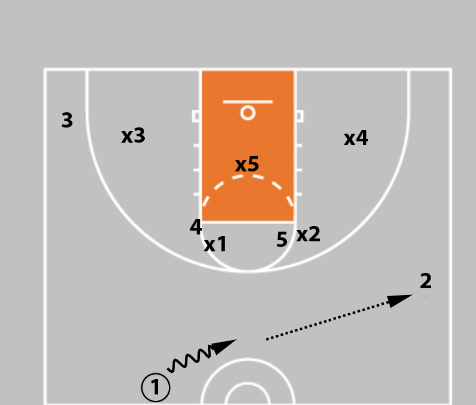
- 4 and 5 fill the two high-post areas.
- 1 and 2 start on opposite sides of the floor.
- 3 begins in the weak-side corner, stretching the bottom defender away from the basket.
- As 1 brings the ball down the floor, they dribble toward the middle to improve the passing angle.
- 1 passes to 2 to begin the action.
Coaching Point: Maintain good spacing. If 4 and 5 stand too close together, or if 3 drifts up from the corner, the zone can guard multiple players without having to move.
Screen the Top Defender and Attack the Middle
Once 2 receives the pass, the offense immediately puts pressure on the top of the zone.
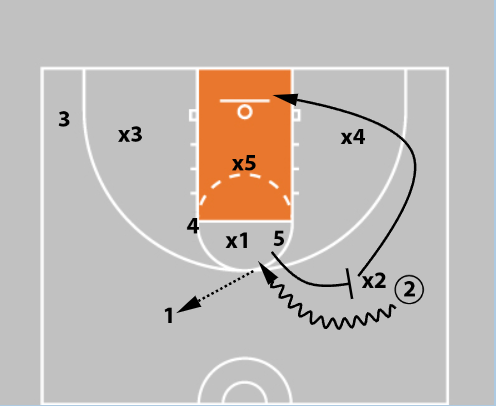
- 5 steps out and sets a screen on X2.
- 2 uses the screen and attacks the middle of the paint.
- This penetration forces X1 to slide over and stop the ball.
- The drive may also cause X5 to begin stepping up from the back line.
- After setting the screen, 5 continues toward the ball-side corner before looping behind the defense and cutting toward the basket.
- As soon as X1 commits to the drive, 2 quickly passes the ball back to 1.
The pass cannot be slow or late. The offense wants to reverse the ball while the zone is still shifted toward 2.
Coaching Point: 2 does not need to force a shot. The purpose of the drive is to pull defenders out of position and create an advantage on the reversal.
Reverse, Drive, and Force the Back Line to Choose
The quick reversal gives 1 an opportunity to attack before the zone can recover.
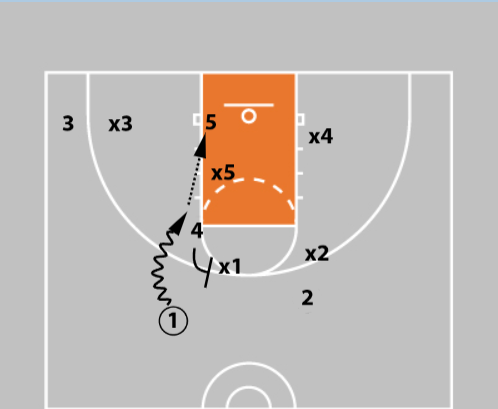
- As the ball is passed back to 1, 4 steps up and screens X1.
- 1 attacks the opening with a straight-line drive toward the rim.
- At the same time, 5 continues the cut behind the back line and moves into scoring position near the basket.
This puts the defense in a difficult position.
- X5 must decide whether to step up and stop 1 or stay near the rim to protect against 5’s cut.
- X3 must decide whether to help inside or stay attached to 3 in the corner.
From there, 1 makes the simple read:
- If X5 steps up and X3 stays with 3, 1 makes the dump-off pass to 5 for a layup.
- If X3 collapses into the paint to take away 5, 1 kicks the ball to 3 for an open corner three.
- If the back line hesitates and neither defender fully commits, 1 continues the attack and looks to finish at the rim.
That is what makes the action so difficult to guard.
The zone cannot take away the drive, the cutter, and the corner shooter at the same time.
Why This Action Works So Well
What makes this quick hitter effective is not one screen, cut, or drive by itself.
It is how each action creates a small advantage, and how those advantages build on one another until the defense is forced into a no-win decision.
The offense is not trying to beat all five defenders at once. It is simply moving the defense out of its comfort zone and forcing one defender to guard two threats.
Once that happens, the easy scoring opportunity is created.
Coaching Point: The screens do not need to completely knock defenders out of the play. They only need to delay them long enough for the next action to create another advantage. The timing of the screens, reversal, cut, and drive is what makes the action so difficult to defend.
Cautionary Tale About A Made 3
From my experience playing against 2-3 zones, as well as watching basketball my entire life, I’ll add a note of caution for coaches.
I’ve seen enough games against a 2-3 zone where the first offensive possession is bad.
No distortion of the zone.
No attacking of the middle.
No inside-out action.
But your player hit a 3. Maybe a perimeter-to-perimeter pass and the defender is a step slow to close out and you bury one.
Sounds good, and the 3 is a good thing, but here is the problem…
That can create a false sense of security for your team about what is a great shot.
So as a coach, you may need to emphasize to your team on the very next possession that you want to create advantages, get paint touches, and look to pressure the defense.
Otherwise, you are likely setting the defense up for success, because your team will continue to shoot perimeter shots without looking for paint touches, screening the defense, and forcing the defense to make tough decisions.
Final Thoughts
The best zone offenses aren't built around trick plays.
They're built around creating impossible decisions.
This action does exactly that.
You occupy the middle.
Stretch the back line.
Reverse the basketball.
Attack the gap.
Then make the simple read.
Against a disciplined 2-3 zone, simple actions executed with great spacing and timing are often more effective than complicated offenses.
If your team can consistently create these reads, you'll generate high-percentage layups instead of contested perimeter shots, and that's exactly what every coach wants when facing a zone.
Coach's Challenge For Next Practice
The next time your team practices against a 2-3 zone, don't count made baskets. Count paint touches created by the action. If your players consistently get the ball into the paint while forcing the back line to make a decision, the points will come.
Want a Complete Plan for Attacking Any Zone?
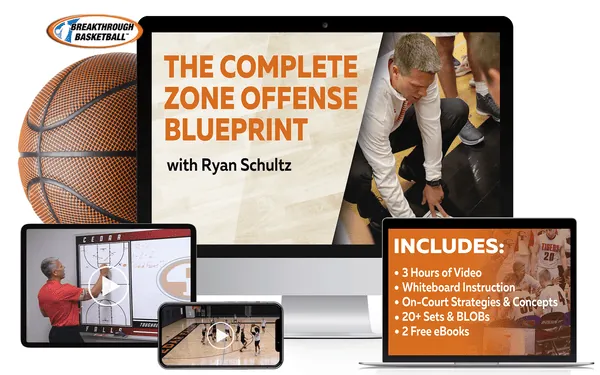
Coach Ryan Schultz's Complete Zone Offense Blueprint gives you a simple framework for attacking virtually any zone defense without having to reinvent your offense every week.
You'll learn universal zone concepts, alignments, screening actions, transition attacks, and 20+ sets and baseline out-of-bounds plays designed to create paint touches and force the defense into difficult decisions.
See The Complete Zone Offense Blueprint →What do you think? Let us know by leaving your comments, suggestions, and questions...
|
|||


 Facebook (145k Followers)
 YouTube (152k Subscribers)
 Twitter (33k Followers)
 Q&A Forum
 Podcasts