

Build A Tougher Team By Teaching This Ball Screen Defense First
A ball screen comes. Your defender gets caught. Someone yells, “Switch!”
But before switching becomes your automatic answer, ask yourself: Are we teaching our players to compete through the screen or simply hand off the toughest part of the possession?
Getting screened doesn’t mean your job is finished. It’s where your toughness shows up.
Communicate early.
Work to get over or under the screen.
Recover and stay with your player.
That’s where I believe teaching ball screen defense should start: with the toughness to get through a screen and take responsibility for the player you’re guarding.
Teach them to solve that challenge first. Then add switching as another tool.
Watch Coach Lepisto teach the flat hedge and explain why he starts every season with it.
Build Toughness by Teaching the Demanding Work First
Coach Lepisto takes this approach by teaching a flat hedge at the beginning of the season, regardless of the opponent on the schedule.
His reasoning is about development. He wants players to learn the difficult job of defending the action together while keeping their original matchups. They can add other coverages as needed, including a communicated switch when the original coverage breaks down.
The standard is simple: a screen does not end your responsibility. Keep moving, trust your teammate’s help, and get back into the play. Repeating that response gives players a practical way to develop toughness and confidence.
Switching still takes technique and communication. But when players learn to navigate screens and recover first, you give them more ways to defend.
What Does a Flat Hedge Look Like?
The screener’s defender meets the dribbler around screen level, on the basket side, and moves laterally to contain the ball. Meanwhile, the on-ball defender works over the screen and gets back into position.
Once the on-ball defender has recovered, they communicate it. The screener’s defender returns to their original assignment.
The job is temporary help, followed by recovery. The defenders are not exchanging players. Going under can also be part of your teaching, depending on the ball handler and your coverage rules. In the example below, X1 goes over.
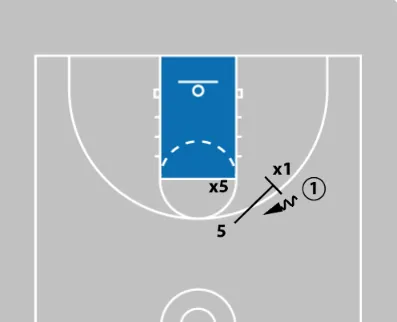
Diagram 1
5 sets a ball screen for 1. X5 moves with 5 toward the screen.
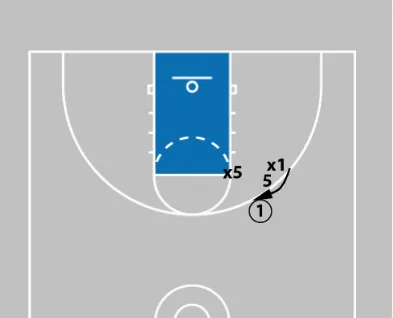
Diagram 2
X5 calls “Screen!” and sees 1 using the ball screen. X5 stays briefly with 1 until X1 can fight over the screen and get back in position to guard the ball.
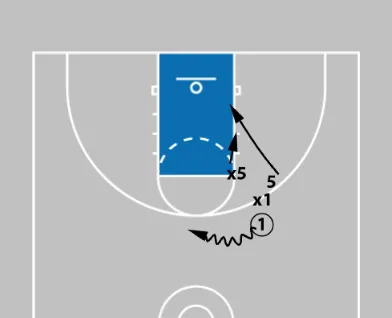
Diagram 3
Now X5 can recover to their man, having taken the drive away.
You Are Teaching More Than a Coverage
- Toughness with a purpose. Getting screened cannot become permission to stop. Players learn to anticipate contact, make themselves difficult to screen, and keep working back into the play. Toughness here means effort and technique, not running through a screener.
- Confidence from disrupting the offense. A ball screen is designed to create an advantage. When your players contain the ball and recover, they experience the satisfaction of taking away what the offense wanted. That gives them a reason to trust their work.
- Accountability and trust. The on-ball defender knows a teammate will help, but also knows that help is temporary. The screener’s defender learns to contain the ball without forgetting the roller. Both players have a job to finish.
- Communication that matters. An early screen call and a clear recovery call directly affect the possession. Players can see why talking matters because it helps their teammate make the next decision.
- More defensive options later. When switching is your only answer, an offense can hunt the matchup it wants. Teaching players to stay with their assignments gives you another option when you want to keep a particular defender on the ball.
Start Small, Then Make It Live
Begin with 2-on-2 and a controlled walkthrough. Establish the screen call, the route over the screen, the flat hedge, and the recovery call.
Then let the offense play. The ball handler can attack and the screener can roll. Look for three things:
- Did we contain the ball?
- Did the on-ball defender recover?
- Did the screener’s defender get back to their player?
Build to 3-on-3 so a third defender can learn when to help on the roller and recover. Eventually, test it in 5-on-5. Teach a clear emergency-switch call so players know how to respond when recovery is no longer possible.
As the season progresses, choose coverages that fit your players and opponents. The point is to build the skills that give you those choices.
Before teaching players to hand off the problem, teach them how to work through it together.


 Facebook (145k Followers)
 YouTube (152k Subscribers)
 Twitter (33k Followers)
 Q&A Forum
 Podcasts