
The Competitive Cauldron Part 2 - Turning Theory Into Real Results (FAQs & Example)!
In part 1 of this mini-series, we discussed the merits of using a Competitive Cauldron in practice.
This idea, which became famous due to Anson Dorrance (UNC women’s soccer) and Dean Smith (UNC men’s basketball) before him.
The basic idea is that you track stats in practice. Those stats become a way to rank players.
Those rankings become a big part of playing time decisions.
Because players know the rankings affect their court time, they will compete harder. Over time, being a competitor becomes part of their DNA!
This all sounds great, but I’ve gotten some good questions on how to implement this, given the constraints many of us face.
Let’s dive in with some competitive cauldron FAQs!
How Can I do This When I Have 1 (or 0) Assistants Or 1 (or ) Managers?
This is a logistical issue. And it’s a legit question. D1 college coaches have a stable of managers and assistants.
While that would be nice, that’s not our situation. Some of us are on our own at practice. Some of us are lucky enough to have 1-2 assistants.
At the high school level, you MIGHT have a student manager. If you’re incredibly fortunate, you might have two.
So, how can you run and coach your practice and do this at the same time?
Here are a couple of ideas.
-
Carry a notebook
This is just a good coaching practice. In practice, we see so much. However, just as we worry about overloading our players’ working memory, we do the same to ourselves.
Something occurs in practice that we want to address. We make a mental note. By the end of practice, we’ve completely forgotten what it was.
Having a notebook helps with that. During practice, you can jot down what you see so you don’t forget it. This helps when you reflect on practice and plan your next one.
It also makes it easier to keep the Cauldron. Put your tracking sheet in your notebook. At the end of each drill that you track, ask the winners to raise their hands. This allows you to note the winners quickly.
Or, if you give losers a consequence (push-ups or a sprint), you can easily see who won and note it.
Having the tracking sheet with you lets you quickly track winners. This is especially useful if you are coaching a team solo.
-
If you have a manager, use them
Too many teams that have managers don’t make the most of them. Your managers are capable of more than filling water bottles.
In fact, they probably want to do more. They will feel more engaged and part of the program if you give them meaningful tasks.
Have them track your Cauldron categories. If they need some help at first, train them. It shouldn’t take long for them to grasp what you’re looking for.
This also applies to injured players. We all know it’s hard to keep injured players focused. This is a great way to keep them mentally engaged while they heal physically.
Competitive Cauldon FAQs - What Should I Track?
If you’re now convinced you can make the Cauldron work, this becomes the next pressing question.
You do so many things in practice. Should you track them all? If not, how do you pick and choose?
-
Choose 3-5 things to track
Be selective in what you track! You can’t track every single thing. If you try, it will become overwhelming.
Instead, pick the things that are most important to you.
I tracked five things.
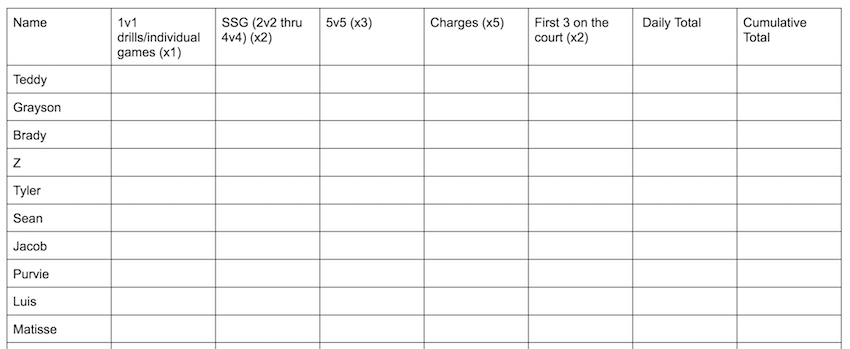
First, I chose three broad categories: 1v1 games, SSG (small-sided games), and 5v5 scrimmages.
Ultimately, winning is the goal. So I tried to reward winning. Every time a player won a game, they got points.
I decided to weight categories as well. This is something you have to decide for yourself. How important is each item? For me, 5v5 wins are more important than 1v1.
Some might disagree with that, since players have more control in a 1v1 game than in a 5v5 game. That is true. However, the game is played 5v5, so I chose to give a greater reward to those who impacted winning in a 5v5 setting.
Additionally, 1v1 games tend to reward those who can score. While that is a valuable skill, there are other ways to impact winning that only show up in a team setting.
I then added two controllable items related to the culture we are trying to build - charges and being first on the court. (One nice thing about categories like that is that they are more achievable for your weaker players.)
Charges were given heavy weighting to incentivize them.
Note that all categories are objective.
At the end of each day, totals were weighted correctly and then added across. That number went in the daily total. The daily total was added to the cumulative total.
One note - I did not include a shooting component. We did a separate shooting ladder for this. I may try to combine them going forward. You may or may not want to include shooting in your cauldron.
Should You Ever Reset The Totals?
Some coaches like to reset their Cauldon periodically. Last year, I did not do this. We had a young team, and I wanted to see who rose and who fell over the course of a season.
Whether you choose to reset is up to you.
If you have multiple injuries, it might be a good idea to reset. If you overhaul your style of play during the season, you might reset. Those are decisions you have to make.
Resetting does give a fresh start to those who’ve struggled. Conversely, it unintentionally “punishes” those who were at the top, as they lose the lead they’ve worked for.
How Should You Use Your Competitive Cauldron?
When I first heard about this idea, it was from a coach who used it to determine starting lineups.
Whoever was ranked 1-5 started. Player 6 was the first one off the bench.
I did this at first. I found it to be good and bad. It’s good in that decisions are based on data. This helps remove some subjectivity.
It’s bad because coaching is both a science and an art. If you commit to using the Cauldron to determine lineups, you have to go by what it says.
Maybe that results in a bad mix of players (positionally or size wise). Perhaps a kid who was sick for a week but is a good player got bumped down. Those are issues that come up if you use the Cauldron as the basis for starters.
In the last couple of years, I’ve used it as a “guide” for lineups. I tell players and parents that lineups will be heavily influenced by Cauldron standings. Heavily influenced does not mean blindly followed. I reserve the right to start who I want based on other factors.
If you go this direction, make sure to communicate it to your team and parents. Also, make sure you really are using the Cauldron to guide decisions.
If you say it’s a guide but then start multiple players who rank low, that sends a mixed message. It undermines what you’re trying to accomplish.
And that leads to our final question...
What If The Data Doesn’t Match The Eye Test?
I’ve had this happen. A player who I thought was one of our best players was ranking low. Or a player who I didn’t think was a top player was ranking high.
If this happens, don’t dismiss it out of hand. You need to examine why this is happening.
-
Are you tracking the right things?
As I mentioned above, I primarily track wins in drills. I weigh them according to what matters most (5v5 > 1v1).
That’s my philosophy. Yours might be different. But if you find player rankings are out of whack, first check what you’re measuring.

-
Is the player from the Allen Iverson school?
Some players don’t play as hard in practice as they do in games. Maybe they’ve always been one of the most talented players on their team. They’ve always played a lot as a result. That’s created some entitlement.
If you have a player like that, use the Cauldron as leverage. Ultimately, you want them to change their practice approach.
In this circumstance, less playing time (based on the Cauldron) can create lasting change. As Bobby Knight once said (with slightly more colorful language), “Butt meets bench. Bench retains butt. Butt transmits signal to brain. Brain submits signal to body. Body gets butt off bench and play better!”
The long term goal is to have a player who is BOTH talented AND hard working. The Cauldron can create the accountability to make that happen.
-
Does the player have game anxiety?
This can work the other way, too. Some players perform well in practice but struggle in games. If you have a player who ranks high on your Cauldron but struggles on game night, that might be the case.
If so, it’s good to know that. You can then work with that player on their mental game. There are numerous strategies to help players who struggle with this. If you’re able to work through it with your athlete, you’ll have a player whose game performance matches their practice performance.
That will be liberating for the athlete and helpful to your team!
Conclusion
Try a Competitive Cauldron. Even if you’re not 100% sure it will work for you.
Yes, it’s some work. But not that much.
And what do you have to lose? If it doesn’t work, scrap it. But if you give it a shot and use it appropriately, I doubt that will be the case.
Instead, I suspect you’ll have a team that practices harder and better. You’ll have a team that focuses on winning.
And if your team does that in practice, they’re a lot more likely to accomplish it in games! If you’re looking for a ready-made verion of a competitive cauldron, check out The Value Point System And Daily Drills With Danny Miles
|
|||


 Facebook (145k Followers)
 YouTube (152k Subscribers)
 Twitter (33k Followers)
 Q&A Forum
 Podcasts