
Payton Pritchard's Secret to Rapid Improvement — And How You Can Copy It
Not long ago, Payton Pritchard shared a simple idea that explains a huge chunk of his success.
It wasn’t a fancy drill.
It wasn’t a new trainer.
It wasn’t some four-hour workout that only pros can do.
It was this:
Pritchard said his game took off when he started playing 1-on-1 every day against players who were better than him… and getting beat.
Payton Pritchard says his game started to take off when he began playing 1 on 1 against players that were better than him every day
— Hoop Herald (@TheHoopHerald) November 17, 2025
Getting beat but having to figure it out, while continuing to work on his craft
You can see the influence
pic.twitter.com/CqOD1GLA6U
Let that sink in.
Most players want to score more.
Most players want to “level up.”
But not many want to step into a gym every day knowing they’re probably going to lose… and lose again… and lose again.
Most players avoid failure. Pritchard embraced it, knowing temporary pain was a path to long-term gain!
And it changed everything, culminating in his 2024-2025 6th Man Award.
Why This Mindset Matters More Than You Think
Playing better competition forces your game to grow — whether you like it or not. You’re uncomfortable. You’re under pressure. You’re challenged on every possession.
This is where real improvement happens.
When you play someone stronger, quicker, or more skilled:
-
Your reads must get faster
-
Your counters must get sharper
-
Your finishing must get craftier
-
Your footwork must get cleaner
-
Your defense must get tougher
-
Your habits must get tighter
There’s no hiding.
You can’t get away with sloppy handles or lazy footwork. You can’t cruise through reps.
You can’t “play casual.”
Better players expose every weakness — and that’s a gift if you’re willing to use it.
The Players Who Improve the Fastest Have Two Things in Common
1. They seek out discomfort.
They want to be challenged. They don’t avoid tough matchups. They don’t quit when things get hard.
2. They don’t take losing personally.
Losing becomes information. Every loss tells you exactly what needs work. It’s not failure — it’s feedback. That isn’t to say you enjoy losing. It still stinks. But, ironically, winners know how to use losing. They aren’t afraid of it because they know it can teach them things that are almost impossible to learn when winning.
In Payton Pritchard’s case, he didn’t just survive those 1-on-1 battles…
He studied them.
He learned from them.
He used them.
And that’s the mindset you need.
5 Ways You Can Apply This Mindset Starting Today
Here are practical, clear ways to build this into your training — even if you don’t have elite players in your area.
1. Play 1-on-1 Against Better Players — Regularly
This is the heart of Pritchard’s story.
If there’s someone in your gym, school, or neighborhood who is:
-
Bigger
-
Stronger
-
Faster
-
Craftier
-
Older
More skilled
…challenge them.
Don’t worry about the score. Worry about getting better.
During the off-season, invite them to work out with you. During the season, play 1v1 before or after practice.
2. Use “Constraint 1v1” to Supercharge Development
If better players aren’t always available, modify the game to create pressure:
-
You only get two dribbles.
-
You have :04 to score.
-
You must finish with the opposite hand.
-
You can’t score in the paint.
Your opponent starts with a lead.
These constraints force you to problem-solve — the same way Pritchard did.
3. Track the Skills You Struggle With
One reason Pritchard improved so fast?
He didn’t just play. He studied himself.
After each session, reflect on what worked and what didn’t. Answer these three questions:
-
What do I need to keep doing?
-
What do I need to stop doing?
What do I need to start doing?
If you can identify one weakness each session, you’ll improve at a ridiculous rate.
4. Add Craft Work to Your Daily Routine
Better defenders force you to become more creative.
Work on:
-
Floaters
-
Inside-hand finishes
-
Step-throughs
-
Pro hops
-
Long-step finishes
-
Pace changes
-
Punishing angles
Ball protection footwork
Craft isn’t about fancy moves. It’s about solutions - for instance, being able to finish in multiple ways based upon the positioning of your defender.
That’s what Pritchard developed — a deeper toolbox of answers.
5. Don’t Chase Comfort — Chase Growth
There’s a reason most players don’t improve as quickly as they should.
They stay in environments where they succeed easily.
They scrimmage with friends they dominate.
They do drills that feel good… not drills that expose weaknesses.
Pritchard chose the opposite path.
He chose the hard route — the uncomfortable route — the growth route.
And that choice transformed him. There’s a saying that goes, “Hard choices, easy life. Easy choice, hard life.” The same principle applies to your development. Are you willing to get outside your comfort zone now to enjoy the benefits later?
Your Challenge This Week
Pick 1–2 players who are better than you in specific areas:
-
One who defends well
-
One who scores well
-
One who’s physical
-
One who’s quicker
One who’s older
Play them 1-on-1.
Keep score… but don’t judge yourself by it.
-
Judge yourself by whether you’re solving problems.
-
Judge yourself by whether your decisions are faster.
-
Judge yourself by whether you compete every rep.
Because if you commit to this process, the same thing that happened to Pritchard can happen to you.
Your confidence will change. Your skill will jump. Your game will grow. And people will wonder what happened.
But you’ll know exactly what happened.
You started chasing the challenge —not comfort.
Looking For More Ways To “Level Up”
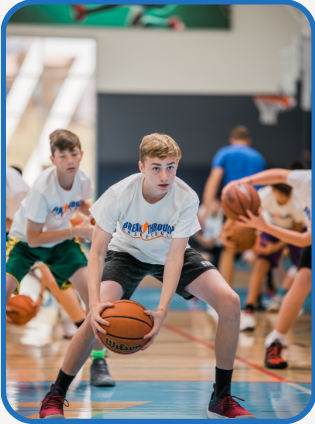
1v1 is one of the best ways to improve. That’s why it’s a key component of Breakthrough Basketball Camps.
At our camps, players receive world-class instruction in the skills of the game. They then get opportunities to apply those skills against other campers, providing instant feedback and accelerating improvement.
If you want to get on the development fast track, find a camp near you!
Gain the Edge to
Stand Out on the Court
Breakthrough Basketball Camps help players improve their skills and decision-making while building the confidence to shine on and off the court. Trusted by over 150,000 players nationwide, our camps provide:
-
Experienced coaches who know how to teach every level
-
Skill development in shooting, ball handling, and all-around play
-
Game-like situations that build confidence under pressure
-
A positive, motivating environment parents can feel good about
-
Beginner, Youth, and Advanced Camps - Ages 6 to 18
|
|||


 Facebook (145k Followers)
 YouTube (152k Subscribers)
 Twitter (33k Followers)
 Q&A Forum
 Podcasts