
Two Full Court End Of Game Plays For The Stretch Run
As the season winds down, everything takes on more significance.If your program is doing things right, the sense of urgency grows this time of year.
Every practice matters more. Every game matters more. And every possession matters more. Before long, you'll be in a survive and advance situation.
Your team must be prepared for the situations they'll face. With that in mind, consider adding these two complementary end of game plays to your playbook.
Why These End of Game Plays Work Great In Tandem
The great thing about these plays is that they start exactly the same. That serves a few purposes.
First, it makes it easier for your players to learn. The formations are identical. Only a couple things change.
Second, it makes it harder for your opponent. If you run Eagle 1 early in a game, you can catch your opponent sleeping with Eagle 2 later.
Third, each play has an option for both 2 and 3 point shots, depending on what your team needs.
These plays can be run in 8 to 12 seconds left at the end of a quarter or end of game situation.
Eagle 1 - DHO > Ball Screen > Flare
When you run these plays, it's important to have your players positioned correctly.
1 should be your point guard.
2 should be your best playmaker.
4 should be one of your best shooters.
5 should be your post or biggest player.
3 can be any type of player and is the spot for a non-scorer.
To start, 1 cuts to receive the ball on the run going up the left side of the floor.
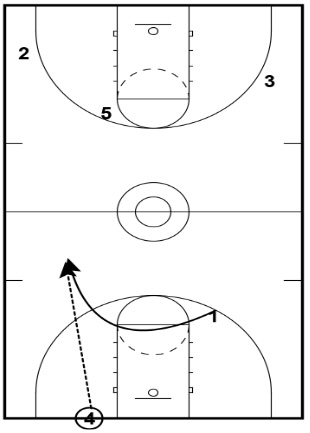
1 dribbles into a pitch or handoff with 2, who is blasting up out of the corner. 1 should try to dribble at 2's defender to open space.
5 comes right behind 1 and prepares to screen for 2
On the other side of the floor, 4 sprints up court and towards the opposite slot.
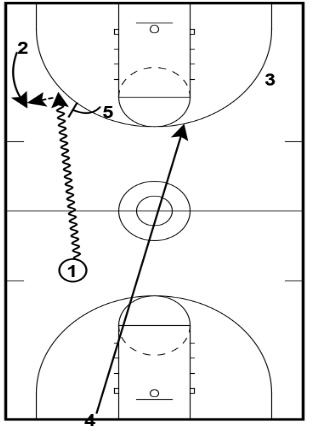
1 clears to the corner after making the pitch to 2.
After receiving the pitch, 2 comes off 5's ball screen. It's important 5 set the screen slightly angled towards the basket so 2's defender cannot go under the screen.
2's first look is to attack! They must be thinking score.
On the weak side, 3 sets a flare screen for 4. 4 will often be open as their defender will look to help on 2's drive. After the screen, 3 slips to the rim.
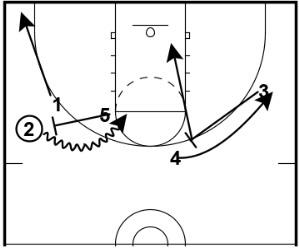
Here's where you have options:
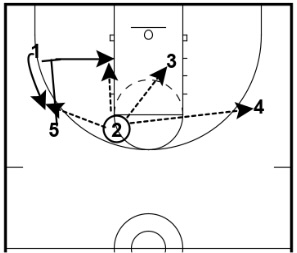
If you are looking for a two-point shot, have 5 roll after their ball screen. If their defender switches onto 2, you will likely have a mismatch you can exploit at the rim.
1 can then fill back up behind the roll. If their defender helps, they will be open for a three-pointer.
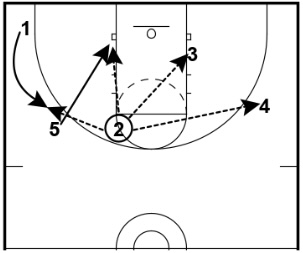
If you're looking for a 3, have 5 down screen for 1 after the ball screen. 1's defender is likely to relax after the handoff, leaving them vulnerable.
This action will often result in 1 being open for a wing 3.
Eagle 2 - Fake DHO > Flare
Eagle 2 starts exactly the same way as Eagle 1.
It is best run after you've run Eagle 1 or if your opponent has seen you run Eagle 1 on film.
If they are expecting Eagle 1, Eagle 2 is a great counter that also offers multiple scoring options.
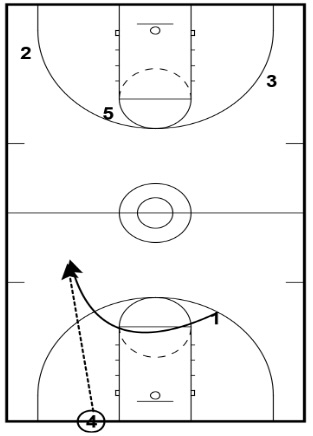
Just as in Eagle 1, 1 drives it hard towards 2, who is sprinting up out of the corner.
5 moves towards the wing to prepare for their screen.
However, instead of pitching it to 2, 1 fakes the pitch. It's important that 1 hesitate slightly. They may even execute a half spin to sell that they are flipping the ball.
After the fake, 1 accelerates towards the rim. The first option (if you don't need a three) is 1 scoring at the rim.
On the weak side, 3 again screens for 4. This time it's a hammer screen for 4 filling the opposite corner.
This is a great option for a 3. If 3's defender helps on 1's drive, there is no help when 3 screens 4's defender.
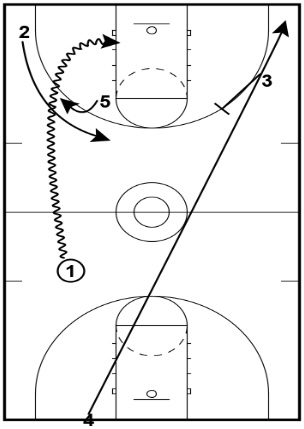
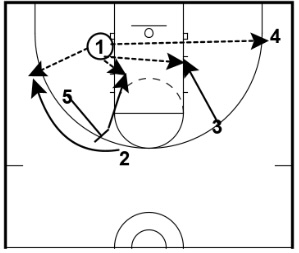
The last action in this play is a good one. 2 has already run past 5 after the fake pitch. Generally their defender relaxes.
2 slams on the brakes and comes back towards where they started. If 1 can't score or pass to 4 or 3, 1 can back pivot and look to 2 filling behind them for a three-pointer. After their screen, 5 dives to the rim.
Conclusion
Eagle 1 & 2 are great end of game plays.
Both make all 5 players scoring options.
Both make the defense guard multiple actions.
Both look similar.
Those three aspects optimize your chances of getting a good shot. And remember, the key to players executing last-second plays is practicing them and being confident they can execute them come game time.
Consider adding these to your playbook to give your team options when you need a late-game bucket!
What do you think? Let us know by leaving your comments, suggestions, and questions...
|
|||||



 Facebook (145k Followers)
 YouTube (152k Subscribers)
 Twitter (33k Followers)
 Q&A Forum
 Podcasts