
5 Zone Offense Concepts Every Coach Should Teach
Zone defenses give a lot of teams headaches. The ball gets stuck, players stand around, and eventually someone jacks up a contested three. But it doesn’t have to be that way.
In fact, zone offense is a great way to show your coaching bona fides. Against man to man, players with elite ball skills can cover for a lot of coaching shortcomings. Against a zone, your players need to understand effective zone offense concepts in order to thrive.
Yes, it’s important to have some plays ready when you face a zone defense. Those are great for a couple of possessions. But what do you fall back on after you’ve used your best sets?
Do you just “trim the hedges” and pass the ball around the perimeter without putting any pressure on the defense?
Not anymore! Check out these 5 zone offense tactics from championship coaches at the high school, college, and Olympic levels!
Zone Busters: 5 Smart Concepts For Every Team
1. Utilize the Core 4 Elements
As Coach Don Kelbick says, you need four ingredients in any zone possession: a strong side threat, a weak side threat, post presence, and ball reversal. When all four are active, the zone is constantly shifting—and that’s when mistakes happen. Without these, your offense gets predictable and easy to guard.
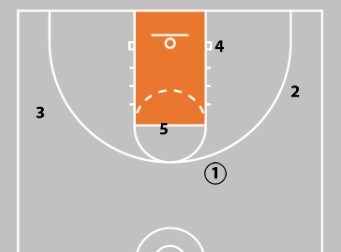
In this example, 2 is the strong-side threat. 4 is the post threat. 3 is the weak-side threat. 1 or 5 (if you popped them to the perimeter) could be reversal options.
Each element offers some flexibility. 2 could be in the corner. 5 could be on the perimeter.
There are multiple ways to fill the four spots. Just make sure you do so!
2. Use Ball Screens vs the Zone
Yes, you can screen a zone. In fact, you should. Set a ball screen and force defenders to make decisions. You’re looking to create gaps, distort the coverage, and get downhill into the kill zone or force a mismatch on the back side.
As 10x Gold Medalist Don Showalter points out, Screens don’t just work in man—they work in zone too when you set them with purpose.
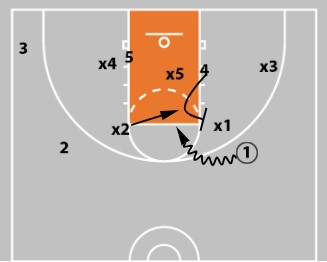
Unlike in man-to-man, zone defenses usually don’t have two players covering the ball screen. That means a defender has to move out of their zone to stop the player with the ball (x2 above).
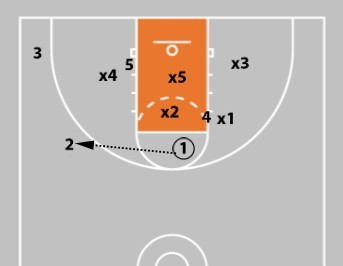
This creates an advantage in the area that the defender vacated. Here, one passes to 2. 2 should be open for a shot. If x4 steps up, 2 can make the extra pass to 3 in the corner (who would be the strong side threat in this example - see concept #1).
3. Screen and Seal Inside
You don’t need complex actions—just teach your bigs to seal defenders and screen the zone from the inside. A good seal can create a wide-open post feed or open up perimeter shooters.
As Matt Lewis points out, it’s especially effective when players learn to flash, seal, and reposition based on where the ball is moving.
Many teams play zone defense because they don’t feel like they can guard you inside. Don’t allow them to take that away.
A lot of zone plays look to screen and seal inside defenders. You should have plays that do that. More generally, coach your post players to look to seal on reversals. They can usually get good post position close to the rim.
4. Flash to Open Spots
This is motion offense 101: fill spots, stay active, and confuse the zone. That’s why Bob Martin can use a similar attack against man and zone with his Screening Game Offense.
Attack from the elbows, blocks, and short corners—then teach your players how to flash to the high post, dive to the baseline, and constantly move behind the zone. Players don’t need to memorize plays—they need to understand spacing and movement.
While this sounds obvious, it’s not. Many players who are positioned at the high post stand in one spot. They allow themselves to be denied. Players must find and move to open areas.
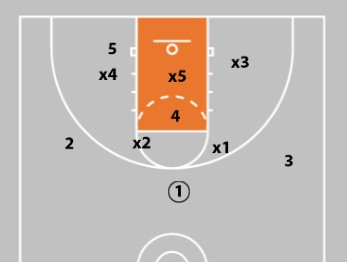
In the short corner, that might even be behind the backboard. Staying behind the zone taxes the backline defenders who can’t see all five offensive players (see player 5 above)
5. Beat Traps Through the Middle
Zone traps are designed to disrupt your rhythm—not just steal the ball. The best way to beat them? Use the middle of the floor. Flash a player to the high post as your ball reversal option, then kick opposite. Maintain your spacing, don’t panic, and keep flowing into your offense. The trap will collapse if your players keep their discipline.
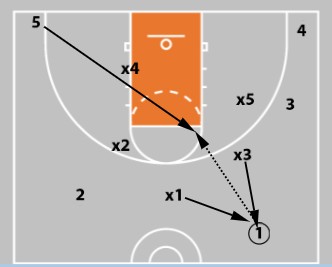
Don Kelbick often has a post player flash middle when they see a teammate being trapped. It’s up to you where you want the player to flash from. What’s critical is that players know to get middle and look middle when traps are coming.
Unlock Your Zone O With Simple & Straightforward Strategies
Effective zone offense isn’t based on intricate plays or offenses. It’s based on the repeated execution of the five concepts above.
It’s one thing for you to know and understand them. What separates the best teams and coaches is that they have players who understand them.
Use them as a checklist for your zone offense, and you’ll have teams begging to guard you man-to-man!
For more zone offense tactics that work against any zone, check out The Complete Zone Offense Blueprint with Ryan Schultz.
|
|||


 Facebook (145k Followers)
 YouTube (152k Subscribers)
 Twitter (33k Followers)
 Q&A Forum
 Podcasts