
How To Overcome The 1 Court, 2 Team Practice Problem
I recently planned a practice for my daughter’s 4th grade basketball team. I felt really good about it. It had a good mix of drills and games, meant to cover a variety of skills.
I was excited... until I walked into the gym. Unbeknownst to me, we were splitting the gym with another youth team.
At that moment, my practice plan went up in smoke. We had half a court and one hoop for 10 girls. Not ideal, to say the least.
I’m sure many of you can relate. Gym time is hard to come by. As a result, teams often have to share a court. Whether you are aware of this in advance or not, it presents a challenge.
Basketball is a full court game. Solely practicing in the half court does your team a disservice.
So what should you do? Throw in the towel? Nope - adapt and overcome! While you may not choose this situation, don’t let it deter you.
Here are some tips & tactics that Coach Jim Huber uses within Jim Huber Beginner Basketball Ages 5-9.
3 Ways To “Play Full Court” In The Half Court
-
Use cones to create transition - most half court scrimmages involve checking the ball up after each possession. Even a fast paced game like FIBA 3v3 generally creates half court situations.
Get around that by putting cones at half court that players have to run around. A great example is this 2v1 Fast Break drill.
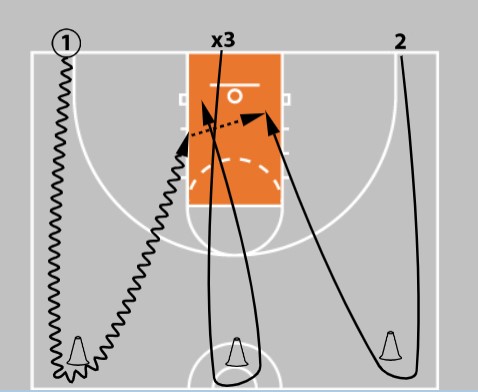
Circling around the cones creates a transition opportunity.
There are several ways to do this. You could make every player circle like in this drill. You could make the shooter circle to create a temporary 5v4.
-
Use the “penalty box” - the penalty box is a fun way to build good habits and create transition situations.
Before a scrimmage segment, give players a couple of “Musts” for that segment. These could be cutting after a pass or squaring up on every catch.
If they don’t do it, it’s a turnover. They must put the ball down. Then, they have to sit out for :05-:10 in the “penalty box.” This creates a temporary advantage for the offense. They must look to keep the advantage.
The defense must look to slow them down until the 5th player gets back in.
-
Play “get away” - get away drills do a good job of simulating transition situations. In the diagram below, you see 3v3 Get Away. On your “go,” the offense must sprint and touch half court while the defense touches the baseline. From there, it’s live.
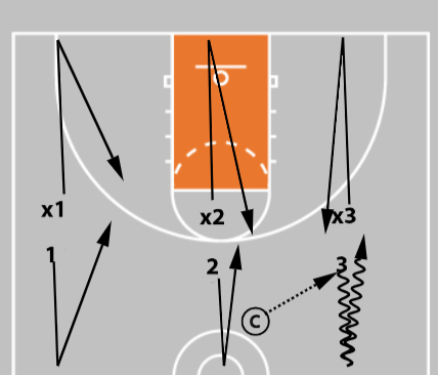
The offense can attack with speed, while the defense must sprint to match up and contain the ball.
If you did this 5v5, you might say that on every change of possession, all five offensive players must touch half court while all five defensive players must touch the baseline.
To increase the challenge and make it more transition-like, you could also say that the defensive players cannot guard the player who was guarding them.
This requires the defense to scramble and communicate.
Is It An Obstacle Or An Opportunity?
Sharing a gym is not the practice situation anyone would choose. However, it doesn't prevent you from having a great practice.
In fact, your players might enjoy being challenged by some different types of drills that simulate full court play.
And by having a ‘can do’ attitude rather than falling into the trap of complaining, you’ll be modeling exactly the type of mindset you want from your team!
For more ways to maximize your youth team’s improvement, be sure to check out our Youth Coaching Products. For those coaching those new to the game, check out Jim Huber Beginner Basketball Ages 5-9! And if you’re coaching those 9-14, check out The Youth Coaching System below.
Want to Make Youth Practices More
Fun and WIN MORE GAMES
Coach Huber's Youth Coaching System gives you all the tried and true practice plans, drills, skills and concepts you'll ever need. Inside you'll get:
-
64 Interactive Practice Plans for all levels of youth basketball
-
Exactly What to Teach - Offense, Zone Offense, Defense, Press Breakers, Out of Bounds
-
Age-Apropriate Skill Development - for ages 9-14
-
Drill Progressions From Beginner to Advanced
-
Step-By-Step Instructions

|
|||


 Facebook (145k Followers)
 YouTube (152k Subscribers)
 Twitter (33k Followers)
 Q&A Forum
 Podcasts