

The Silent (But Deadly) Message Your Workouts Are Sending About Defense (& How To Correct It)
Let’s perform a thought exercise:
I want you to think about the skill work you do with your team. This could be in-season or offseason, individual or small-group. Better yet, look back through your written workout plans.
Then, ask yourself this question: during those skill workouts, what percentage of your coaching was focused on defense?
If you’re like me, I’m guessing it’s a pretty small number.
With the start of this offseason, I’ve been thinking about things I can do better to help my players improve. And I keep coming back to this realization.
Am I hurting my players (and my team) by focusing so much on offense? I’m starting to think I am.
You might be doing the same thing. Read on to find out why.
Well-Intentioned but Misguided: The Offense-First Coaching Trap
Offense is hard. In fact, I would argue it’s much harder to become a good offensive player than it is to become a good defensive player.
If that’s the case, am I justified in spending the overwhelming majority of my skill development time on offense?
No! And here are two reasons why:
-
It is indeed harder to become a really good offensive player than it is to become a really good scorer.
But what if that’s actually a reason to put more emphasis on defense? What if we could make a bigger impact by focusing more of our instruction on areas where players can improve more quickly?
-
Players pay attention to what you emphasize.
If all they hear you coaching is offense, what will they think is important to you?
If Teaching Defense Feels Boring, You’re Teaching It Wrong
One of the main arguments I hear against focusing on defensive development in offseason workouts is that it’s not fun.
The logic goes something like this: “If players aren’t having fun, they won’t want to go to the gym. Offense is more fun than defense. Thus, it makes sense to focus on offensive development to keep players coming back for more.”
If we were talking about doing defensive slides, wall sits, and drills on taking a charge, I would agree.
However, if that’s how you’re teaching defense, I’d argue you’re going about it the wrong way.
The most effective way to teach defense is to play defense. And how do you do that? By competing, specifically by using small-sided games. Coaching defense within that setting is the best way to develop defensive skill and decision-making.
Even better, those small-sided games also work on your offense, since you’ll always have someone trying to score.
3 Small-Sided Drills That Build Defensive Skills (If You Emphasize Them)
Let’s look at 3 small-sided games that are often used for offensive skill development through the lens of defensive skill development.
1. BU Closeout from The Outer Third Defense With Nick LoGalbo
In this drill, players play 3 consecutive possessions of 1v1 defense. Players are often coached in how to attack closeouts. This drill teaches your defenders how to close out under control and direct the ball where you want it to go.
-
Each possession starts from a closeout. In the example below, 1 rolls the ball out to 4 and tries to stop them from scoring. 1 would then repeat that against player 3 and player 2.
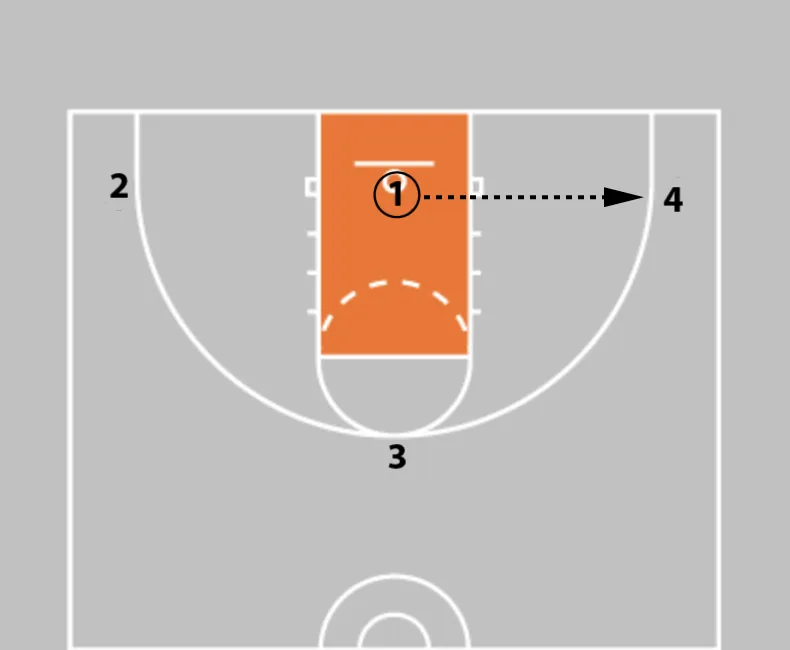
To get out of the drill, 1 must get at least 2 stops.
-
When performing the drill, emphasize your closeout rules. Coach LoGalbo emphasizes keeping the ball on one side of the floor. You could even give bonus points to a player who does not allow the ball to be driven middle.
On a shot, the defender must box out and pursue the rebound. This is often overlooked. Many defenders contest, but then do not box out, allowing the shooter to rebound their own shot.
2. 2v1 Shooting from How To Run Championship Practices With Nate Steege
2v1 shooting is a common drill used by coaches to work on the shot or pass decision. However, it’s also a great way to work on defensive disadvantage situations.
-
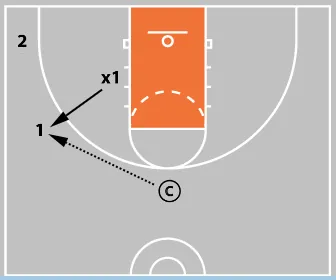
The coach starts by passing to an offensive player. The defender starts on the block and can move on the pass.
-
If the shooter is open, they should shoot. If not, they can pass to the corner for a shot. In many cases, the offense is not allowed to move or dribble, and is limited to one pass.
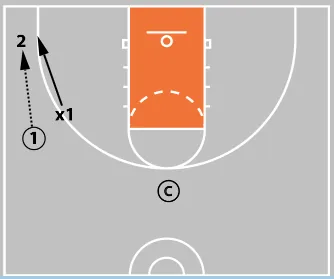
Defensively, this drill simulates a situation in which a defender must temporarily guard two people. This often happens in transition or in rotation.
In that situation, the defender’s job is to create indecision and buy time for their teammates to get back in the play.
Within the context of this drill, that means muddying up the offense’s decision-making. If the defender runs directly at the person catching the first pass, they have an easy decision - throw it to their teammate in the corner.
If the defender does not close out on the first pass and runs towards the teammate in the corner, it’s also an easy decision - shoot!
Thus, teach your players to “cat-and-mouse” the two offensive players by faking and stunting. This prevents the offense from having an obvious choice.
Even better is closing out close to the shooter, but slightly in the passing lane. That makes the player with the ball uncomfortable when shooting and makes passing difficult.
If your players can learn to guard two people effectively, you will be better prepared to negate offensive advantages and get back to neutral.
3. Hip Pocket 1v1 from The Breakthrough Basketball Shooting & Scoring System
Hip Pocket 1v1 is a great drill to work on finishing when the offense gets the defender on their side. It challenges the offensive player to maintain their advantage and score.
But it’s also a great drill to work on competing and defending when at a disadvantage.
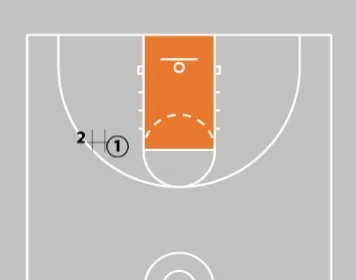
The offense (player 2) and defense (player 1) start facing each other.
-
The defender holds the ball out in front of them.
-
When the offensive player grabs the ball, it’s live.
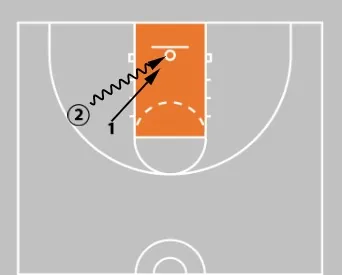
We would love to think our defenders will never get beat. However, that’s not reality. This drill is a great way to teach players how to get back into the play when they are beaten.
-
As 2 starts their drive, 1’s first goal should be to cut them off. Teach them to use a crossover step (ignoring the “don’t cross your feet” advice) to move faster.
If they can get their chest back in front of the offensive player, they’ve gotten the situation back to neutral and are in a great position to get a stop.
That said, there will be times when the defender cannot get all the way in front. In those situations, teach your defender to contest from the side without fouling. This means they must maintain their verticality and reach for the lights with their hands.
As soon as the ball is shot, they must box out and pursue the rebound.
Now look back at those 3 drills. If you use them as part of your skill development plan, your offense should get better. That’s great. But that’s only half the game.
If you go one step further and also emphasize the defender’s role, you’ll get players who:
-
Close out under control and can guard 1v1 situations.
-
Players who can buy time for their teammates by guarding multiple players when at a disadvantage
-
Players who can recover from a disadvantaged 1v1 position to get a stop.
Same drill, but twice the benefits if you teach it with an intentional 2-way focus!
Conclusion - 2 Way Coaching = 2 Way Players
The best coaches have one thing in common:
-
They can coach both sides of the ball simultaneously.
Yes, offense matters. But so does defense. So, as you plan your workouts, make sure they are developing well-rounded players.
Because well-rounded players make for well-rounded teams. And well-rounded teams are winning teams!
If you want to build defenders who can guard the ball, protect the paint, and think the game at a high level, you need more than random defensive drills.
Nick LoGalbo’sOuter Third Defense gives you a complete system for developing elite individual and team defenders. His drills are competitive, game-like, and designed to teach positioning, communication, closeouts, rotations, and how to control space, not just survive it. By teaching his system, you will improve offensively and defensively!
The result? Tougher on-ball defenders. Smarter help defenders. A team that understands how to shrink the floor and dictate action.
If you’re ready to stop treating defense as an afterthought and start building a connected, disciplined defensive unit, take a closer look at the Outer Third Defense system here and see how it can transform the way your team guards.
|
|||


 Facebook (145k Followers)
 YouTube (152k Subscribers)
 Twitter (33k Followers)
 Q&A Forum
 Podcasts