
3 Fun Youth Basketball Games That Build Skills (Without Losing the Fun)
A few years ago, I heard a stat that stopped me in my tracks:
70% of kids quit sports by age 13.
And the number one reason?
“It’s not fun anymore.”
If you’ve coached youth basketball long enough, you’ve probably seen it.
Players who used to sprint into the gym now walk in with their hood up.
Kids go through drills with zero energy.
Some even stop showing up altogether.
And here’s the tricky part:
Most kids don’t quit because of games. They quit because of practices.
That’s why great youth coaches make development fun. Not silly. Not chaotic.
Fun with purpose.
And that’s exactly what these three drills from renowned youth coach Jim Huber and Wisconsin State Champion coach Dave Leisto accomplish. They keep kids smiling, laughing, and competing—while secretly teaching them high-level skills like finishing, ball-handling, agility, spacing, and decision-making.
Below are three fun games you can plug into your next practice to keep kids engaged AND developing.
1. Rock-Paper-Scissors Finishing Game
Kids already love rock-paper-scissors… so why not use that to teach basketball skills?
How it works
-
Two players face each other with a basketball on the floor.
-
They play one round of rock-paper-scissors.
-
The winner becomes the offensive player.
-
They grab the ball, “rip” into a triple-threat position, and attack the rim.
-
The loser instantly becomes the defender and tries to recover.
What kids learn
-
Ripping the ball low and strong
-
Accelerating into the first step
-
Finishing at the rim at game speed
-
Defensive recovery and effort
Quick reactions and competitiveness
Why it works
It turns a skill-building moment into a game. Kids forget they’re drilling finishing—they’re too busy trying to WIN rock-paper-scissors and score.
Coaching Tip: Add variations like finishing with the weak hand only, or placing the defender in a disadvantage position to create chase-down pressure.
2. Crossy Road Game (a.k.a. Frogger)
If you grew up in the 80s or 90s, you’ll appreciate this one—and your players will love it.
How it works
-
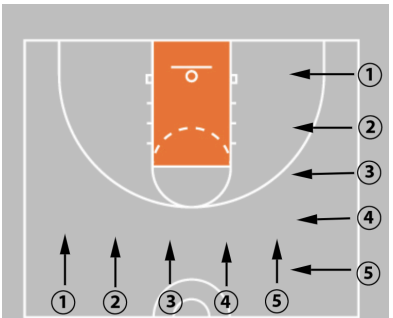
Players start on opposite baselines.
-
Everyone moves in a straight line toward the other side.
-
They must avoid crashing into anyone.
-
Every successful trip across = 1 point.
-
If they bump another player, the point doesn’t count.
-
Round one: no basketball
Round two: dribbling with a basketball
What kids learn
-
Spatial awareness
-
Change-of-speed (“playing with a wiggle”)
-
Body control
-
Decision-making (stop, go, slow, fast)
Ball-handling on the move
Why it works
Players need to adjust their speed, read traffic, and anticipate movement—exactly what happens in real games when navigating crowded lanes or transition situations.
Pro Tip: Reduce the space each round to increase the challenge and force more problem-solving.
3. Partner Dribble Tag
Ask any group of kids what their favorite recess game is, tag always makes the list. Dribble Tag takes that joy and blends it with real basketball development.
How it works
-
Players pair up: one is “it,” one is escaping.
-
Both must dribble the entire time—no running with the ball.
-
When “it” tags their partner, they switch roles.
-
After 30–45 seconds, players count how many tags happened.
You can play strong hand, weak hand, or both.
What kids learn
-
Change-of-direction
-
Change-of-speed
-
Protecting the ball
-
Eyes up while dribbling (so they don’t run into someone)
Agility, balance, and body control
Why it works
It builds dribbling habits without kids even realizing they’re working. It also adds competitiveness, which increases engagement and effort.
Pro Tip: Add constraints like “weak hand only” or “no crossovers” to add challenge.
Why These Games Work (And Why Kids Need Them)
Fun is not the enemy of development. For youth basketball, fun is the path to development.
These drills:
-
Build essential skills
-
Keep players moving
-
Encourage creativity and problem-solving
-
Reduce standing around
-
Build competitiveness in a healthy way
Help kids fall in love with the game
And most importantly… They keep kids coming back.
If you can make practice the best part of their day, they’ll stay longer, try harder, and develop faster.
Want More Fun, Skill-Building Games?
If you coach those new to the game, check out our Jim Huber Beginner Basketball Ages 5-9 — 48 plug-and-play practices that keep every kid active and engaged.
If you coach ages 9–14, The Youth Coaching System with Jim Huber gives you 64 practices, skill progressions, defensive systems, and more.
And for even deeper skill development, check out Youth CLA Drills With Dave Lepisto, teaching players how to solve problems and build true game IQ.
Let’s keep kids smiling, competing, and improving — one fun game at a time.
|
|||


 Facebook (145k Followers)
 YouTube (152k Subscribers)
 Twitter (33k Followers)
 Q&A Forum
 Podcasts