
Motion Offense Without the Chaos: How A National Champ Keeps Freedom from Becoming Freelancing
One of the biggest objections coaches have to running motion offense is this:
-
“It gives players too much freedom.”
And they’re not wrong.
Motion creates spacing. Motion creates reads. Motion creates opportunities.
That’s the strength of motion offense. But as the saying goes, your greatest strength is also your greatest weakness.
That freedom can also create:
-
Indecision
Bad shots
-
Players doing what they want instead of what the team needs
If you’ve ever watched your team take three quick, contested shots in a row and thought, “This is not what we practiced…”, you understand the concern.
The good news?
Freedom doesn’t have to mean chaos.
Division III National Champion Head Coach Matt Lewis (formerly of University of Wisconsin–Oshkosh) has built a championship-level motion offense that gives players freedom while keeping them aligned and disciplined.
Two of the smartest tools he uses inside his Linked Up Motion Offense are:
-
The Motion Menu
-
The Shot Scale
These two concepts keep players doing the right things inside motion.
The Motion Menu: Clarity Within Freedom
Motion gives players a million options.
That’s both the beauty and the danger.
As Coach Lewis explains, the issue isn’t motion itself. The issue is:
Too many options
Not knowing what to focus on
Players trying to do everything
So instead of telling players, “Just play,” he gives each player a Motion Menu.
What Is a Motion Menu?
A Motion Menu is a short, individualized list of the specific actions a player should hunt inside the offense.
Not 12 things.
Not everything they can do.
Just what they should focus on.
For example:
For one player:
Drive right and attack the rim
Catch-and-shoot 3s
That’s it.
Another player might have:
Post seals
Short corner jumpers
Offensive rebounds
Your best player might have five or six options.
Your role player might have two.
The key: The menu fits the player. Here are a couple of examples from Wisconsin-Oshkosh.
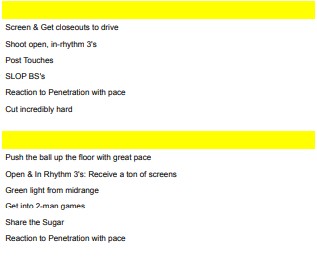
Why This Works
Instead of overwhelming players with unlimited reads, you:
Simplify their decision-making
Play to their strengths
Increase efficiency
Build confidence
Players aren’t thinking, “What should I do?”
They’re thinking, “Is this on my menu?”
That clarity eliminates hesitation and bad freelancing. It also ensures players play to their strengths.
The Team Component (This Is Critical)
Coach Lewis doesn’t just give players individual menus.
He compiles them into one document and presents them to the entire team.
Why?
Because motion requires five players working together.
If one player knows his menu but his teammates don’t, it doesn’t work as well.
When everyone understands:
What each teammate is hunting
Where their strengths are
-
What shots are good for whom?
You get rhythm, chemistry, and unselfish basketball.
That’s structure inside freedom.
The Shot Scale: Eliminating Bad Shots in Motion
The second fear coaches have with motion:
-
“We’ll take too many bad shots.”
Coach Lewis attacks that head-on with what he calls a Shot Scale (or what he calls the “Duck Meter”).
Instead of judging shots only by makes and misses, he grades the quality of each attempt. In other words, a shot is a good or bad shot when it leaves the shooter’s hand.
Because here’s the truth:
You can miss a great shot. You can make a terrible shot.
Makes and misses alone don’t tell the whole story.
How the Shot Scale Works
At Oshkosh, they’ve used two systems:
Option 1: A-B-C-D Grading
A = Great shot
B = Good shot
C = Marginal shot
D = Poor shot
Track them. Average them. Evaluate them.
Option 2: 0–10 Visual Scale
0 = Turnover (worst possible outcome)
10 = Best possible shot (wide-open rhythm three, dunk, uncontested angle score)
Then they color-code it:
-
7–10 = Green (Great Shots)
-
4–6 = Orange (Marginal)
-
0–3 = Red (Bad Shots)
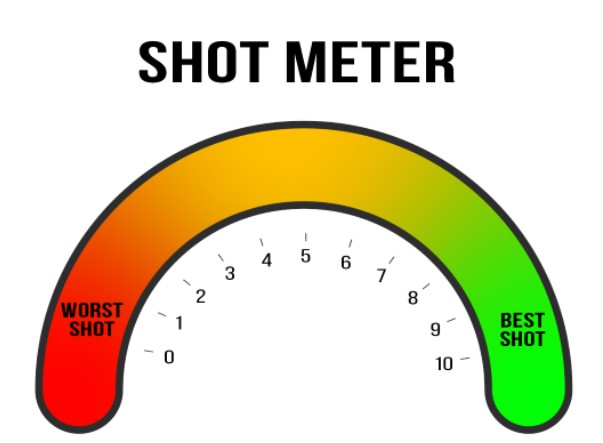
In film or practice, they’ll literally point and ask:
-
“Where does that shot fall?”
Players learn to evaluate their own decisions. Doing it in front of the team creates accountability.
That’s powerful.
The Key: Shot Quality Is Personnel-Based
An “8” for your best scorer might be a “3” for your role player. This illustrates how the motion menus tie into the shot quality score.
This reinforces:
Self-awareness
Role acceptance
Team-first mentality
Players begin to understand:
Who should take which shots
What we’re hunting as a team
What winning offense actually looks like
Instead of yelling “That’s a bad shot!” you now have a shared language.
“Let’s hunt green shots.”
Much more effective.
Why These Two Concepts Change Motion Offense
Motion fails when:
Players don’t know their strengths
Teammates don’t understand roles
Shot selection isn’t defined
Motion thrives when:
Roles are clear
Strengths are emphasized
Shot quality is measured
The Motion Menu controls who does what.
The Shot Scale controls which shots get taken.
Together, they give you:
Freedom without freelancing
Player empowerment without chaos
Structure without rigid play-calling
That’s how Coach Matt Lewis won a Division III National Championship running motion.
Want to See the Entire System?
Coach Matt Lewis breaks down the full Linked Up Motion Offense — including the Motion Menu, Shot Scale, spacing rules, teaching progressions, and practice integration — in his complete system.
If you love the freedom of motion but want more clarity, structure, and smarter shot selection, this is worth a look:
It’s motion done the right way.
|
|||||



 Facebook (145k Followers)
 YouTube (152k Subscribers)
 Twitter (33k Followers)
 Q&A Forum
 Podcasts