

The High Powered Dribble Drive Motion Offense
Unless you've been hiding under a rock, you've probably heard about the high powered Dribble Drive Offense that has been used successfully by teams at all levels of basketball!!
So what's the scoop on this basketball offense?
In all honesty, it's just a fashionable new name for something that has been played for years. So don't go jumping on the band wagon (just yet)...
With that said, the Dribble Drive is a POWERFUL offense and you can probably learn something from it. But you need to understand what it's really all about.

Where did it come from?
The nexus of the fascination has been the enormous success of John Calipari's University of Memphis team. Coach "Cal" is one of
the most innovative coaches I have ever met and this offense fits his personnel like a
glove. Vance Walberg, former Head Coach at Pepperdine and a speaker very much in demand
is also an innovator and has brought this style back to the forefront of basketball
thinkers. Though not credited, Jay Wright of Villanova used many of these concepts to
take his four guard one post offense to great success in the Big East and the NCAA
Tournament. The "Dribble-Drive" term hadn't been coined yet but Wright surely should
be considered one of the innovators as well.
The roots of the Dribble-Drive Motion go back to the roots of the motion offense itself.
Dean Smith, former coach at North Carolina, used the drive and kick aspect of his "passing
game" with great success. It did not get great notoriety at the time because Smith coached
much of his career without the 3-point shot. Rick Pitino used many of the concepts,
beginning at Providence College with point guard Billy Donovan, and was at the forefront
of effective use of the 3-point shot in college basketball. Pitino brought to his great
Kentucky teams and while he doesn't use this motion at Louisville, he still incorporates
many of the same concepts.
Just as an observation, both Coach Pitino and Coach Calipari used the 3-point shot to
much greater effectiveness upon returning to the college game after years in the NBA.
The NBA used the 3-point shot for several years before it was added to the college game.
I think that their NBA experience sent them ahead of the pack in regard to using the 3
and the rest of us are still trying to catch up.
What is the Dribble Drive Motion Offense?
The Dribble-Drive Motion is first and foremost a motion offense, complete with its own discipline, rules and philosophy. The basic philosophy is the ball handler tries to push the ball for a layup. If there is no help he continues for a layup. If there is help, he finds the open man for either a shot if on the perimeter or a dump-off to the post. Driving lanes are created by great spacing and constant hunting of open areas for kick-outs.
9 Benefits Of The Dribble Drive Offense?
The dribble drive offense can be a game-changer for your basketball team, especially at the middle school and high school levels. Here are some reasons why you might want to consider running it:
Creates Driving Lanes: The dribble drive offense spreads the floor, which opens up lanes for players to attack the basket. With good ball movement and spacing, players can break down defenders one-on-one and get easy scoring opportunities.
Maximizes Athleticism: If you have players who are quick, explosive, and good at driving to the hoop, the dribble drive offense is a perfect fit. It allows them to use their strengths, like speed and agility, to create scoring chances.
High-Percentage Shots: By focusing on driving to the basket, your players are more likely to take higher-percentage shots (like layups or close-range shots). This reduces the chances of settling for contested jumpers or outside shots.
Improves Decision-Making: This offense teaches players to read the defense and make quick decisions. Whether it's kicking out to an open shooter, dishing it to a teammate for a layup, or finishing at the rim themselves, players develop the ability to recognize and exploit defensive mistakes.
Creates Opportunities for Shooters: While the main focus is on driving, the spacing the offense creates can lead to wide-open three-point shots. When defenders collapse to stop the drive, shooters on the wings will often find themselves with clean looks at the basket.
Versatility: You don’t need a traditional big man to run the dribble drive offense. It works well with teams that have multiple guards and forwards who can handle the ball, as it allows everyone to contribute in different ways.
Increases Defensive Pressure: When your players are constantly attacking the basket, it forces the opposing defense to work harder. They’ll have to make quick rotations, and players who can finish or draw fouls will keep the defense on its heels.
Builds Team Chemistry: Because the offense often involves quick passes, good movement off the ball, and shared responsibility, players learn to work together more effectively. This helps foster better communication and teamwork.
Adaptable: The dribble drive offense can be tweaked to fit the strengths and weaknesses of your team. Whether you have a dominant ball handler, a sharp shooter, or an athletic post player, you can adjust the system to highlight what your players do best.
If you have a group of players who are hungry to drive hard to the basket and create chaos for the opposing defense, the dribble drive offense might be just the strategy you need!

Personnel Needs
The Dribble-Drive is not for everyone. You need to have very specialized personnel. You need to drill the reads and actions. You can do this in many different ways.
Your perimeter players must be equally adept at taking the ball to the basket and shooting from beyond the 3-point line. Your post players have to be comfortable catching the ball on the move. If he can shoot the ball a little, that will make you better. If he can put the ball on the floor, you'll have the whole package.
Athletic ability helps, as it does in most aspects of basketball. However, you can run variations of the dribble drive with different types of players. The Dribble Drive produces a lot of rebounds. If you are able to control the offensive glass, it is difficult for opponents to recover. You also have to be in great shape. The Dribble Drive, because of its aggressiveness tends to wear down its opponents, leading to great shots.
The offense can start from any set. The one requirement is that the middle be open. If you are going to have a post player, he should be off the block, opposite the ball handler and my preference is to put him on the baseline.
It’s also a great offense for youth players, too!
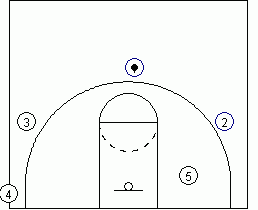
Here are some sample sets.....
 |
 |
 |
 |
Below are some sample actions in the Dribble-Drive Motion. These are just examples. They are not meant to be the only actions of the offense. In fact, you might not like any of the actions. As with any motion offense, the only limitation is your imagination. You can initiate the offense in many different ways. If you are a coach who likes to control movement, this is not the offense for you.
For this offense to be effective, it has to be free-wheeling and active. Encourage your players to let go.
Here are some of the basic rules of the Dribble-Drive Motion. Some of the rules are notated in the diagrams. Remember, different coaches have different rules. It doesn't make them wrong and doesn't make it a different offense; it just makes them different than this one.
Perimeter Player Rules
-
Player with the ball first tries to penetrate, on the dribble. First choice is a layup.
- Perimeter players step to openings, beyond the 3-point line, making passing angles and preparing for shot.
- If penetrator meets defensive help, he kicks to the open man on the perimeter for a shot. If help comes from the post, he looks to dump to the post.
- After passing, penetrator cuts out of the middle to an open spot beyond the 3 point line.
- Player who receives the pass, if he has no shot, will attempt to dribble penetrate and repeats the process. He can also pass to reverse the ball and cut through the middle to clear it out for the next ball handler.
- All cutters vacate the middle as soon as possible and find a spot beyond the 3-point line.
- If player can't dribble penetrate take ball to middle for spacing
- Ball goes to high post, open-side wing cuts backdoor. All players bump up to maintain spacing.
- If the ball is dribbled at you, either go backdoor or take dribble handoff.
Post Player Rules
- Post player set opposite the ball, off the lane.
- Post player can ball screen on the open wing or high.
- Post player looks to pop or roll after setting ball screen.
- If ball stalls on top, weakside forward posts to the top.
Options off a 1-2-2 Set

4,5 - Front Court
All players can shoot and are comfortable putting the ball on the floor.

1 penetrates and looks to score
3 creates passing angle to the top

3 looks for shot

1 cuts to the right
3 dribble penetrates and looks to score
2 creates passing angle to the top.

3 clears to the left side

2 dribble penetrates looking to score
3 creates passing angle to the top
1 spots up for shot
4 & 5 step in
2 can shoot, kick to 1 or 3, or dump off to 4 or 5

1 dribble penetrates looking to score (following the rules)
3 spots up and creates passing angle back (following the rule)
1 kick to 3

1 clears to the side (following the rule)
3 dribble to middle (following the rule)

5 posts to the top (following the rule)
3 passes to 5

2 goes backdoor (following the rule)
3 cuts to open wing (following the rule)
1 fills spot for 3 (following the rule)
5 looks backdoor to 2, kicks to 3 for shot
5 kicks to 1 for shot.
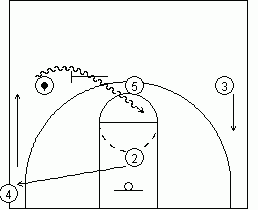
2 clears to corner
4 bumps ups
1 dribbles off screen looking to penetrate
3 spots up


5 bumps up
4 bumps up
3 dribble penetrates and looks to score.
3 can kick to any of the perimeter players.
Options off a 2-2-1 Set

3,4 Forwards
5 Post

1 dribbles at 2
2 goes backdoor (following the rule)
1 passes to 2 for layup.

2 clears to open side (following the rule)
3 spots up (following the rule)
4 spots up (following the rule)
1 dribble penetrates looking to score
1 shoots or kicks to 3 or 4, or dumps to 5

1 clears to open side (following the rule)

1 spots up
3 spots up
4 can shoot, kick to 1, 2 or 3 or dump to 5

4 dribbles at 3
3 goes backdoor (following the rule)
4 passes to 3 for score


3 clears to side
1 bumps up
4 tries to dribble penetrate
2 spots up
5 ducks in
4 looks to score, kick to 2 or dumps to 5

4 continues his dribble and dribbles at 2
2 cuts at 4 and takes handoff (following the rule)

2 looks to score, kick to the perimeter or dumps to 5.
Dribble Drive Motion in Transition

1 handles the ball on the side
2 runs right lane
3 runs left lane
4 (first post) run middle, opposite the ball
5 (trailer) runs behind, opposite the ball

4 runs to the baseline, outside the lane
1 dribbles up the floor
5 trails opposite

1 can kick to 2 or 3 or dump to 4 for shots.
Rotation now runs as if it were a half court Dribble-Drive Motion.

1 "head-mans" to 2
1 cut through and comes out opposite
5 fills for 1 (following the rule)
3 bumps up for 5 (following the rule).

2 can kick to 1 or 3 or dump to 4
5 spots behind ball
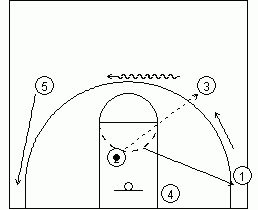
If no shot, 3 dribble middle for spacing
1 bumps up for 3
2 comes out and replaces 1
5 spaces

4 cuts opposite the ball (following the rule)

1 can kick to 5 or 3 for shot or dump to 4.
2 spots behind.
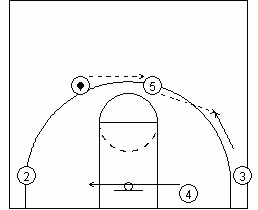
1 passes to 5
3 pops to wing
4 cuts opposite the ball (following the rule)

1 spots to wing
5 spaces out

3 can shoot, kick to 1, 2, 5 for shot or dump to 4.
Offense then proceeds as if it was a half court set.
I hope this gives you a little insight into the dribble drive motion offense. This is not the be-all and end-all thesis on the offense, just my experience with it. A dribble drive offense is constantly changing and evolving entity. The more you play it, the more you will see. The only limitation is your imagination and the imagination of your players. Teach the concepts with small sided game type drills (penetration and kick, spot up, space the court), don't teach the offense and your team will handle every adjustment made against you.
If you’re looking to incorporate dribble drive concepts into your offense, check out The Hybrid Attack Offense With Ryan Schultz. The Hybrid Attack Offense merges 2 proven systems - Dribble Drive & Motion - seamlessly into 1 offense. Beyond being hard to guard, it is an excellent offense for player development. Players are taught how to play with & without the ball, making them well-rounded players.
What do you think? Let us know by leaving your comments, suggestions, and questions...
|
||||||||||||||||||||||||||||||||||||||||||||||||||||||||||||||||||||||||||||||||||||||||||||||||||||



 Facebook (145k Followers)
 YouTube (152k Subscribers)
 Twitter (33k Followers)
 Q&A Forum
 Podcasts