
Subscribe for FREE and Get 3 eBooks…
Just for subscribing to our free newsletter you’ll get these 3 eBooks for free…
-
72 Basketball Drills & Coaching Tips – 136 page eBook.
-
21 Basketball Tips & Tricks for Players – 20 page eBook.
-
32 Winning Basketball Plays – 96 page eBook.
Plus you’ll get ALL updates to this website delivered to your inbox for free. Over 100,000 other coaches, players, & parents have already subscribed.
We will never send you spam or share your email address, guaranteed!
Close
3 Simple Strategies to Attack a Zone Defense
Want to score more points against zone defense? Here are 3 really simple yet effective strategies that every coach should consider.
These strategies work against all types of zone defenses and will help you score more points...
Strategy #1 - Put Your Best Ballhandler in the Middle (Even if They're 4 Foot Nothing)
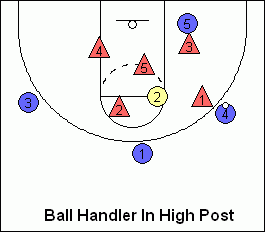
I picked up this strategy from Danny Miles who is #4 with most wins in college
history (900) and the head coach of Oregon Tech.
It's very common for teams to put their big man at the free throw line in the middle of the zone offense. Instead, he urges you to put your best
ball-handler and creator there. It's doesn't matter if they're 5'2".
Big players usually aren't as good at catching and handling a ball in traffic. But if you put one of your best ball handlers in the high post area,
they will be able to drive around the bigger defensive players. They can score, dish, and cause lots of problems for the defense. This especially
causes match up problems for the defense because they always put the biggest clumsier players in the middle of the zone defense. They will not be able
stop your quick guards.
Coaches should take a real good look at just putting one of their taller kids in the middle - because usually those kids don't pass or shoot it very
well and you don't attack as well with that kind of kid.
Strategy #2 - Attack from Behind the Zone
|
One of the best ways to attack from behind the zone it to always have at least one player in the short corner area.
You'll find that on almost every ball reversal the player in the short corner will be open. Then the wing can pass down to the open player in the short
corner.
Once the ball is there, this is a very tough place to guard because at the moment none of the defenders are looking at the short corner player (because
he or she is "behind" the zone).
| |

|
Once the ball is caught in the short corner you have several excellent options to get high percentage shots...
-
If wide open, the short corner player can take one step to the basket for a lay up.
-
The short corner player can shot fake and take it to the hole.
| |

|
-
The player in the middle can dive to the basket and receive the pass from short corner (this seems to be
open for a lay up almost 50% of the time).
| |

|
-
If they double down, the short corner can kick it out for a wide open three pointer.
| |

|
The key is to force the defense to guard what is front of them (with ball reversals, cutting, and screening actions) and then attack from behind the
zone. It works extremely well!
Strategy #3 - Put Em Where They Ain't
I can thank Coach Ken Sartini for reminding me about this strategy and catchy phrase...
I heard a college coach say this about attacking zones... "it's not rocket science... put em where they aint!"
Keep things simple, put your kids in the gaps of the zone.
This is a common strategy but I feel it's worth mentioning in this context because it's a good reminder to keep things simple. Attacking a zone doesn't
have to be complicated.
Not to mention, wording things so players understand can certainly help. Sometimes when you say "find the gap" players don't really understand what you
mean (even when they tell you that they do understand).
Try wording things differently. Simply tell your players to find spots where's there no defense (go where they ain't at).
Do you currently employ all three of these strategies?
I'll bet not. Use these simple suggestions and you'll get better. These strategies work against all types of zone defenses.
What do you think? Let us know by leaving your comments, suggestions, and questions...
|
Comments
|
|
Matewing says:
2/5/2010 at 8:13:55 AM
i'll try strg#1... i think we loose the mismatch on this spot(d#1 d#2 vs a#4)... but... who knows..
Matewing
|
|
Richard Goetz says:
2/12/2010 at 4:41:16 PM
I think strategy #1 is excellent as long as you currently have a "clumsier" player at the high post, i would still prefer to have a big guy at the high post so long as he is a decent passer and ball handler. I think a guard in that situation may be able to create some more, but his lake of size will make it difficult for him to get consistent scoring chances against a 2-3 zone. Strategy #2 is excellent and sometimes just forcing a team to defend that short corner entry is enough to open up the middle of the lane and get them to over rotate and get easier looks, you gotta make 'em defend the "backside". #3 and number 2 really go together in that the way to attack a zone is to attack from the weak side and force the zone to stretch and rotate and then passing in the the 'little tears' in the zone. I think 3 excellent ideas that will definately help a coach who is struggling against a zone.
|
|
Joe Haefner says:
2/13/2010 at 7:06:48 PM
Thank you for your thoughts, Richard. You make some good points.
I think the ideal situation is to have a player who has the quicks to get around the post players to create and can also finish down low with the bigs.
My old high school coach had a player a few years ago that was 6'1 2-guard that he stuck in the high post. He just ate up all of the big guys because he was so much quicker. It didn't hurt that he could jump out of the gym and could finish over the bigger post players as well. He won State & the Drake Relays (high school division) in the high jump. I think he got 6'11.
|
|
Joe B says:
2/16/2010 at 4:09:22 AM
We have one player under the basket behind the defense running from short corner to short corner. I have had this team for 2 years when we first started I put my best guard at the high post and it was very successfull. We got easy shots and layups. Guard was small but great court vision and court awareness.
|
|
Antonio Barrote says:
2/16/2010 at 5:26:08 AM
Great tips..
Here's five more principles to attack any zone defense (from Coach K): - use the ball intelligently (penetrate the gaps - penetrate and kick) - use ball reversal and pass fakes - flash to the middle - bigs must stay behind the zone - screen the zone
This season, we've had a lot of success attacking zones by building an offense based on these principles... The only strategy we haven't used is #1, but I'll give it a try....
Thanks, Breakthrough Basketball :)
|
|
Greg says:
2/16/2010 at 6:07:06 AM
Great info! Our league allows zone for the first time and we struggled the first two games, but we won our 3rd game big after learning the basic principles outlined in http://www.basketballalberta.ca/clientuploads/ZoneAttack_MacKay_Mike.pdf. What was really huge was the drills where they aren't allowed to dribble. We scored more without dribbling in the drill games than we did with dribbling. It's also important that the 1 learn to freeze the guards with a dribble. That lets him pass to the wing where he can catch it much closer to the basket.
At the last practice, I taught them your strategy #2 above and it worked unbelievably well in a scrimmage. If 5 gets it in the short corner that mid-post was open almost every time. Unfortunately our kids are two young to shoot from the wing if 5 has to kick it out to 2 (we shouldn't allow zone in our league). What I told them was to reverse the ball as quickly as possible if the ball goes out to the wing. 4 then cuts to the other short corner and 5 to the other mid-post. 3 is probably wide open anyway though.
|
|
Mike says:
2/16/2010 at 8:13:47 AM
All great stategies for attacking zones. What I try to do is put my big guy on the block, give him the ball and then look to pass out to the weakside elbow area. The zones will always collapse on the ball and if you have shooters who can knock down elbow jumpers they will get alot of uncontested shots
|
|
Joe Haefner says:
2/16/2010 at 8:40:32 AM
Joe B, Antonio, Greg, & Mike, thank you for all of the great thoughts and tips!
|
|
Geezzoo says:
2/16/2010 at 8:47:00 AM
Good chat re attack the zone... Noone
pointed out that the short corner shot is
a high percentage shot for a reliable shooter... I want that player to first look for that shot... the look will draw defense then the cutters will be visable... I hammer that I want that shot which in turns gives the shooter confidence... I find that when a player knows I EXPECT him/her to shoot they are much more confident....
|
|
ryan says:
2/16/2010 at 1:25:50 PM
i agree with Geezzoo on this. i have found that i have to actually tell my kids to shoot the ball, which i find odd. but against the zone so many times they just dribble and pass the ball on the outside. one thing i found really helpful is just telling my kids to shoot the open shot. if they don't, then the zone just sits back and waits...
i know this won't be a groundbreaking comment. but through the few years i've been coaching, i found it just really depends on your personnel. i like to have high/low positioning usually high post to opposite block. i personally prefer someone who can shoot the free throw line shot and who is comfortable with driving playing the high post. whether it's one of my big men or my 2 guard. the one thing i tell everyone who goes high post, is that they need to make themselves a threat (not just catch the ball and pass back out right away) this makes the defense collapse or at the very least turn their heads and attention to the high post. that's when my team really gets going against the zone...
i like the idea of having a smaller guy skill player at the high post, but ultimately i think it just depends on personnel. the one problem i can forsee with that, is if your bigs are not too skilled away from the basket. if a small guy takes the high post, then the big men are either crowded down low, or it puts one of them outside. not saying it won't work though, as this year i've put my best driving guard at the high post at times against a smaller team (so he can finish easier), just some random thoughts... thanks to everyone for all their ideas and comments!
|
|
Johnny Griffith says:
2/16/2010 at 2:32:09 PM
We have a big who has usually played in the high post for us against a one-front zone while everyone else, bigs included spreads the floor in four corners. She''s a great passer AND can put the ball on the floor and dribble effectively, so our offense has worked really well almost always. She''s injured, though, and we don''t have another big who is as good a dribbler or passer, so teams have been able to stimy us a bit more with an off-front zone. I think we''ll try putting one of our very good guards in the high post over the next few games and see how it plays out. I wouldn''t if we still had our number one big, but this seems to make sense, since we don''t have a mobile, good-passing big right now. Thanks.
|
|
Jon K says:
2/16/2010 at 3:29:04 PM
My 6th grade team used to struggle against zone defenses. Especially last year even though we run a couple of your plays - Pitt, flat, and double. What I started teaching the kids is to use take the open/outside shot early in the game. This opens up the short corner like you would not believe. We got down 9 early, but won 36-33 because the short corner was open the whole 2nd half. We take more shots doing this, and our plays work much better because the defense must respect the outside shooter. We also tell them to fake the shot and pass. This gets the defender out of position and opens up 2 players. Thanks for all the great information.
|
|
Ron Adams says:
2/16/2010 at 6:26:23 PM
Coach we use the same 4 principles regardless of running offense against man to man or zone defenses a.) change sides of the floor b.) make at least 3 passes c.) get a lane touch either by pass or dribble penetration d.) allow the defense a chance to make a mistake However as far as the x's and o's you have given some good stuff here Coach....We love the short corner...Thanks
|
|
Greg says:
2/16/2010 at 6:42:51 PM
On strategy #3, I'm not sure it stands by itself. If I tell the kids to fill the gaps, they'll stand stationary in a gap with the defense free to play center field and intercept a pass. Sealing a defender, freezing one with the dribble, or screening turns those gaps into areas that can be attacked (i.e., passed into). Just a thought.
|
|
Mike says:
2/16/2010 at 7:49:18 PM
Great strategies! I coach middle schoolers and I am going to employ all of them. We are a good team and your advice is going to make us better.
|
|
Dave says:
2/16/2010 at 9:40:54 PM
We started using option #2 with our 6th grade team vs the zone in the last 2 weeks. We have the 4 player moving the baseline hiding behind the defense. It does work provided the boys move the ball quickly and look for the low guy coming across. The wing guy needs to make sure he ball fakes either to the middle or the top guy before dishing to the low guy. We find the middle guy diving to the middle works a lot of the time. He also draws fouls from the defender trying to recover.
|
|
ralph says:
2/17/2010 at 12:46:37 PM
We run a great motion offense against man defense and are good pressure defenders,but teams have been playing a lot zone and traps against us so your advise will really help us.
|
|
coach joseph says:
2/22/2010 at 7:44:24 AM
thank u for the info i will try with my team and give you feedback later
|
|
|
|
|
|