

How to Get Your Shot Off Quicker
Like Stephen Curry
|
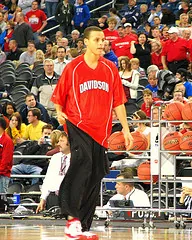
If you watched any of the NCAA Men's basketball tournament this spring, you'll know Stephen Curry is the guard that torched the nets as he led the Davidson Wildcats to the Elite 8 and a near upset of the eventual NCAA champion Kansas Jayhawks. One thing you'd notice right away is that Stephen has one of the quickest shots in the college game. If you gave Stephen a millisecond to shoot, you'd see the ball splashing through the net.
Now, you may be wondering… how the heck can I shoot the ball that quickly or how can I teach my players to do that. Developing a "quick shot" is all about eliminating wasted movement and excess motion. |
 |
Here are seven keys to developing a quick shot release:
- Be prepared before you catch the ball.
Every time you catch the ball, your knees should be bent and your feet should be aligned with the basket a split second before you catch the ball. So now all you have to do is catch and go right up with your shot.
On the other hand, if you catch the ball and then bend your knees, that is excess motion and wasted time. This gives your defender extra time to block your shot.
Along the same lines, you should cut with your knees bent...
Reggie Miller and Richard Hamilton are two examples of NBA players who are great at moving without the ball and getting their shot off quickly. If you watch them on TV, they always cut off screens with their knees bent. So when they get open, they only have to catch and shoot.
Bottom line, always have your knees bent and feet ready before you catch the ball.
- Provide passers with a target near your shot pocket.
Having great passers on your team can help you get your shot off quicker. To help them give you more accurate passes, you should always provide them with a hand target right at your shot pocket.Your shot pocket is the place you put the ball before going into your shot motion. 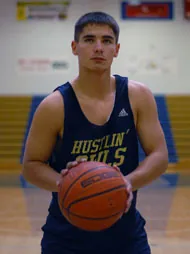
If you're moving in your shot-hand direction, then your target can be your exact shot pocket. If you are moving in the direction of your off-hand, you should provide a target as much in line with your shot pocket as possible and use your off hand to get the ball over to the pocket as quickly as possible.
This is pretty subtle, but the idea is that rather than reaching over to bring the ball over with your shooting hand, you are emphasizing the force of the off-hand on the ball to deliver it to the proper position. Even though you are catching the ball with both hands, you will find that you're gaining a split second of quickness by developing this off-hand-force habit.
- Put the ball in shot pocket immediately.
The quicker you can move the ball in your shot pocket, the quicker you can shoot. This takes practice!!
You need to practice moving the ball into you shot pocket off the catch and off the dribble. This takes thousands and thousands of practice repetitions.
You need to practice catching the ball, then quickly and fluidly moving the ball directly into your shot pocket. If you fumble the ball, then the defense has an extra split second to contest your shot. This is a very subtle movement you must practice over and over.
- Eliminate wasted movement in your shot delivery.
When you catch the ball, it should go immediately into your shot pocket, and then you should go right up into your shot from there.
You should not put the ball in your shot pocket and then dip your knees or move the ball downward. The ball should go straight up, along with the rest of your body (legs, hips, etc).
Any such excess motion adds time to your delivery, plus it is doing nothing positive for your shot. The simpler your motion, the more it is continually upward from your loaded stance, the quicker your shot will be.
- Shoot just before the top of your jump.
Shooting a split second before the top of your jump improves quickness, too. If you wait until the very top, that may be all the time needed for a quick defender to get up for the block.
- Try dipping rapidly
Another concept that can sometimes help players is to dip rapidly as you're catching the ball.
To get your shot off as quickly as possible from your jump stop, you should work on a rapid dip into a squared-up jump stop rather than a leap that gets you into the air and covers distance. This dipping technique involves a sudden crouch into your jump stop, catching the ball in your shot pocket as it returns from a dribble, and springing right up into your shot. It is a sudden delivery that gives the defender hardly any time at all to react to your shot.
- Think shot, shot, shot.
One way to improve all the areas above, is to be in the new triple threat position every time you touch the ball, the triple threat of "Shot, Shot, Shot." In other words, any time you touch the ball, you have the ball in your shot pocket, your eyes on the rim, and your feet and stance loaded in case you have an opportunity to take a good shot.
Note that this doesn't mean that you should shoot every time you touch the ball. No, that wouldn't make much sense; but you should be ready to shoot every time you touch the ball. You will find it much easier to move from that readiness into a pass or dribble than to transition from a passing or dribbling expectation into a shot-ready mentality.
Related Products & Helpful Resources
One Motion Shooting VideoBasketball Shooting Camps
Basketball Shooting Workouts
Recommended Shooting Resources
FREE BONUS PDF
Shooting Workouts
|
|||||||||||||||||||||||||||||||||||||||||||||||||||||||||||||||||||||||||||||||||||||||||||||||||||||||||||||||||||||||||||||||||||||||||||||||||||||



 Facebook (145k Followers)
 YouTube (152k Subscribers)
 Twitter (33k Followers)
 Q&A Forum
 Podcasts