

2 Great Defensive Tips that Will Lower Your Opponent's Shooting Percentage and Virtually Eliminate Penetration
I'm a big advocate of man-to-man defense and that's what I consider to be one the things I'm best at teaching.
For several years, I taught my players to always deny the ball when they are one pass away. I taught them to get a few steps away from their man (up the line) and get a hand in the passing lane, with your back to the ball (in a closed stance).
We drilled this almost everyday because it was very challenging for players to do a good job of denying the ball, yet never get out of position, see man and ball, and be ready to help.
My reasoning for denial was to put pressure on the offense to cause more turnovers.
However, after watching a few Indiana games, I finally decided to try something new...
I decided to try Bobby Knight's concept of denying all penetrating passes, but allowing the pass around the perimeter.
The key difference is to allow the perimeter pass near the 3-point arc and use an open stance when one pass away.
Here are a few diagrams to illustrate the change of positioning:
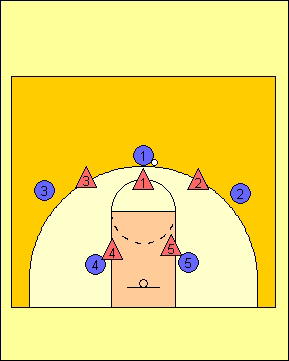
Our old way: Full denial with closed stance
This diagram shows our old positioning with Players 2 and 3 in a full denial position and a closed stance. With a closed stance, the defense is facing the player they are guarding and their back is to the ball.
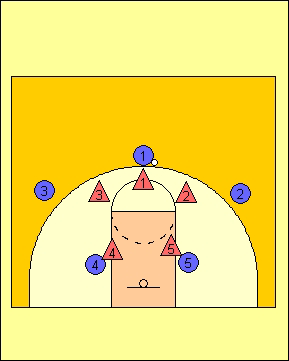
Our new way: Allow the perimeter pass with an open stance
This is our new way. The only difference is that Player 2 and 3 (since they are one pass away from the ball) are now sagging towards the basket and they have an open stance (they are facing the opposite end of the court, so they can easily see the player they are guarding and the ball).
Personally, this was quite a change for me at a weird psychological level. I didn't want to give up my old way of doing things, which I always thought was best. I took pride in our intense pressure defense.
But this change turned out to be a great thing for us at the high school level. It also worked great for our youth teams.
It actually made our defense much more effective because this method is easier to teach and gives you time to work on other things. It just makes it easier to develop a team defense that almost never gave up inside shots. Players that are one pass away can step back a little bit and see everything. You can let them open up their stance a little, instead of strictly facing their man in a closed stance.
This made our help side defense much better, because they could easily see the defense and step in to stop the penetration. They were also in better position to help and they had less ground to cover when they stepped in. It's almost like a sagging man defense. But not too much sagging.
All in all, we gave up fewer lay ups and our turnover ratio just changed a little bit.
The other team's shooting percentage went way down and this offset the slightly few turnovers that we caused.
You might want to give this concept a try.
Tip #2 - Improve your man-to-man defense by creating a "danger zone".
To help teach your team how to stop penetration and really reinforce the concept, try this...
 First, bring a tape measure to practice.
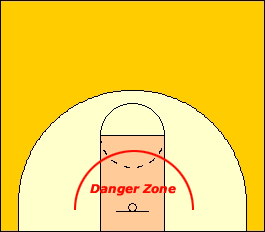
Next, have the kids gather round and choose one person to help you measure 10 feet from the basket. Put tape down in five or so places making an arch 10 feet from the basket.
The tape marks show your team where the danger zone is at.
In other words, this is the area where you absolutely never want to allow the ball.
This visual reminder does a couple of important things for you...
First, it helps reinforce the concept of keeping the ball away from the basket. Most coaches use the phrase, "keep the ball out of the paint". However, I don't agree with this because if a player gets a shot in the post area, that's a very high percentage close shot, yet they are still just outside of the paint. Little things like this can confuse players and limit your defense.
Second, the tape marks create a physical and mental barrier for your players. It really helps them understand what you, as a coach, are trying to accomplish. It also lets them know if they are doing a good job or not. It's easy to tell if the other team gets the ball in the "danger zone".
Third, this allows you to add some really effective rules that helps you improve your defense.
For example, you could add a special scoring system when practicing defense in the half court. You could do something like:
- Every time a player gets a shot in the "danger zone" (made or not), your team loses 2 points.
- Every time you take a charge you get 2 points.
- Deflections are 1 point.
- And so on.
You'll be amazed how much this improves focus, positioning, and your overall defense.
FREE BONUS PDF
The Best 11 Defense Drills
|
|||||||||||||||||||||||||||||||||||||||||||||||||||||||||||||||||||||||||||||||||||||||



 Facebook (145k Followers)
 YouTube (152k Subscribers)
 Twitter (33k Followers)
 Q&A Forum
 Podcasts