|
|
 |
Basic Basketball Screens
If you've ever watched the game of basketball, the great basketball teams set very good screens.
Screens will open up your offense in many ways.
For example, when an offensive player sets a good screen
the offensive player receiving the screen will have a good opportunity to score and pass to someone who is open.
Once the defense adjusts, the screener often becomes wide open for shots. If you're setting good screens, it'll open your game
as well. Most of all, it benefits the TEAM.
In this article, we will cover what a screen is, how to set a screen, how to run
off a screen, and how to use basic screens.
Here's the definition of a screen:
When an offensive player legally blocks the path of a defender to open up another offensive
player for a shot or to receive a pass.
Fundamentals of the Screener (Person setting the screen):
- Feet should be a little wider than shoulder-width apart. It's very important to have a wide, strong base.
- Hands should be crossed across your chest (girls) or protecting your groin area (boys)
- The screener needs to be stationary as the screen is set. Otherwise, the screener will be called for a
offensive foul.
- Body should be vertical (should not be leaning forward or backwards).
- Square to the defender. The middle of the screener's chest should be in line with the
defender's shoulder and hips.
- After the offensive player has ran off the screen, it is very important to open up to the basketball. Normally,
you will pivot 180 degrees to the basketball. Sometimes, a cut to the basket or away from the basket may be open.
Many times, the screener is the person who is open.
Fundamentals of the Person Receiving the Screen
- Set up the defender - It's very important for the offensive player to set up the screen.
First of all, (s)he needs to wait until the screener is completely set. If (s)he leaves too early while the screener
is moving, the screener will get called for an offensive player.
Second, it's very good to set up the screen by faking the opposite direction even if it's only a slight
head fake. This will get the defender leaning in the wrong direction and when he explodes the other direction to
catch up with you, he'll run hard into the screen.
- Shoulder to Shoulder - When running off the screen, you will need to run shoulder to shoulder. This will
not give the defender any room to get around the screen. It will force him to either trail behind you or plow through
the screener for a defensive foul.
- EXPLODE! It's very important for the offensive player to blast off of the screen. This will leave the
defender in the dust and give you much more time to set up for a shot.
Next, we cover some basic screens:
- Down Screen
- Ball Screen
- Back Screen
- Away Screen
Basic Screens
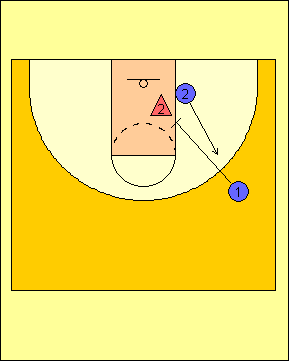
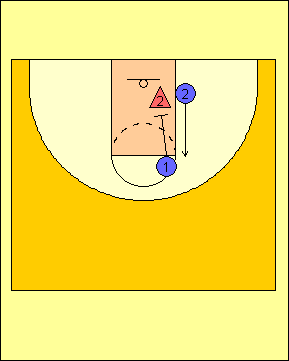
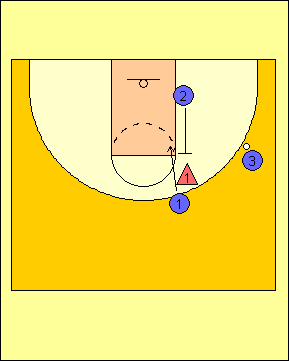
- Down Screen - A player runs toward the baseline closest to their basketbal goal to set a screen.
In the next two diagrams, we have examples of down screens.
In this diagram, Player 1 starts from the three point line and runs to the block area to set a down screen
for Player 2.
In this diagram, Player 1 starts from the high post area to set a down screen for Player 2.
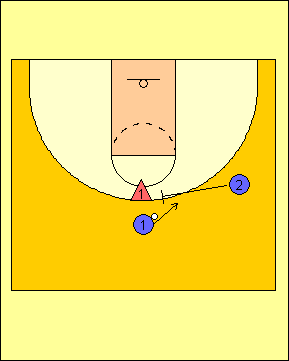
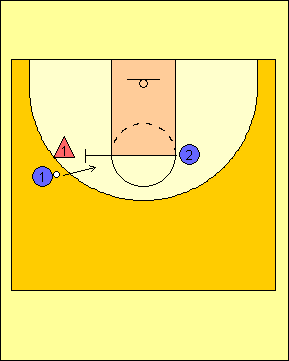
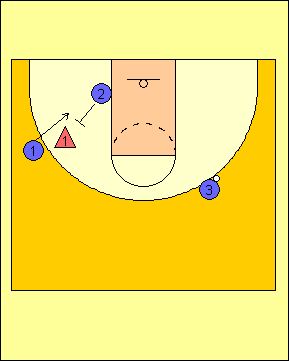
- Ball Screen - A ball screen is when an offensive player sets a screen for another offensive player
who currently has the ball in possession. The only time you will want to set a ball screen is when the offensive player still
has his or her dribble.
In this diagram, Player 1 is at the top of the key and Player 2 runs from the wing to set
a ball screen on the defender guarding Player 1.
- In this diagram, Player 2 is setting a ball screen on the defender guarding Player 1, except this time he
is coming from the high post.
- Back Screen - A back pick occurs when the screener sets a screen away from the ball on the defender's back.
It may also be called a "Blind Screen" as well. Legally, the screener is suppose to give the defender one step, otherwise,
the screener may be called for an offensive foul.
In this diagram, Player 2 comes from the block area to set a back screen for Player 1 near the three point line.
- In this diagram, Player 2 comes from the block to set a back pick for Player 1 on the wing.
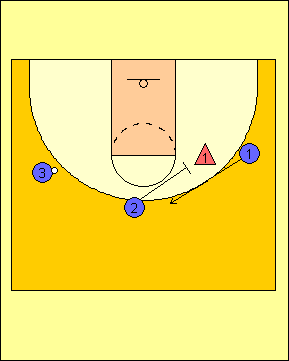
- Away Screen - This is when a player sets a screen away from the ball. This happens when a player
passes the ball to a player, then runs away from the ball to set a pick for another offensive player. This can also
happen when a player is denied the ball, and he goes away from the ball to free up another offensive player.
In this diagram, Player 2 passes to Player 3 and runs away from the ball to set a screen for Player 1.
|
|


|
|
Comments
|
|
rogelito h. abanggan says:
7/30/2007 at 9:30:01 AM
coach, can you give me a drill on screening?
|
|
Jeff Haefner says:
8/1/2007 at 10:14:44 AM
Rogelito,
We will be adding more screening drills to this website soon. In the meantime, check out the screening drills included in our free Winning Drills eBook. If you don't have the eBook yet, you can get it here: http://www.breakthroughbasketball.com/freebooks.html
Once you open the eBook, you'll find screening drills on pages: 25, 57, 59, 71, 73, 75, and 135
Hope this helps!
Jeff Haefner BreakthroughBasketball.com
|
|
AMMIT says:
9/4/2007 at 10:59:30 PM
I WANT THIS DRILLS IN REAL PICTURE CAN U HELP ME
|
|
maher matar says:
9/19/2007 at 2:58:46 AM
i like it so much .
|
|
Amy Teller says:
10/30/2007 at 1:16:37 AM
This really helped me understand the rules of screening. Do you have any info on when a screen is done players call out switch?
|
|
Coach Graham says:
10/30/2007 at 10:59:37 AM
Excellent explainations of the different basic screens. I coach young girls, so this will help me to exlplain the screens in a very simple form.
|
|
Joe says:
10/30/2007 at 2:36:10 PM
Hi Amy,
I'm not sure which viewpoint you want, so I will give you both defensive and offensive view points on switching on screens.
Switching on Screens (Defense)
You may want to switch if two guards are setting screens for each other and the defensive players have equal ability. That way a disadvantage is not created. If most of your players have a similar height and have a similar athletic ability, you may want to switch on screens.
If a post player sets a screen for their guard player or vice versa and you switch on this screen, this creates a disadvantage. Your guard defensive player is guarding the opposing teams post player and your defensive post player is guarding the opposing teams guard, which can create a huge disadvantage. Any smart team will know how to take advantage of that situation.
Switching on Screens (Offense)
If you notice the defense is switching on ball screens, the screener should try to pin the defensive player on their hip, pivot to open up to the ball, and roll to the basket. Often, this is wide open.
If a switch occurs away from the ball, the same thing should happen. The screener should try to pin the new defensive player on his hip, pivot to open up to the basketball, and maintain good position for an entry pass.
|
|
magdy says:
11/23/2007 at 2:54:21 PM
thank you
|
|
coach ronnie says:
11/28/2007 at 10:07:04 AM
What kind of screens can you set against a zone defense?
|
|
Coach Chris says:
11/28/2007 at 5:56:32 PM
Coach, I've heard people like Hubie Brown talk about a 'dribble pick'.
I have never learned this technique - can you explain? How do you do it, when and why?
thanks Chris
|
|
Don Kelbick says:
11/29/2007 at 2:20:37 PM
Coach Ronnie
You can set the same kind of screens against a zone as you do against a man with 2 adjustment.
The first adjustment is timing. Because a zone moves with the ball, setting a screen too early will be ineffective because the defense will not be in the same place when the ball arrives. The screen should be made at the time the ball can be delivered, maybe even when the ball is in the air. It is not as hard as it sounds, it just takes an awareness of when to pass the ball.
The second adjustment is to screen an area instead of the player. Since coverages change with ball movement, the defensive player who is defending a player when the ball is in one place, won't be defending with the ball in another area. For example, if you have a player on the block who you are going to bring to the wing, screening the player defending on the block will not be effective. You need to screen in the area on the wing where your player is going to cut to.
To be an effective screening team against a zone, you need to think as a zone coach, understand how the zone moves and what the coverages are and then screen, at the proper time, the areas where you want your offensive players to be effective.
If I can be of help, feel free to contact me
Don Kelbick Contributing Editor, Breakthrough Basketball www.DonKelbickBasketball.com
|
|
Jack Connor says:
1/25/2008 at 2:54:07 PM
My homeschool group is doing Basketball in PE. This is guys and girls together, and everyone is working really hard, but our coaches lack even the most basic knowledge (by their own admission) and could use some quick pointers. Any help?
|
|
Joe (Co-founder of Breakthrough Basketball) says:
1/27/2008 at 3:10:50 PM
You can look at our fundamentals page at this link: http://www.breakthroughbasketball.com/fundamentals/basketballfundamentals.html
|
|
|
|
|
|
|