
Transition Gauntlet
Ages: Middle School High School+
Purpose of the Drill:
Transition Gauntlet is a conditioning drill to sharpen the execution of passing, cutting, footwork and scoring/defending break away layups. Good for thr beginning, middle or end of practice.
A full team rotation drill that has continuous:
-rebounding and outlet passing
-pushing the ball up the floor at fastbreak speed
-feeding a cutter for a lay-up
-strong finishes against defenders trying to catch-up and challenge shot or take a charge.
This is an exciting high stakes drill. When it gets going, the player "running the Gauntlet" can not make mistakes. One poor pass by any player grinds the drill to a hault!
Instructions
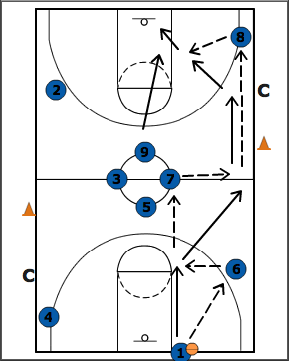
- 9 players begin on the floor on spots as shown (first diagram, above).
- Player #1 will sprint from one end of the court to the other (following the path of the solid arrows in the diagram) while making and getting a pass back three times (with 6, 7 and 8) before finishing, strong, with a lay-up.
- Player 9 will sprint to try to stop or disrupt 1's lay-up. Player 9 may not move to defend until player 1 breaks his horizontal plane (the imaginary line between 9 and the cone on right sideline).
- If Player #1 converts the lay-up, 9 must rip the ball out of the net and make a baseline inbound pass (to player #2) within three seconds. If 1 misses, 9 must secure the rebound, chin, pivot and make the immediate outet pass to 2. (1 and 9 can battle a miss until a conversion or defensive rebound.)
- Now, gaining possession of the ball, player 9 executes the inverse of what player 1 just executed: 9 quickly sprints up court to receive a pass back from 2, pass and receive with 3, pass and recieve feed from 4 to score against 5, who waits till 9 has broken horizontal plane (between 5 and cone on left sideline) before moving to cut him off at the hoop. In other words:
Overview:
This drill was created to encourage quick transition from defense to offense. The drill divides the court in half, lengthwise. On the first side, a player will "run the Gauntlet" by advancing the ball, while sprinting, with a series of passes and get backs, fill the outside lane and then cut to the hoop for a lay-up feed on the other end of the court. This player will be challenged by a trailing defender closing down against the fast break. That defending player then transitions to offense, and "runs the Gauntlet" the opposite way, on the second side of the court. Eight (or more) other players advance through a rotation, feeding successive offensive players until they defend against him/her and then "run the Guantlet" themselves.
Initial set-up:
1= Inbounder/Rebounder-Scorer,
6= First Passer,
7= Second Passer,
8= Third Passer,
9= Defender-Inbounder/Rebounder-Scorer
9= Inbounder/Rebounder-Scorer
2= First Passer,
3= Second Passer,
4= Third Passer,
5= Defender-Inbounder/Rebounder-Scorer
See following diagram for player rotations.
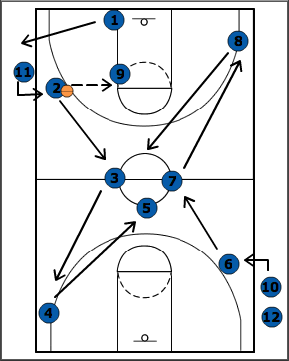
- 6 (having made the pass to 1 in the previous diagram) replaces 7, becoming the Second Passer
- 7 will rotate from being the Second Passer to become the Third Passer
- 8 rotates to become the Defender,
- 9 became Inbounder/Rebounder-Scorer
- 1 goes end of line to replace First Passer after 11.
- 2 will become Second Passer
- 3 will rotate to become Third Passer
- 4 will become Defender
- 5 will become Inbounder/Rebounder-Scorer going the other way after defending against 9's drive.
- 10 and 12 wait their turn to become First Passer for two rounds before 9 re-enters.
Player Rotations (second diagram)
Essentially, Passers will rotate up court to the next Passer's spot (after making a pass from their spot) and the Third Passer (8 and 4 in the diagram) will rotate to their respective bottom of half court circle to become the Defender.
The Defender will then always become the next Inbounder/Rebounder-Scorer after challenging the lay-up.
Here, #1 has completed three exchanges and scored on far end. 1 rotates off to wait in line or become next First Passer on this side. (Here 1 rotates off to line up behind Player 11, who will replace #2 as First passer.)
Player #9 has inbounded, made outlet pass to #2 and is sprint down court, about to recieve "get back" from 2.
9, as the new Inbounder/Rebounder-Scorer, after exchanging passes with 2, 3, 4 and attempting to score against 5, would rotate to wait in line behind #12 (or replace 6 directly, if only 9 players are running drill).
Here, more than 9 players are participating (10,12 on right side and 11 on left side of Diagram).
Therefore:
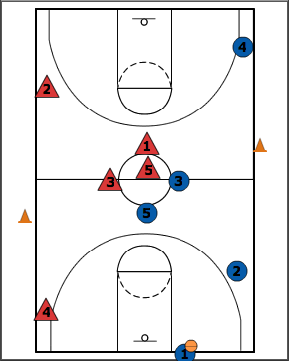
- 1 Blue inbounds to 2 and "runs the Guantlet" with 2, 3 and 4, finishing against 1 Red.
- 1 Blue rotates quickly back along his/her sideline to become next First Passer by replacing 2.
- 2 replaces 3
- 3 replaces 4
- 4 rotates to center circle and waits behind 5
- 5 will defend againt 1 Red coming down to score on second side, and then, will become Inbounder/Rebounder-Scorer
- Then, 1 Red rebounds or inbounds to 2 Red and "runs the Guantlet" with 2, 3 and 4, finishing against 5 Blue.
Gauntlet 5 on 5 (one ball):
Advanced. For 10 player team that can execute the drill at a good clip with no rotation errors and unforced mistakes (third diagram).
Blue starts with the ball.
Blue gets a point if 1 Blue scores. Red gets a point if 1 Red gets a stop.
Rotation:
1 Red rebounds 1 Blue's miss or inbounds 1 Blue's make.
Red gets a point if 1 Red scores. Blue gets a point if 5 Blue gets a stop.
Red Rotates same as Blue. (Note that 5 Red begins drill already in line behind 1 Red.)
First to 10 wins.
Points of Emphasis:
- Run this drill at 6 - 10 of your team's practices. Give time for players to understand the rotation and watch for what they are doing after running it the first time. Do the passes have zip, or are they soft? Are they accurate? Are players going strong to the hoop, or folding when intimidated? Coaches can focus on one skill each time drill is run. Make sure players retain each skill as you move to a new focus the next time the drill is run.
- The Defender position (5 and 9) will tend to aggressively try to stop the Scorer and foul or overrun their opportunity for a rebound or quick inbound. Emphasize getting position to take a charge and staying in position for the potential miss/quick rip inbound). Don't let Defender relax after a huge effort to make a play...a new play follows and Defender must become Inbounder/Rebounder to initiate it!
- Inbounder/Rebounder pivots to look up court and makes an overhead outlet pass (if rebounding a miss). The next two passes are made on the run - they must catch and release the next pass in stride and without traveling. When inbounding after a make, each player should know his/her own body and the number of steps from ripping the ball out of the net to crossing the baseline out of play (and clearing the backboard overhead), planting and passing to the outlet. (i.e. is it three steps? 4 steps? Which foot takes the first step so that they can plant and make a solid throw. (Larry Bird, Robert Parrish and Kevin McHale were brilliant at this). Have players practice the footwork from net to inbound and the footwork for rebound pivot outlet!
- This drill reveals the players who love to run!
Motivation/Teaching Tips:
- It takes a little time to for players to understand and get the rotation.
- Coaches/managers can stand at sideline with an extra ball to more quickly replace Basketballs that bounce out of play.
- The goal is to stay crisp, and not get sloppy while performing at high speed. (Turnovers = Sprints after drill!).
- Good to run for 2, 3 or 5 minutes with each player counting their offensive finish/miss and defensive stop/charge/lay-ups allowed.
- Or can have a team goal: (#) lay-up goal in (X) minutes.
- Once players know the drill well and can run it full speed, add a ball and run both sides simultaneously. (only do this if you have players waiting in line on each side - at least 12 total)
- Even more advanced: Split into two teams (see last diagram) and compete to get (#) lay-ups first.
- Players love and look forward to this drill!!
|
|||


 Facebook (145k Followers)
 YouTube (152k Subscribers)
 Twitter (33k Followers)
 Q&A Forum
 Podcasts